Sourcing Tips

10 Mistakes When Sourcing 100W LED Flood Lights from China

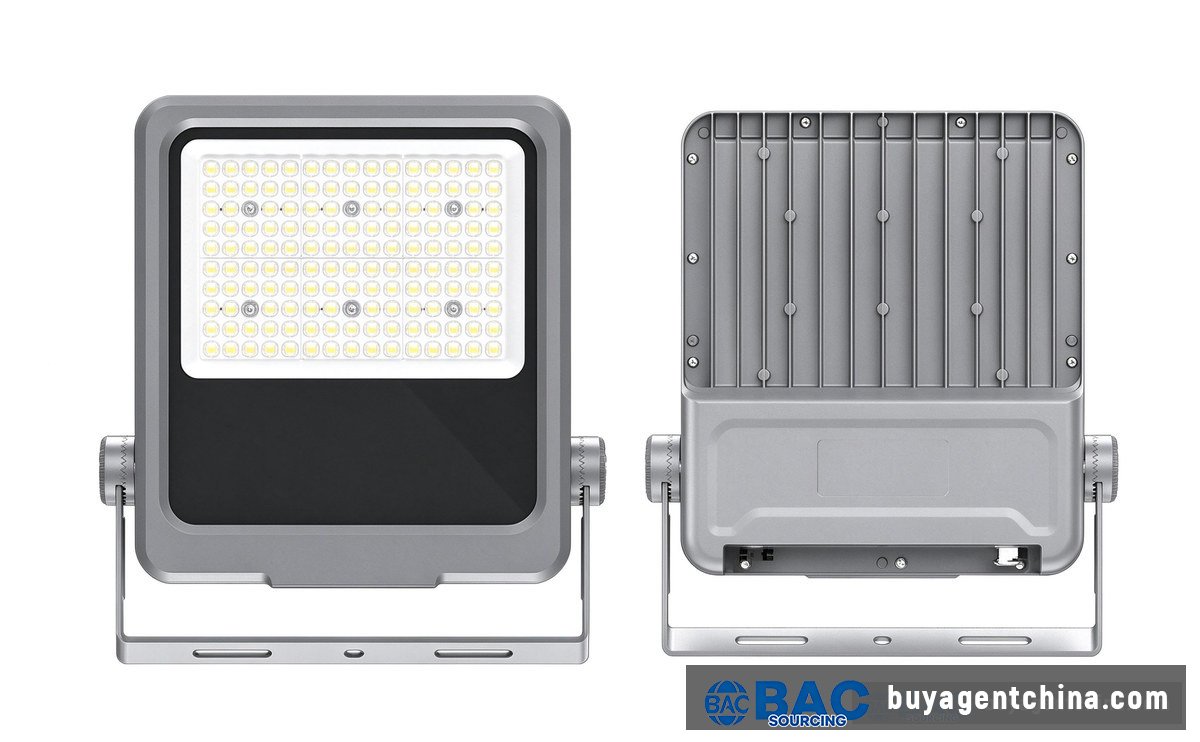
02 Front and back of a 100W flood light shell. The price gap is inside — the LED bin and driver brand — not visible on the outside

Direct answer: A 100W outdoor LED flood light is a die-cast aluminum, IP65-rated area/security light that uses ~100 watts of input to throw 9,000–13,000 lumens. China makes the large majority of the world’s LED flood lights, and a 100W unit runs roughly US$4–7 FOB at the budget end, US$10–17 mid-range, and US$24–64 premium/commercial depending on the LED bin, driver brand, sealing and certification. The product is also one of the easiest to overpromise — nameplate wattage, IP rating and “CE” marks are all routinely inflated. The ten mistakes below are the ones that quietly turn a good margin into a warranty claim.

Why Sourcing 100W Flood Lights from China Is Different

LED lighting is China’s most mature lighting export. The town of Guzhen in Zhongshan, Guangdong is widely described as the “Lighting Capital of China,” producing on the order of 70% of the country’s lighting exports and hosting tens of thousands of registered lighting companies. Zhongshan and Shenzhen together account for roughly 60% of China’s LED output; Ningbo in Zhejiang dominates outdoor and industrial export fixtures; Xiamen is known for certified, energy-spec models. The HS code you will use is 9405.40 (LED lamps and lighting fittings, often 94054090 at the item level).

 That density is a gift and a trap. Because the supply chain is so layered — chip, driver, housing, lens, assembly all sit within a few kilometers — you can buy a 100W flood light for US$4.20 or for US$64, both called “100W IP65.” The difference is not branding; it is whether the light survives two rainy seasons, a summer heat spike, and a lightning surge.

ClusterWhat it is good forTypical 100W flood light tier
Guzhen / Zhongshan (Guangdong)Volume, housing, residential/commercial fixtures, fast samplingBudget to mid-range
Shenzhen (Guangdong)Premium, smart, OEM/ODM, certified engineeringMid to premium
Ningbo (Zhejiang)Outdoor/industrial export, private-label buildsMid to premium
Xiamen (Fujian)Certified energy-spec, project-grade fixturesPremium
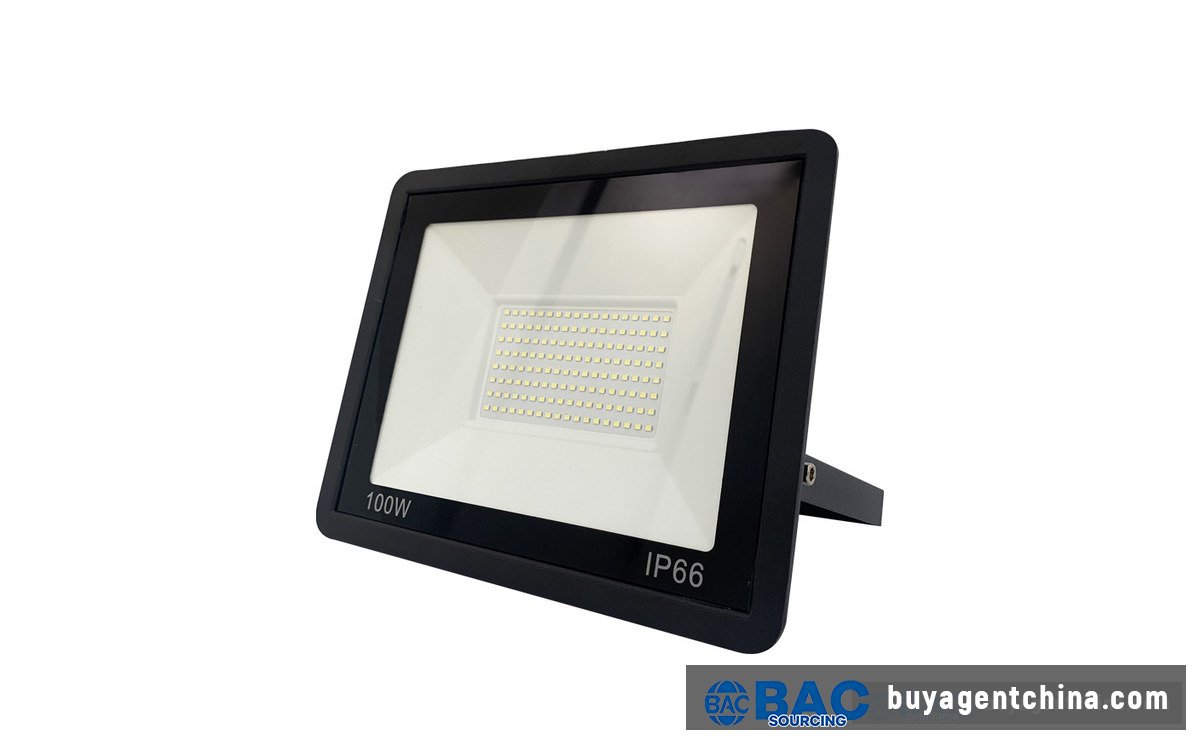
01 A standard 100W IP66 LED flood light — the volume wall-mounted tier most buyers first quote

A standard 100W IP66 LED flood light — the volume wall-mounted tier most buyers first quote.

Mistake 1 — Buying by "100W" Nameplate Only

The single most common mistake is treating the printed “100W” as a measured input. On budget units, the nameplate wattage is a *marketing* figure: the LED package may be binned to 60–70W while the housing is sized for 100W, and the driver pulls less than the label claims. Two identical-looking lamps can differ by 30–40% in real output.

The consequence: you quote a project at 100W/10,000 lm, your customer installs it, and it reads like a 60W light — a failure you cannot see until the lamps are up on a pole.

The fix: ask for the actual *input wattage* and *lumen output* (lm) on the quotation, not just “100W.” A genuine 100W flood light should measure around 9,000–13,000 lm depending on efficacy (90–130 lm/W). Ask for a LM-79 photometric report or a quick lab test of a preproduction sample. If a supplier hesitates to commit to measured lm/W, that is your first red flag.

Mistake 2 — Accepting No-Name LED Chips and Dull Optics

Under the hood, “LED flood light” hides two very different products. One uses reputable SMD packages (for example Philips Lumileds, Epistar, or Samsung bins) at CRl \(Ra ≥80\) ; the other uses unmarked, low-bin chips at CRI Ra70 that make skin, signage and merchandise look washed out and greenish.

The consequence: CRI 70 is fine for a parking lot but wrong for retail facades, building wash and any area where color matters. Low-bin chips also depreciate faster, so a lamp that started at 10,000 lm may drop to 7,000 lm within two years.

The fix: specify the LED brand and bin, CRI target (Ra≥80 for commercial, Ra≥90 for facade/retail), and efficacy in lm/W on the PO. Reject any spec sheet that says “LED chip: high quality” without a brand. This is exactly the detail a supplier hopes you will not ask about.

Mistake 3 — Letting a No-Name Driver Decide Your Warranty

The LED chips rarely fail first. The driver — the box that converts AC to constant current — is the number-one failure point in an outdoor flood light, especially in summer heat and at 220V grid fluctuation. Mean Well and Inventronics are the industry benchmark; reputable commercial fixtures pair the LEDs with a named driver and 6–20 kV surge protection.

02 Front and back of a 100W flood light shell. The price gap is inside — the LED bin and driver brand — not visible on the outside

Front and back of a 100W flood light shell. The price gap is inside — the LED bin and driver brand — not visible on the outside.

The consequence: a no-name driver dies within 12–18 months, often right when the “3-year warranty” starts to matter. Because the driver is glued into the housing, the whole lamp is scrap.

Sourcing 100W LED Flood Lights from China

What to ask about the driver

The fix: ask which driver is inside and request a photo of the driver label. Insist on surge protection (≥6 kV minimum, 10 kV+ for exposed sites) and a wide-voltage input (AC 85–265V or 100–277V). If the supplier cannot name the driver, price the lamp as a throwaway — never as a 3–5 year asset.

Mistake 4 — Treating "IP65" as a Promise

“IP65” is printed on almost every flood light listing, but IP ratings are self-declared on most budget pages. A real IP65 seal needs a continuous silicone gasket, a properly torqued driver door, and a waterproof vent plug that equalizes pressure without letting moisture in. Cheaper housings skip the gasket path and sweat inside when the lamp heats and cools.
The consequence: internal condensation clouds the lens, corrodes the driver board, and — in winter climates — freezes. You will not see this in a sample; you will see it after 6 months outdoors.

How to verify the seal

The fix: ask how the driver compartment is sealed (one-piece silicone gasket, captive screws outside the gasket perimeter), what the IK impact rating is, and whether there is a vent plug. For coastal or heavy-rain sites, step up to IP66. A pre-production sample left in a bucket of water overnight tells you more than a spec sheet.

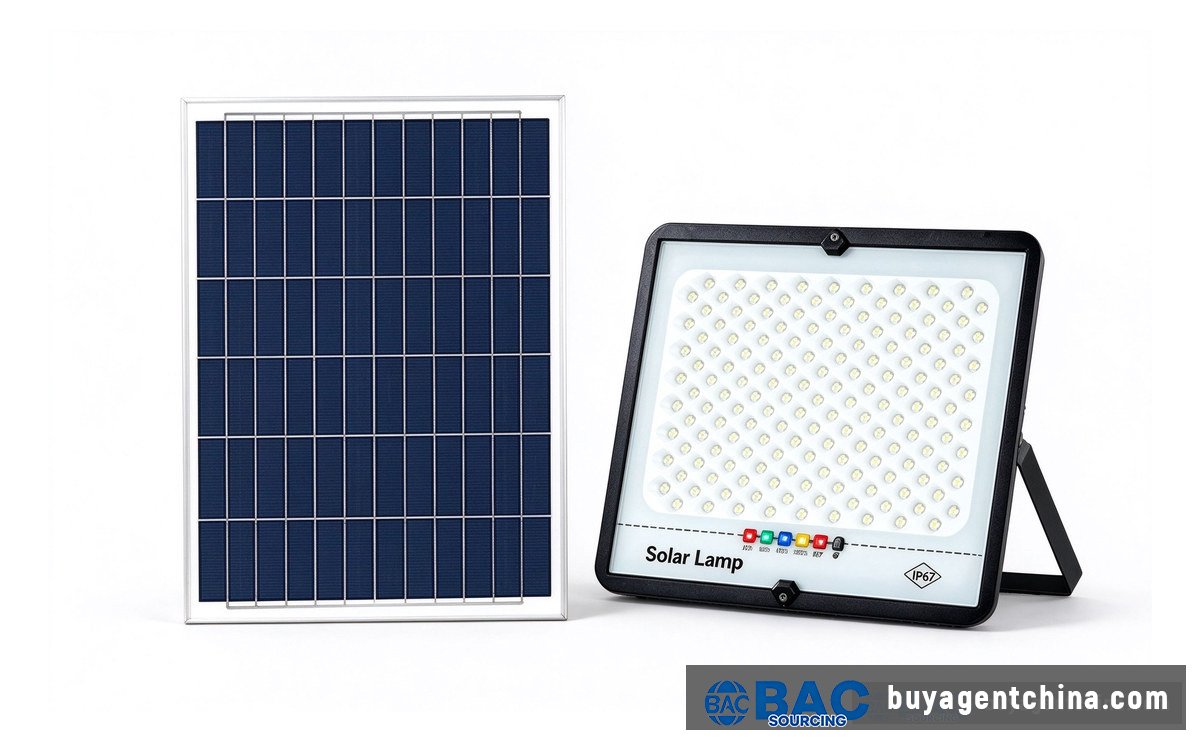
03 A solar LED flood light with separate panel — a different product class buyers often mix up with wired 100W units

D flood light with separate panel — a different product class buyers often mix up with wired 100W units.

Mistake 5 — Believing Printed CE/RoHS Marks

A CE or RoHS mark costs nothing to print. On budget listings these are self-declared marks with no lab report behind them. For the US market you also need UL or ETL; for the EU, meaningful CE plus, where required, ENEC and the latest RoHS/ERP declarations. Without LM-79 (optical testing) and LM-80/TM-21 (lumen depreciation), any lifespan claim is unsupported.

The consequence: a shipment without real certification can be detained at customs, fail a retailer’s compliance audit, or void an insurance claim after a field failure.

The fix: ask for the actual test reports (with lab name, report number and the model covered), not a photo of the logo. Verify the report covers *your* exact model and wattage. If the mark appears on the housing but the report is for a different SKU, treat it as unverified.

Mistake 6 — Confusing a Trading Company for a Factory

Because Guzhen is so dense, many export-facing sellers are trading companies or “integrators” that assemble bought-in parts rather than manufacture. That is not always bad, but a trader’s quote often hides the real factory and inflates the price by 10–20%.

The consequence: you negotiate hard with a middleman who has no control over the driver bin or the gasket, and no incentive to absorb a warranty failure.

The fix: ask for a factory video (production line, aging rack, driver area), the business license scope, and export history. A real manufacturer can walk you through an aging test rack where 100W lamps burn for 24–48 hours before packing. This is precisely the on-site verification BAC arranges through its Factory Visit service.

Mistake 7 — Choosing on Price Alone

Once you strip out wattage lies and driver quality, the 100W flood light market splits into three clear tiers. The cheapest price is rarely a bargain — it usually buys a lamp you will replace twice.

The three price tiers

TierTypical FOB price (100W)What you actually getBest use
BudgetUS$4–7No-name SMD chips, generic driver, self-declared IP65, CRI ~70Short-life, temporary/construction lighting
Mid-rangeUS$10–17Named LED bin, decent driver, real IP65, 1–2 yr warrantyResale, parking lots, security
Premium / commercialUS$24–64Mean Well/Inventronics driver, CRI≥80, IP66, surge 10kV+, certified, 5-yr warrantyFacade, sports, project work

On 1688, budget 100W “Apple-style” housings trade around ¥78–96 a piece, IP66 engineeringversions around ¥95, and stadium/engineering builds near ¥298. The FOB ranges above reflectthat same ladder.

The fix: decide your tier *before* you send RFQs, and write the tier criteria into the RFQ so suppliers quote the same product. Comparing a US$5 lamp to a US$30 lamp tells you nothing.

Mistake 8 — Blurring Stock vs OEM and Your Order Size

Most 100W flood lights ship from standard housing molds. Stock product ships in 3–7 days but with the housing, driver and lens the factory already makes. OEM/ODM — your logo, custom housing color, dedicated driver bin, private-label box — changes the math on MOQ, lead time and unit price.

Stock vs OEM/ODM

Stock / off-the-shelfOEM / ODM custom
Lead time3–7 days25–40 days
MOQOften 10–50 pcs500–1,000+ pcs
Unit priceLowest10–30% higher for small runs
What you can changeLogo onlyHousing color, driver, lens, packaging
Best forTest orders, repeat restockBranded resale, project specs

Small test order vs bulk order

Split your order plan the same way: a small test order (10–50 pcs, stock SKUs) to validate real output, sealing and the supplier’s aging process; then a bulk order (500–1,000+ pcs) once samples pass your own test, with OEM customization if you are building a brand. Never place a 1,000-piece PO before you have burned a sample outdoors for at least two weeks.

Mistake 9 — Skipping Pre-Shipment QC and Real Warranty Terms

This is where most margin disappears. A factory’s “3-year warranty” means little if you cannot inspect before shipment and have no local person to absorb a defect rate. With LED flood lights, defects show up as dead channels, flickering drivers, poor sealing and mismatched color temperature — all visible on a pre-shipment check.

Direct factory vs a sourcing agent

Direct from factoryUsing a sourcing agent (e.g. BAC)
Supplier vettingYou do it over videoFactory vetting, aging-rack video, business license check
Price controlYou negotiate aloneFactory original invoice shown; fee transparent
Pre-shipment QCYou fly in or trust the factoryAQL 2.5 sampling in the agent’s warehouse
Inspection cost on topAir fare, hotel, timeStandalone inspection from ~US$200 per visit
Warranty disputesYou argue with a factory in ChineseAgent mediates; escrow until QC passes

What a sourcing agent costs (live rates)

BAC’s current published rates (checked live) are: an Entry sourcing report at US$29 for 3 supplier quotes, a DIVE report at US$140 for 4–6 factories with original quotes and factory videos, a Factory Visit at US$170 per day, and order-management services on a 3–5% (Basic) or 5–8% (Growth) commission with a base fee of US$220–280. Custom/OEM work is quoted per project rather than a flat rate. A pre-shipment inspection alone runs about US$200. For a 1,000-piece flood light order, that inspection is a rounding error against one dead-on-arrival driver batch.

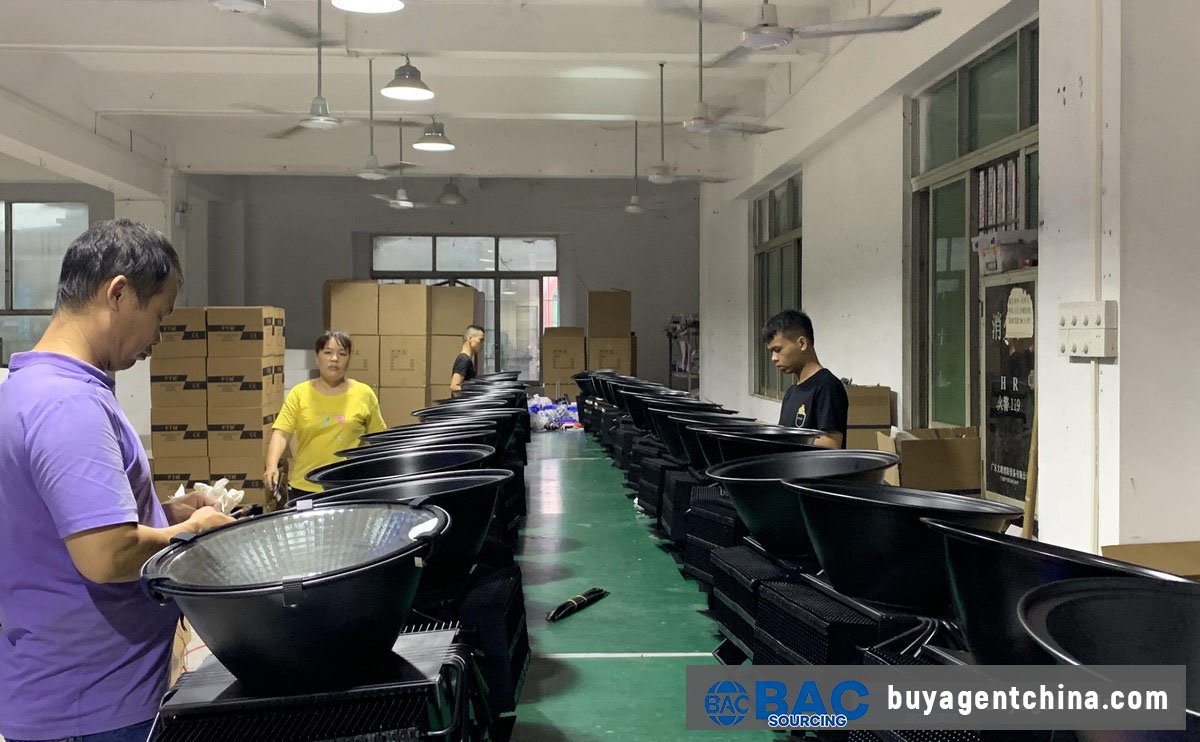
04 Workers assembling flood lights on a production line — worth verifying on a factory video or visit

Workers assembling flood lights on a production line — worth verifying on a factory video or visit.

Mistake 10 — Forgetting HS Code, Freight and Surge Protection

Finally, the back-office traps. The HS code for these lamps is 9405.40 — get it wrong and your customs entry can be delayed or assessed the wrong duty. Freight matters because a 100W flood light is a surprisingly *bulky* item: die-cast housings weigh 1.5–3 kg each, so ocean freight by pallet is usually cheaper than air for bulk orders, but you need volumetric weight quoted before you commit. And for exposed sites — rooftops, coastal areas, open sports fields — surge protection (6–20 kV) and a proper vent plug are not optional; lightning spikes are the most common outdoor failure after the driver.

The fix: confirm HS 9405.40 with your forwarder, ask for both net and gross weight plus carton dimensions before freight, and specify surge protection on exposed-site POs. This is the last gap that sinks an otherwise good order.

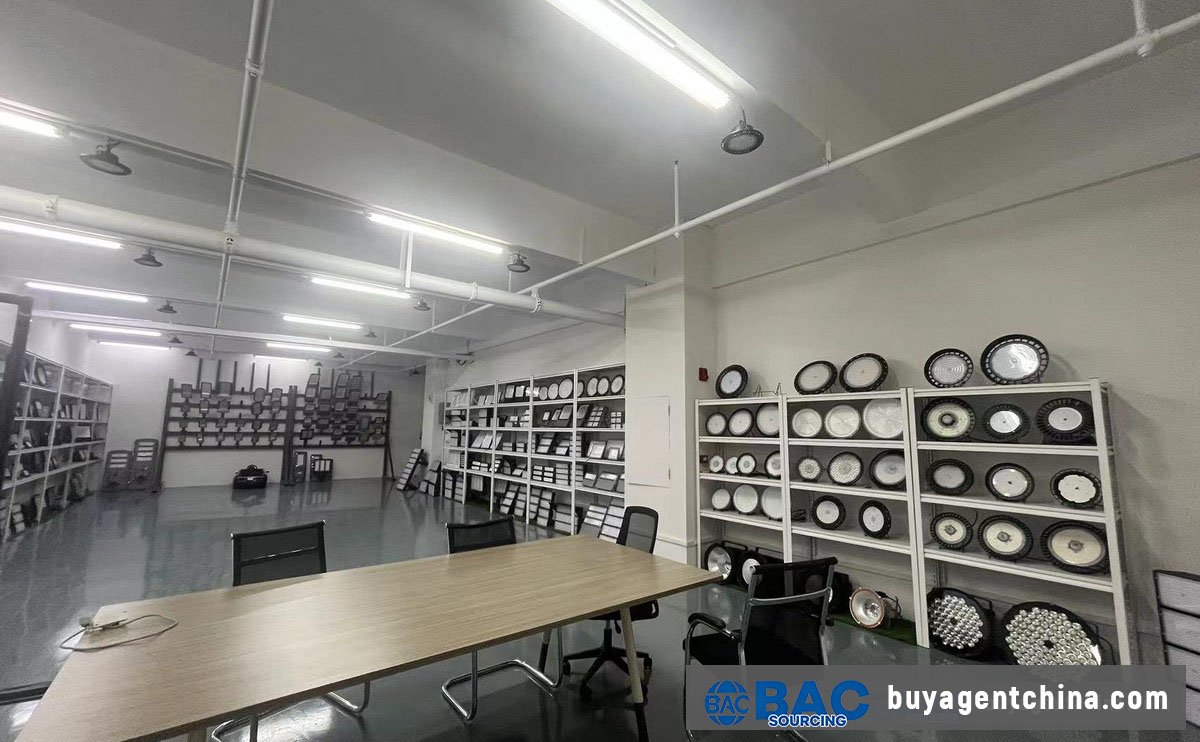
05 Finished flood lights on shelves before packing and shipment
Finished flood lights on shelves before packing and shipment.

Your Sourcing Checklist and the 5-Question Stress Test

The 10-point checklist

Before you place a PO, have the supplier put all of this in writing:

 Measured input wattage and lumen output (lm/lm/W), not just “100W”

 LED brand, bin, CRI and efficacy on the spec sheet

 Driver brand named (Mean Well / Inventronics / equivalent) + surge kV

 Real IP rating, sealing method, IK rating, vent plug

 Test reports (CE/RoHS/UL/ETL, LM-79, LM-80/TM-21) for the *exact* model

 Factory video, business license, aging-test evidence

 Written tier/price basis (budget / mid / premium) and FOB price

 Stock vs OEM terms, MOQ and lead time in writing

 Small test order first (10–50 pcs), bulk only after samples pass

 Pre-shipment AQL 2.5 inspection and warranty/return policy

The 5-question stress test

Then run the stress test: can your supplier answer these five within 24 hours — a real factory video, the export license, the HS code, a QC/aging report, and the exact driver brand? If not, that is your first red flag, and it is cheaper to walk away now than to accept a container of lamps that fail in the first rainy season.

Frequently Asked Questions (FAQ)

Q1: What is a fair FOB price for a 100W LED flood light from China?

A genuine 100W outdoor flood light runs roughly US$4–7 at the budget tier, US$10–17 midrange, and US$24–64 for certified commercial units with a named driver. If a quote comes in below US$4 for a "commercial" IP66 lamp, assume the wattage, driver or IP rating is inflated.

Q2: Which Chinese city is best for 100W LED flood lights?

Guzhen (Zhongshan) for volume and budget housings, Shenzhen for premium and OEM/ODM, Ningbo for outdoor/industrial export, and Xiamen for certified project-grade fixtures. Most buyers source through Guangdong but should still verify the actual factory rather than assuming a listing is a manufacturer.

Q3: How do I verify a flood light's real wattage and IP rating?

Ask for measured input wattage and lumens (lm/W) on the quote, a pre-production sample to bench-test, and a photo of the driver label. For IP rating, ask how the driver compartment is sealed and whether there is a vent plug; an overnight water-bucket test on a sample is more convincing than a printed IP65 mark.

Q4: What certification do I need for 100W flood lights?

For the EU: meaningful CE plus RoHS/ERP declarations; for the US: UL or ETL. Across markets, ask for LM-79 (optical) and LM-80/TM-21 (lumen depreciation) reports that cover your exact model. Self-declared marks with no report are not protection against customs or retail-audit failures.

Q5: Should I order stock or OEM for my first 100W flood light order?

Start with a small stock test order (10–50 pcs) to validate real output, sealing and the supplier's aging process. Move to a bulk OEM order (500–1,000+ pcs) only after samples pass an outdoor burn-in. Never place a full PO before inspecting samples.

Leave a Reply

Your email address will not be published. Required fields are marked *