Custom Sourcing, Procurement Guides

Aluminum Carabiner Clip Buying Guide: Types, Prices & MOQ

Aluminum Carabiner Clip Buying Guide

Stock aluminum carabiners ship from Dongguan and Ninghai under HS 7616.99 at USD 0.05–0.50 FOB; climbing-grade 7075 bins run USD 1.50–4.00.

Walk through any outdoor gear aisle and the carabiners on the rack all look alike. That changes the moment you need one to actually hold something. The same D-shaped clip that hangs a water bottle from a backpack strap is not the same product as the one rated to hold a human body. Confuse the two, and a container full of “cheap” clips comes back to you. This guide eliminates the shapes that do not fit your market first, then prices the ones that do.

1. First, Eliminate the Shapes That Do Not Fit Your Market

Most buyers start by comparing prices. That is the wrong order. A carabiner’s shape decides 80% of where it can be sold and what it can be claimed to hold. Run these four elimination rules before you ask a single supplier for a quote.

Rule 1 — If your customer is a rock climber or a tactical brand, cut every decorative shape.

Heart-shaped, star-shaped and 8-shaped S-hooks are not load-rated. They are keychain and backpack charms. Putting a 25 kN climbing claim on a heart-shaped clip is not a marketing stretch — it is a product-liability lawsuit waiting to happen. Climbing buyers want a forged or machined D-ring or offset D, with a UIAA or CE 0120 certification number on the body, and they will reject anything that does not have it.

Rule 2 — If your customer buys promotional gifts, keychains or pet products, cut the heavy-duty climbing bins.

A 7075 aircraft-aluminum screw-lock climbing biner weighs 50–80 grams and costs USD 1.50–4.00 FOB. Promotional buyers want 8–15 gram anodized aluminum clips in four to eight colors, printed with a logo, at USD 0.05–0.20. The climbing biner will not move in that channel, and the price will price you out of it.

Rule 3 — If your customer is an outdoor lifestyle brand selling backpacks, water bottles or camping gear, keep the standard spring-gate D and the S-hook.

These are the workhorses. They clip on and off one-handed, they cost next to nothing, and they are what your customer expects to find on a backpack zipper or a bottle loop. This is the biggest volume segment and the one most Dongguan factories are set up for.

Rule 4 — If your customer is a hardware, marine or utility buyer, cut the thin-walled decorative clips.

Marine and utility buyers want galvanized or stainless steel screw-gate oval links, not anodized aluminum. Aluminum scratches, corrodes in salt air, and cannot hold a steady load in the way a steel oval can. If the order mentions “load-rated,” “marine,” or “rigging,” you are looking at a different material family entirely.

Run those four filters and you will be left with one or two shapes that actually match your channel. Everything else is noise. The reason this matters so early is that carabiners are one of those products where the listing photo hides the cost structure. A heart-shaped clip and a climbing D-ring can sit next to each other on a supplier’s page at the same pixel size, and the price difference between them is not a rounding error — it is a 30x gap. Buying before you filter the shape means you are comparing apples to a different fruit.

One more thing buyers miss: the finish. A cheap dyed anodize looks identical to a proper electrolytic anodize on a product photo, but the dyed version fades after one rainstorm and the electrolytic version holds its color for two years. Ask the factory which process they run, and ask for a salt-spray test time. A factory that cannot answer in under a day has not thought about the finish at all.

2. The Six Types, Reviewed on the Same Frame

Once you know which family fits, compare the survivors on the same five dimensions: wire gauge, gate type, alloy grade, finish, and realistic use case. The table below is the frame I use on every carabiner inquiry — it is the same five questions I ask a factory in the first ten minutes of a video call.

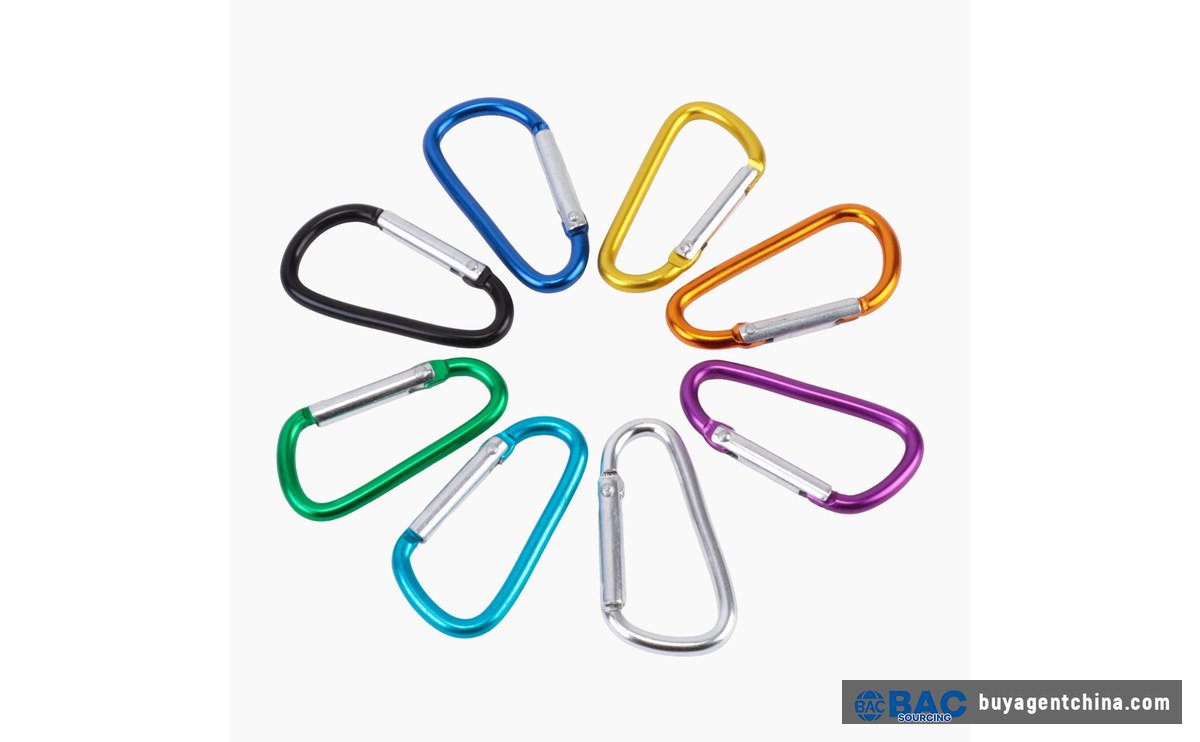
Six aluminum carabiner shapes, including anodized D-rings in eight colors

Six aluminum carabiner shapes, including anodized D-rings in eight colors

TypeWire gauge / sizeGateAlloyRealistic use caseFOB range (2026)
Mini S-hook / quick link3–4 mm, 5–6 cmWire spring6061 aluminumKeychains, bag charms, cable managementUSD 0.045–0.066
Standard D-ring spring gate5–6 mm, 6–8 cmStraight spring gate6061 aluminum, anodizedBackpacks, bottle loops, dog leashesUSD 0.08–0.18
D-ring screw lock6–8 mm, 8–10 cmScrew-lock sleeve6061–7075 aluminumOutdoor gear, hammocks, heavy bagsUSD 0.26–0.55
8-shaped dual S-hook4–5 mmTwo wire gates6061 aluminum, anodizedMulti-clip organizers, purse hooksUSD 0.10–0.25
Heart / star decorative4 mmWire spring6061 aluminum, paintedPromotional gifts, fashion keychainsUSD 0.30–0.45
Climbing-grade D-ring11–12 mmSolid or wire gate, keylock7075 aircraft aluminum, forged/CNCRock climbing, rescue, tacticalUSD 1.50–4.00

The column that trips buyers most is the alloy grade. 6061 is a general-purpose aluminum: it extrudes easily, anodizes cleanly, and is fine for a clip that holds a water bottle. 7075 is aircraft aluminum, roughly twice the tensile strength, and it is the only alloy a climbing bin should be made from. A factory that quotes you a “climbing” biner at USD 0.30 is not selling you 7075 — it is selling you a decorated 6061 with a kN stamp. Ask for the alloy on the quote, and ask for a material certificate.

The gate type matters just as much. A straight spring gate is the cheapest and the most common — it opens one-handed and closes automatically, but it can pop open if it catches on a strap or a belt loop. A wire gate is lighter and less likely to ice up in winter climbing, but it bends if you drop the biner on rock. A screw gate — the threaded sleeve you twist to lock — is the slowest to use but the only one that will not open by accident. For promotional and backpack use, the spring gate is what your customer expects. For load-bearing use, the screw gate is not optional.

Check the wire diameter and the anodizing tank — a biner that gets clipped and unclipped every day is sold by its wire gauge and alloy grade, not by its listing photo. The difference between a 5 mm and a 6 mm wire is 0.1 cents on the quote, but it shows up in the first winter, when the thin-walled clip bends in a customer’s hand and the return email lands in your inbox.

3. The Price Ladder: What the Same Shape Costs Across Tiers

The most common mistake I see is a buyer who finds a USD 0.12 D-ring on Alibaba, orders 5,000 pieces, and then discovers the finish fades in three months and the spring gate dies after a few hundred openings. The USD 0.12 price was real — it just bought a different product than the one the listing photo showed.

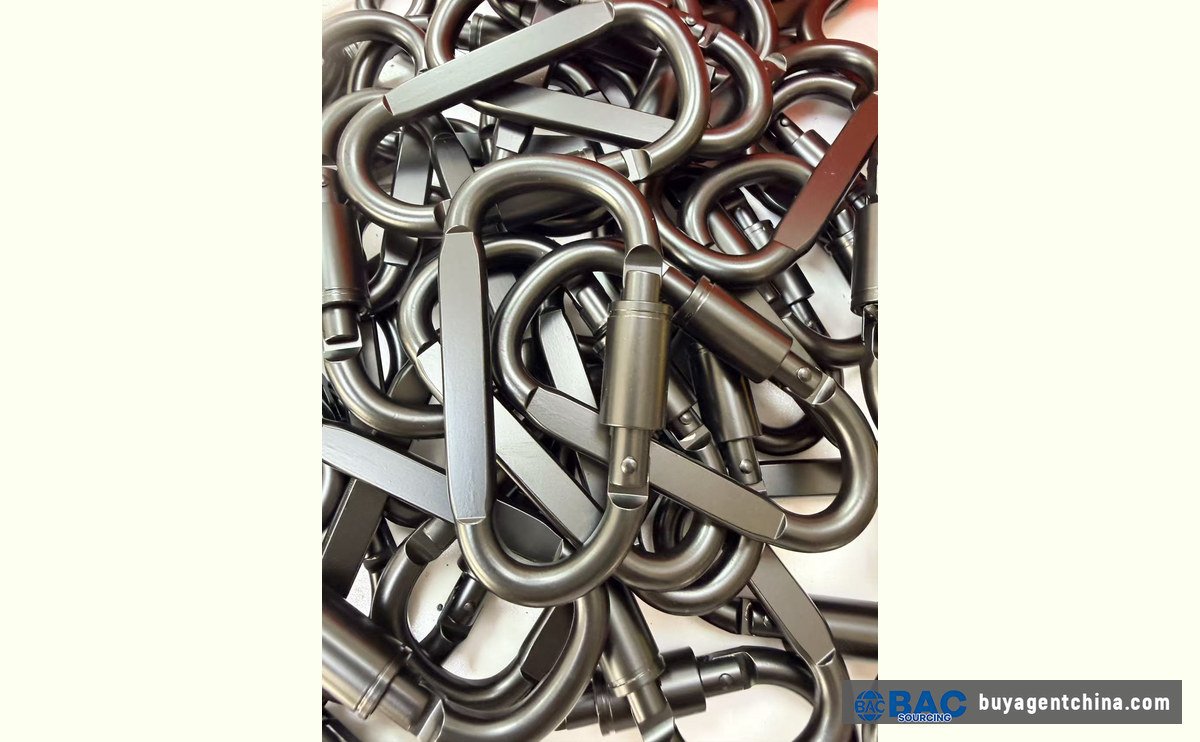
Heavy-duty gunmetal D-ring screw-lock carabiners in bulk

Heavy-duty gunmetal D-ring screw-lock carabiners in bulk

The price ladder below is built from 2026 quotes across 1688, Alibaba and Made-in-China, with the Dongguan and Ninghai factories I have personally walked through.

TierWhat you actually getUnit price (FOB, 2026)Typical MOQ
Promotional entry6061, 5 mm wire, basic anodize, no logoUSD 0.05–0.10500–1,000 pcs
Stock color D-ring6061, 6 mm, eight-color anodize, bag packingUSD 0.10–0.18500 pcs
Logo-printed retail6061, 6 mm, laser engraving or UV print, individual poly bagUSD 0.18–0.301,000 pcs
Screw-lock utility7075 or thick 6061, 7–8 mm, screw sleeve, gunmetal electrophoresisUSD 0.30–0.55500 pcs
Climbing-grade7075 forged, 11 mm, UIAA/CE certificate, wire gateUSD 1.50–4.00100–300 pcs
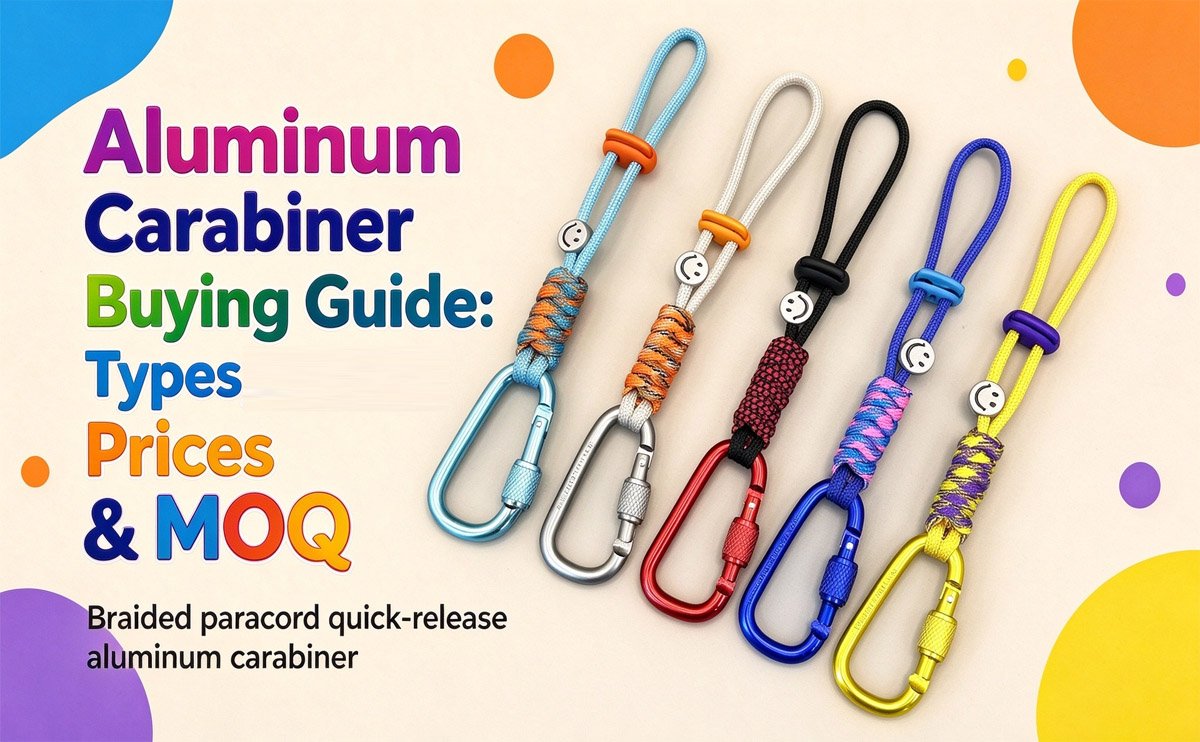
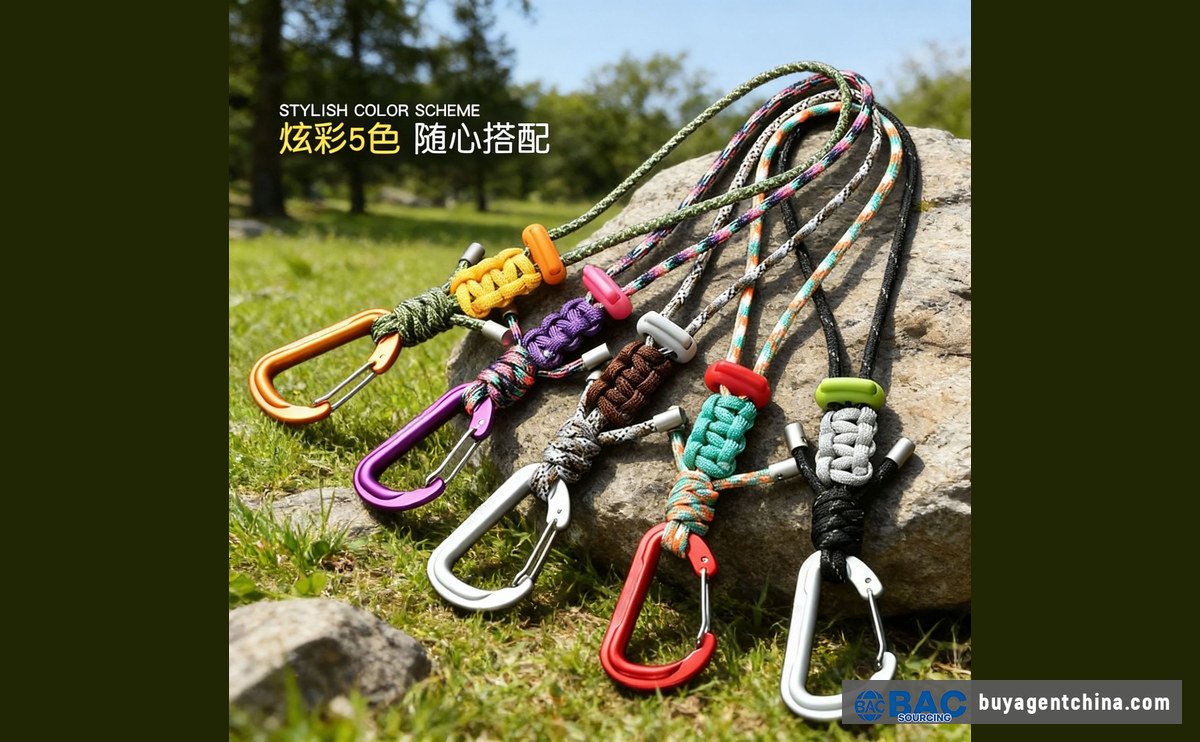
Paracord lanyard set6061 biner + 550 paracord + plastic cord lockUSD 0.80–2.50500 sets

The gap between tier 2 and tier 4 is the part that matters. Both look like a D-ring in a photo. The tier 2 clip will survive a backpack season; the tier 4 screw-lock will survive a hammock load and a few hundred open-close cycles. If your customer is hanging anything with weight — a hammock, a bike lock, a dog leash that snaps — the tier 2 clip is not the product, even if the quote is half the price.

Cheap is not a sin; chasing cheap is. The question is not whether the USD 0.18 clip is a fair price. The question is whether your customer expects it to hold weight for longer than one weekend.

One detail I always ask on the phone: how many open-close cycles does the spring gate survive? A good factory will quote you a number — 5,000, 10,000, 20,000 cycles before the spring weakens. A factory that has no idea is buying springs off the shelf from the cheapest supplier, and those springs die on a customer’s second month of daily use. Ask the question, write it into the spec, and test ten pieces yourself before the container ships. Ten springs clicked open and closed on your desk costs an afternoon. A 5,000-piece return costs a quarter of your margin.

4. Where the Factories Are: Dongguan, Ninghai and Yiwu

China makes the overwhelming majority of the world’s aluminum carabiners. Volza’s trade data for HS 7616.99 shows China leading the category with roughly 7,474 shipments in the most recent twelve months, ahead of the next exporter by an order of magnitude. Within China, three clusters dominate, and they do not make the same product.

CNC machining floor at an aluminum hardware factory in Guangdong

CNC machining floor at an aluminum hardware factory in Guangdong

ClusterWhat they do bestTypical MOQPrice position
Dongguan, GuangdongCNC-machined D-rings, anodizing, custom logo, OEM for outdoor brands500–1,000 pcsMid to premium
Ninghai / Ningbo, ZhejiangStamped and forged bins, 7075 climbing-grade, hardware export300–500 pcsMid, strong on climbing
Yiwu, ZhejiangPromotional volume, mini S-hooks, rainbow anodize, mixed lots100–500 pcsEntry, fastest to ship
Shenzhen, GuangdongClimbing and tactical-grade 7075, UIAA-certified production100–300 pcsPremium
Fujian provinceMini quick links, S-hooks, simple wire forms1,000 pcsEntry, lowest unit price

Dongguan is where the CNC machines and the anodizing tanks live. The factories there do the gunmetal electrophoresis finish you see on the heavy-duty screw-lock clips, and they are the ones most likely to handle your custom logo and packaging. Ninghai is the stamped-hardware belt — that is where the climbing-grade 7075 bins get forged and heat-treated, and where the UIAA certification paperwork lives. Yiwu is the promotional lot where you can mix twelve colors in one carton and ship in seven days.

Send the same one-page spec to one factory in each cluster. The replies will not be the same price, and they will not be the same product — the spread is the cheapest market research you will buy all month. A Dongguan factory will quote you a polished, anodized clip with a laser-etched logo and a five-day lead time. A Yiwu factory will quote you a basic dyed clip in twelve colors at half the unit price, with no minimum on colors. A Ninghai factory will tell you they cannot make the decorative heart shape but can deliver a 25 kN climbing bin with a test report in twenty-five days. You are not looking for the cheapest reply. You are looking for the reply that matches what your customer actually buys.

One warning: a lot of the “Dongguan carabiner factory” listings on Alibaba are trading offices three floors above a tea house, not the CNC floor. Ask for a live video walkthrough of the workshop, not a pre-recorded one. A real factory will walk you past the extrusion line, the anodizing tank and the QC bench without hesitation. A trading office will give you a photo album and a polite smile.

5. Stock vs Custom: When to Grab Off-the-Shelf and When to Tool Up

Types of aluminum carabiner

A sample is a sample, and mass production is mass production — I have said it for fifteen years. Nowhere does that matter more than on a carabiner, because the difference between a stock anodized clip and a custom-machined one is not just the logo.

Decision pointBuy stockCustom / OEM
Your order quantityUnder 3,000 pcsOver 5,000 pcs, or a recurring monthly order
ShapeStandard D, oval, or S-hook from the factory catalogA new shape (heart, star, brand-specific profile)
LogoLaser engraving on stock bodyCast or machined into the body, custom color
Tooling costNoneUSD 300–2,000 per shape, depending on complexity
Lead time7–15 days25–45 days for sampling, 35–60 days for bulk
RiskDead stock if the color flopsTooling sunk if the design does not sell

The rule I give new buyers is simple: run 500–1,000 stock pieces in two or three colors through your channel first. Let the sell-through data decide whether your shape earns a tooling budget. A custom shape that sells out in three weeks is a profit; a custom shape that sits in your warehouse for six months is a tooling invoice you keep paying for.

Laser engraving on a stock body is the middle ground most buyers should start with. It costs USD 0.03–0.08 per piece, it does not require tooling, and it lets you test whether your logo adds enough perceived value to justify a custom run later.

6. Two Order Plans: A 500-Piece Test and a Full Container

Anodized aluminum carabiners on a paracord lanyard, outdoor lifestyle use

Anodized aluminum carabiners on a paracord lanyard, outdoor lifestyle use

You place the order differently if you are testing a market or scaling a proven seller. These are the two plans I write into every buyer’s first email.

The 500-piece test order.

Buy 200 pieces of the standard spring-gate D in two colors, 200 pieces of the S-hook, and 100 pieces of the screw-lock utility. Mix them in one carton. This is not a container — it is a parcel or a small air shipment. You are paying roughly USD 150–300 in product, USD 80–150 in express freight, and you get real-world feedback on which shape your customers actually pick off the rack.

The 5,000-piece bulk order.

Once the test order tells you which shape sells, place a 3,000–5,000 piece run on that winner, with laser-engraved logo and retail poly-bag packing. This is the order where you negotiate the unit price down 10–15%, where you ask for the material certificate, and where you schedule the three-stage inspection (30–50% production, 100% finished goods, and container loading).

 Test order (500 pcs)Bulk order (5,000 pcs)
Unit price (FOB)USD 0.15–0.30USD 0.08–0.18
Lead time7–15 days25–35 days
FreightExpress parcel, USD 80–150LCL sea, USD 300–600
InspectionSkip or one sampling at 100%Three-stage AQL 2.5 inspection
Payment100% T/T in advance30% deposit, 70% before shipment

Put down the usual deposit, but never pay the balance in full before the goods pass inspection. On a 5,000-piece run, the inspection fee you saved comes back, with interest, in returns and ratings.

7. Direct Factory vs Sourcing Agent: What Each Path Actually Costs

You can message a Dongguan factory directly on Alibaba, or you can work through a sourcing agent like BuyAgentChina. Both paths work. They just cost different amounts of your time.

Direct with factorySourcing agent (BAC)
First supplier contactYou negotiate in broken English across time zonesAgent sends one brief to 3–5 vetted factories
Factory verificationYou trust the video callAgent audits the workshop, checks the anodizing line
Price negotiationYou do it, aloneAgent negotiates on your behalf, you see the original quote
InspectionYou fly in or skip itAQL 2.5 pre-shipment inspection included in Growth Plan
Paperwork / HSYou classify yourselfHTS classification and document checking included
Service feeUSD 0 (your time costs money)Entry USD 29; DIVE USD 140; Basic 3–5% commission base USD 220; Growth 5–8% commission base USD 280 (as of July 2026)

The direct route is right if you already speak Mandarin, you have a factory you trust, and the order is a simple reorder of a stock shape. The agent route is right if you are a first-time buyer, if you are comparing multiple factories, or if the order involves custom tooling, a certification requirement, or a QC step you cannot do yourself.

What you are paying an agent for is not the buying. It is the ten minutes in the workshop I mentioned earlier — the look at the wire diameter, the anodizing tank, the spring-gate fatigue sample, and the material certificate that a video call alone will not show you. On a carabiner order, that ten minutes matters more than on most products, because the difference between a 5 mm and a 6 mm wire, or between a dyed and an electrolytic anodize, is invisible on a product photo but shows up in your customer’s hands after the first season of use.

A small order is not a scaled-down big one; it is a different business. Do not drive a tricycle with a train license. If you are placing a 500-piece test, you do not need a full Growth Plan service — you need the Entry or DIVE package to find the right three factories, then you manage the small run yourself. If you are placing a 5,000-piece container with custom tooling and a QC requirement, the Growth Plan pays for itself in the inspection step alone.

8. HS Code, Tariffs and the Paperwork That Stops Your Shipment

Get the HS code wrong, and a whole container sits at the dock while your margin disappears. Aluminum carabiners are almost always classified under 7616.99 — other articles of aluminum. China’s export code is 7616999000, and that is the code most Ningbo and Dongguan factories use on their commercial invoices.

ScenarioHS codeNotes
Plain aluminum carabiner, no accessories7616.99Default; this is what 90% of shipments use
Carabiner with paracord or lanyard7616.99 or 5609.00Mixed-material; declare the dominant component
Stainless steel carabiner7326.90Do not mix up with aluminum — different duty rate
Plastic / ABS carabiner3926.90Not aluminum at all

The tariff rate depends on your destination. For the US, HTS 7616.99.5000 carries a most-favored-nation duty of roughly 3.7%, plus any Section 301 duty that applies to Chinese-origin aluminum articles. For the EU, the third-country duty under 7616.99 is typically around 5–6%. Your forwarder will confirm the exact rate before booking, but you should ask the factory for the correct HS code in the first quote email — a factory that does not know its own export code is a factory that has not exported before.

The other paperwork trap is the country of origin marking. Every piece in the carton should be marked “Made in China” either on the biner itself or on the retail polybag. If you are ordering a logo-printed retail pack for the US market, the marking has to be visible on the unit your customer buys, not hidden in the master carton. Customs can and will pull a container for origin-marking issues, and the storage bill lands on your desk, not the factory’s.

9.Frequently Asked Questions (FAQ)

Q1. What is the minimum order for custom aluminum carabiners from China?

A1. Stock anodized D-rings commonly start at 100–500 pieces from Yiwu and Dongguan suppliers. A custom shape with tooling usually requires 1,000–3,000 pieces to amortize the mold.

Q2. Are the carabiners on 1688 rated for rock climbing?

A2. Most are not. A genuine climbing biner needs 7075 aircraft aluminum, a UIAA or CE 0120 certification number, and a unit price above USD 1.50. Anything cheaper is a promotional or utility clip, not a climbing bin.

Q3. How long does an anodized aluminum carabiner last in retail?

A3. A well-anodized 6061 clip holds its color for 12–24 months of outdoor use. Cheaper dyed finishes fade in 2–3 months. Ask the factory for the anodizing process (dyed vs electrophoretic) and a salt-spray test report.

Q4. Can I mix different carabiner shapes in one order?

A4. Yes, most Dongguan and Yiwu factories accept mixed shapes and colors in one carton at a 500–1,000 piece total MOQ. This is the best way to test multiple SKUs without committing to a large single-shape run.

Q5. What is the difference between a screw lock and a spring gate carabiner?

A5. A spring gate opens and closes automatically — fast, but can open under load or friction. A screw gate has a threaded sleeve that you twist to lock the gate closed; it is slower to use but will not open accidentally. Choose screw lock for load-bearing use, spring gate for quick-access everyday carry.

Q6. Is a sourcing agency or direct sourcing more cost-effective?

A6. Direct looks cheaper on paper, but inspection, communication and after-sales are hidden costs. For mid-sized orders, a transparent-fee agency is usually cheaper on total cost — what it negotiates off the factory price often beats its fee. For big orders, veterans with people in China, direct wins on margin.

Leave a Reply

Your email address will not be published. Required fields are marked *