Procurement Guides

How to Wholesale Ceramic Essential Oil Burners from China?

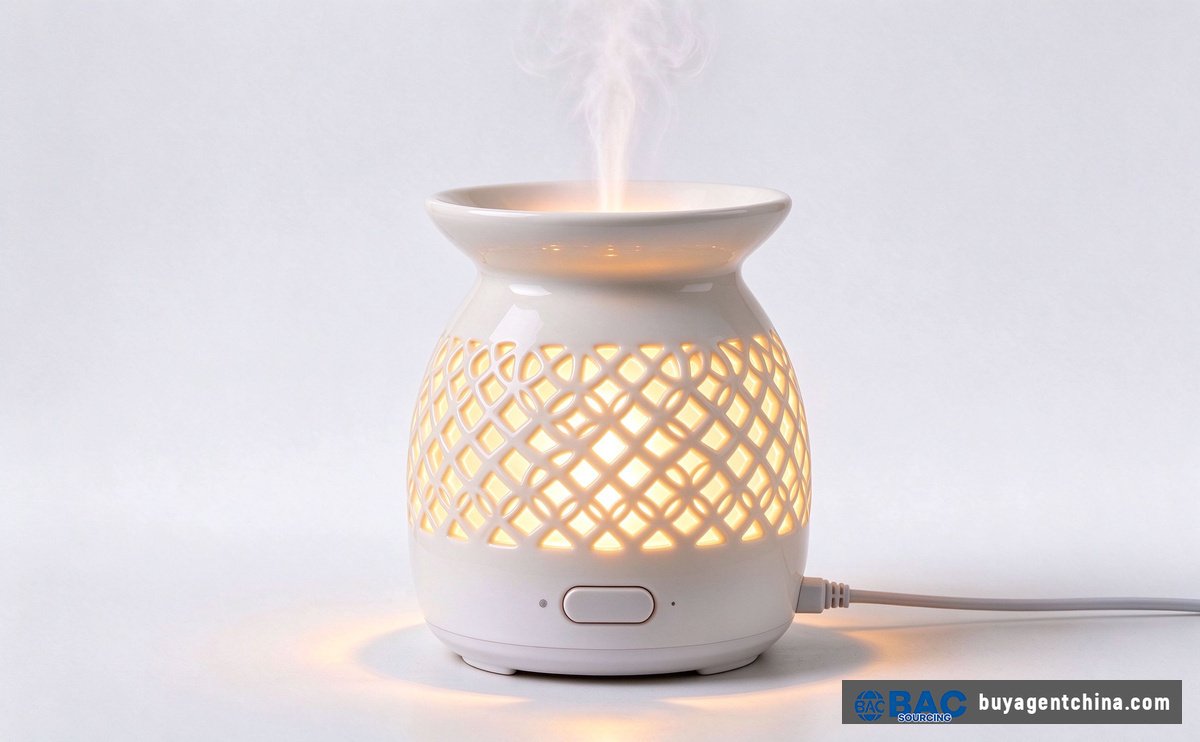
05 Electric ceramic aroma lamp with warm LED and mist — cross-border high-end model

A candle-powered ceramic oil burner can leave the factory at as little as CNY 4–9 (about USD 0.6–1.3 FOB) and still sell on a European or US shelf at USD 15–40. That gap mostly comes down to whether you got a few things right at the source. China supplies over 65% of the world’s decorative oil burners (2026), and the US alone accounts for close to 40% of regional demand — but “cheap” and “profitable” have never been the same thing.

1. Why Buyers End Up Sourcing Ceramic Oil Burners from China

Saying China is the global supply center for ceramic oil burners is not a slogan; it is a checkable set of numbers.

Dehua, in Fujian province, is China’s largest production and export base for ceramic handicrafts. Its ceramics cluster reached CNY 66.3 billion in 2024, up 15% year on year (China Light Industry Federation), pushing toward the 100-billion mark in 2025. Chaozhou, in Guangdong, is the other heavyweight: its ceramic electric aroma burner output hit CNY 4.26 billion in 2025 (Guangdong MIIT, 2026 Yue-Dong Ceramics Cluster Upgrade Report). Add Jingdezhen’s craft-ceramics system, and one country covers the whole price ladder from cheap volume models to premium handcrafted pieces.

For a buyer, the real advantage is not “cheap” by itself. It is that you can build an entire price ladder inside one region: from Dehua’s CNY 4–13 white-porcelain volume models, to mid-range pieces with copper pans or iron bases, to Jingdezhen’s high-end customizable craft models — all in the same ecosystem.

But “you cannot avoid China” is not the same as “easy to buy.” Ceramic is fragile. Glaze, packaging, shipping and inspection — one slip hands back every dollar you saved. This guide is for buyers who want to import ceramic oil burners from China but do not know where to start, and for buyers who keep getting stuck on on-the-ground problems. Read the factory regions, price ranges and agent strategy below — the parts most sourcing guides skip.

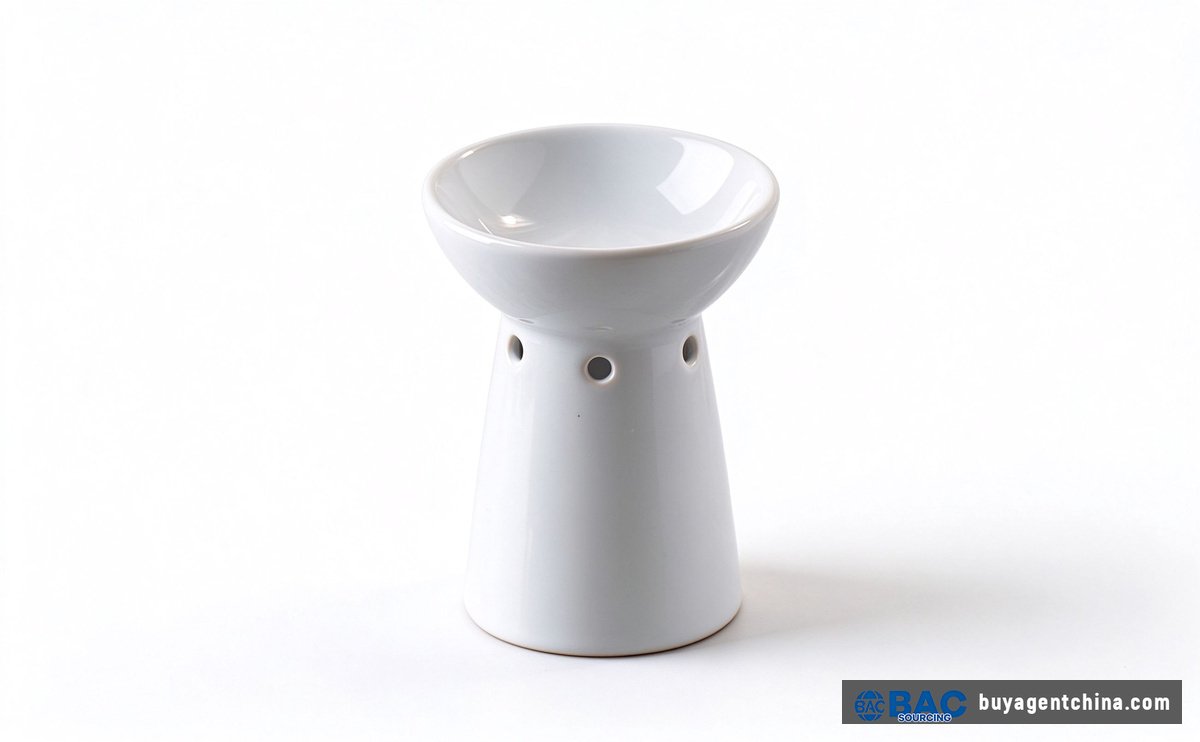
01 Candle-powered white-porcelain essential oil burner — the entry volume model

Candle-powered white-porcelain essential oil burner — the entry volume model

2. Decide What You Are Actually Buying: Stock Wholesale or OEM/ODM

Newcomers often treat “buying ceramic oil burners from China” as a single errand. It is really two different businesses hiding behind one phrase, and betting on the wrong one can burn three months or sink an entire batch.

2.1 Off-the-Shelf (Stock) Wholesale

Under this model the mold is already cut, the shelf already stocked, and you are simply picking existing SKUs — at most swapping a logo or a color. For someone who wants to feel the water before diving in, stock is the fastest route into trade.

AspectStock Wholesale
Best forDropshippers, marketplace sellers, retail shops, promo-gift traders, anyone in a hurry to test demand
Minimum orderVery low — some Dehua workshops ship in a few days and accept dozens of pieces; drop-ship is routine
Lead timeFast — 3 to 15 days
PriceCheapest (no tooling, no design charge)
DifferentiationNearly zero — hundreds of traders can carry the identical shell
Biggest riskCommodity price wars, thin margins, no brand protection

2.2 OEM/ODM Customization

Here the workshop builds to your blueprints, drawings or a sample (OEM), or takes a proven shell and reshapes it with your colors, features and trim (ODM). This is the only road to a private label and a real margin — which is why most own-brand ceramic oil burner programs begin here.

AspectOEM/ODM Customization
Best forImporters and sellers chasing a private label and fatter margins
Minimum orderHigh — roughly 300–600 pcs for logo/color work; 1,000–3,000 pcs for an all-new mold
Lead timeLong — 3–7 days sampling plus 25–45 days bulk production
PriceHigher (sampling, tooling and management add up)
DifferentiationStrong — form, glaze, function and packaging are all yours
Biggest riskHeavy upfront spend, a mold you cannot undo, and sign-off that must be airtight

2.3 A One-Line Decision Rule

Want to move fast and check whether the market even wants the product? Buy stock first and hold off on custom work. Want a durable brand and a moat against the price war? Then OEM/ODM is unavoidable — but arrive with capital and patience. The most common rookie error is commissioning a new mold before the market has voted.

Rule of thumb: run 50–200 stock units through your channel to test color, size and price point, and only then sink money into customization. That sequence works whether you are buying one container or building a five-year private-label line.

3. China's Ceramic Burner Factory Map: Match the Region to Your Order

No single region owns ceramic oil burners; the craft is split by specialty. Dehua handles export craft ceramics and volume, Chaozhou churns out cross-border best-sellers and electric aroma burners, and Jingdezhen covers high-end craft and bespoke work. Seasoned buyers match the factory town to the order instead of chasing the cheapest quote nationwide.

RegionPositioningStrengthsRepresentative dataBest suited for
Dehua
(Fujian)
Export craft-capital · volume & mid-rangeChina’s largest ceramic handicraft export base; mature e-commerce chain (2024 online retail over CNY 20B); 7–10 day direct overseas shipping; lots of stock, mature drop-ship2024 cluster CNY 66.3B (+15%); Jan–Jul 2025 self-operated export CNY 2.138B (+5.06%); products to 190+ countriesStock wholesale, testing, mid-volume, cross-border stocking
Chaozhou
(Guangdong)
Cross-border best-sellers · electric burnersFuyang town concentrates many Amazon/AliExpress-supply burner factories; strong iron+ceramic craft; mature cross-border relabeling2025 ceramic electric aroma burner output CNY 4.26B (Guangdong MIIT)Amazon/cross-border best-sellers, electric aroma lamps, iron-combo models
Jingdezhen
(Jiangxi)
High-end craft · customizationCraft-ceramics system, deep glaze and hand-painting skill, strong high-end and bespoke capacityOne of China’s top three ceramic regionsHigh-end craft models, private label, gifting/collection

3.1 Small Custom vs. Large Custom — Which Region to Pick

This fork is easy to miss, yet it does more to move your cost and calendar than almost anything else.

For small customization — a logo swap, a glaze-color change, a rebrand of a stock shell — Dehua wins. It keeps the deepest pool of ready shells, handles runs from a few dozen to a few hundred, samples in 3–7 days and ships in 15–25 days. That is a real edge when your ceramic oil burner order is small.

For large customization — a new mold, a structural redesign, added electric heating, a premium glaze — the map shifts. Jingdezhen carries the craft and the high-end bespoke work; Chaozhou shines on electric aroma burners, electric-heat/LED cross-border best-sellers and sits close to Shenzhen port with a mature export chain. If you need 3,000+ pieces and cost matters, negotiate volume in Dehua or Chaozhou.

One line to keep: volume stock from Dehua, cross-border hits from Chaozhou, high-end craft from Jingdezhen. Running it the other way works, but it spends your money and your lead time for no reason.

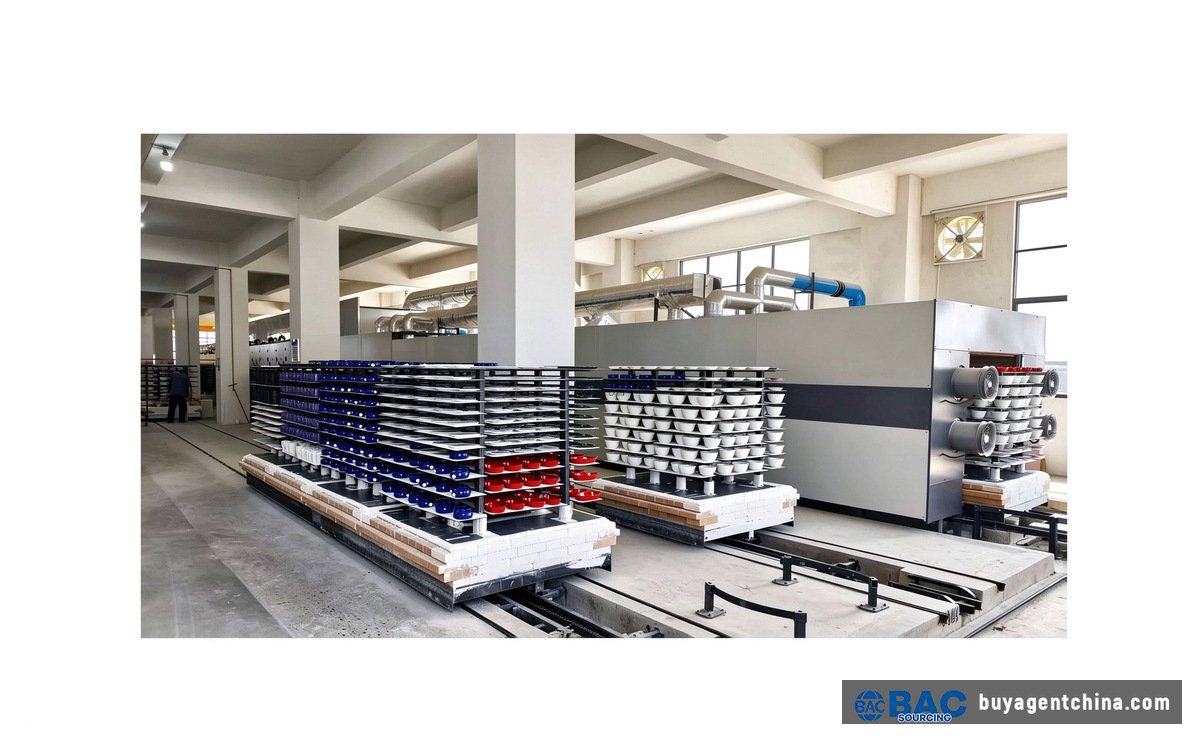
02 Dehua ceramic factory — kiln and racks loaded with porcelain ware

Dehua ceramic factory — kiln and racks loaded with porcelain ware

4. The Four Real Difficulties — and Their Money Pits

Plenty of people picture the whole job as “find a factory on Alibaba, place an order, pay, wait.” It is not that short. Four obstacles hand almost every first-timer a tuition fee, and they show up on nearly every attempt to import ceramic oil burners from China.

4.1 Language: It Is Not Just Translation

Export staff at Chinese ceramic workshops usually manage basic English, but glaze recipes, firing temperatures, wall-thickness tolerances and inspection clauses resist translation tools. One “ceramic oil burner” can be a completely different structure and firing process at two factories, and a loose English spec sheet becomes a different product on the line. There is also a quieter layer: an English inquiry often lands with a foreign-trade salesperson, not the workshop owner, so both information and price get filtered through extra hands.

4.2 Culture: The Negotiation Logic Is Different

Chinese workshops like to warm the relationship before the deal, and first quotes usually carry room to negotiate. Take the opening figure without pushing back and they may quietly re-grade how professional you are. “Reply soon” in China tends to mean today or tomorrow, but “start production soon” normally waits on a deposit (the common habit is 30%) — before money moves, every promise is verbal. Watch the calendar too: capacity and prices swing around Chinese New Year (January–February) and the National Day holiday (early October), and orders placed in those windows routinely slip 2–4 weeks.

4.3 Paperwork: More Complex Than It Looks

Exporting ceramic oil burners from China runs a full chain: contract → deposit → production → inspection → balance → booking → customs declaration → sea or air freight → destination clearance (HS classification, import duty, possible surtax) → inland delivery.

The classic mistake is the HS code. Candle-powered ceramic burners usually sit under 6914 (other ceramic articles), some under 3307 (room-fragrance preparations); electric/ultrasonic models fall under 8509 (electro-mechanical domestic appliances, e.g. 85098090). Classify by material, function and whether it is electric — a wrong code means at best a delay and at worst a seized and fined shipment. Paperwork is not paper; it is money.

4.4 Shipping and Inspection: Where the Money Goes, the Risk Follows

Freight: express or air works for small parcels but gets expensive fast; sea LCL adds per-cubic-meter charges and port fees; FCL leaves you to arrange booking, trucking and customs yourself

Inspection: this is where ceramic sourcing bites hardest. The industry truism is “the sample is the sample, the bulk is the bulk” — a perfect sample with a subpar production run happens far more often than it should. Without a third-party ceramic inspection or someone on the line, you only discover cracks, glaze bubbles and size drift after the cartons land, and returning them costs more than scrapping them.

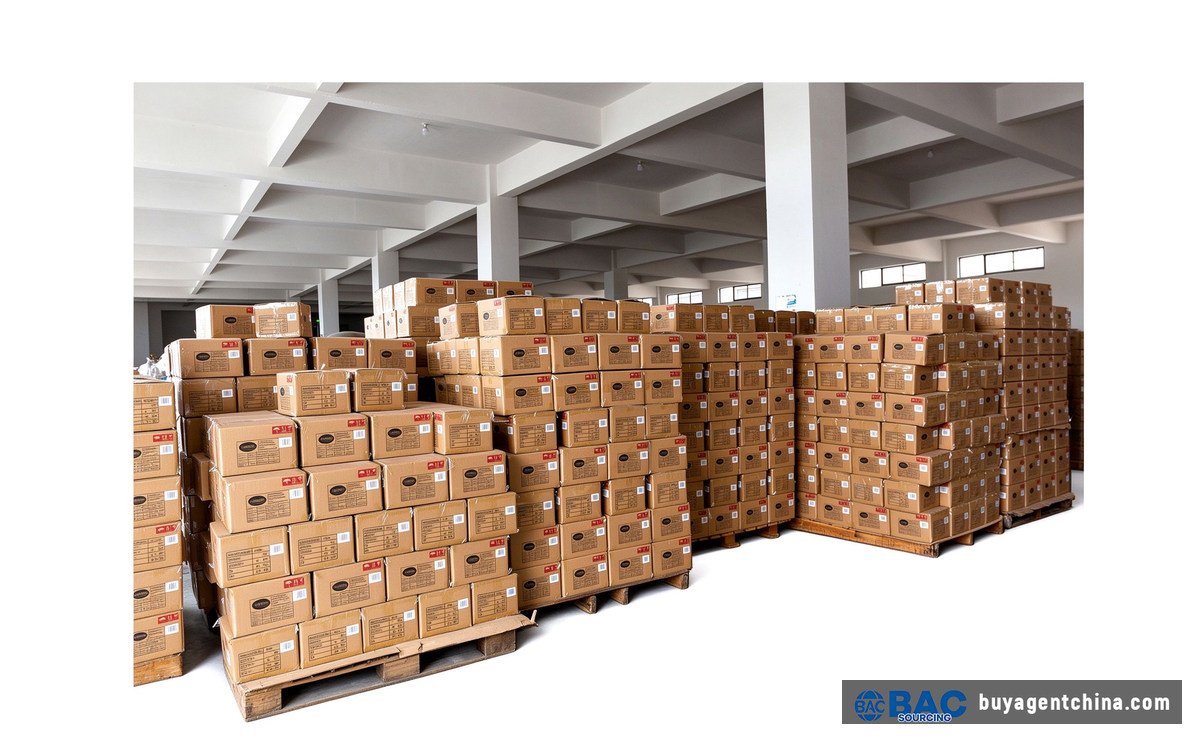
03 Export warehouse — cartons of ceramic ware palletized and ready for shipping

Export warehouse — cartons of ceramic ware palletized and ready for shipping

Payment: most Chinese suppliers quote T/T and stay cautious. Beyond a certain order size the norm is 30% deposit and 70% balance before shipment — you pay before you see the goods, and the exposure sits entirely with you.

These four obstacles are why so many people “found a cheap factory and still lost money.”

5. Sourcing Direct from Factories vs. Using a China Sourcing Agent

“Should I hire an agent?” turns on three things: what your time is worth, how large your orders are, and how much risk you will carry. For many importers the tipping point is the first ceramic oil burner batch that arrives with defects they cannot fix.

AspectSourcing Direct from FactoriesUsing a China Sourcing Agent
CostLowest on paper (no agent fee), but high hidden costsA service fee (often 3–8% of order value, or a fixed fee), but low hidden costs
CommunicationSlow — language, time zones, message distortionFast — the agent deals with factories in Chinese, directly
Quote accuracyHard to judge — padded quotes are commonAgents know the market and push quotes near the floor
InspectionAlmost none unless you fly to ChinaCore value: on-site inspection, line follow-up, reports
Quality assuranceDepends on luck and contract wordingSomeone watches sample-to-bulk consistency
Risk coverageAll risk on youAgent blocks problems and cuts bad-goods losses
Paperwork & logisticsYou deal with customs and forwarders, easy to slip upAgents usually have vetted forwarders and customs channels
Supplier managementNone — you argue alone when problems hitBuilds a supplier ledger and handles after-sales disputes
Best forExperienced buyers, big orders, plenty of timeNew buyers, scattered orders, little time, burnt before

Verdict: if you ship dozens of containers a year and keep your own team or a China-based contact, direct sourcing keeps the widest margin. If you are new, your orders are mid-sized, or language, inspection and communication problems have already burned you, a trustworthy China sourcing agent that covers quotes, negotiation, inspection, order follow-up and logistics handoff is very often cheaper once you count the full cost.

6. Two Sourcing Plans by Order Size

Order size changes the playbook, so here are two plans matching how people usually buy ceramic oil burners from China — a small test order and a large bulk order.

6.1 Small Test Order Plan (50–500 pcs)

Goal: validate the market with minimal cash — do not lose, just learn the trade.

Region: Dehua stock first (drop-ship and 48-hour dispatch are common). Model: stock wholesale or a rebranded stock shell, no new mold. Order size: start from a few dozen to a couple hundred pieces.

How to execute: (1) find a Dehua stock or shared-mold burner factory and ask for real videos and actual transacted prices — watch out for bait quotes that are too low to be real; (2) buy one or two samples and ship them home to check glaze, firing quality, weight and packaging — the freight pays for itself; (3) use express or air for small orders and avoid sea LCL, whose fixed fees eat your margin; (4) even for a small test order, arrange one third-party inspection or agent follow-up, otherwise you are not testing real quality.

Budget reference: white-porcelain volume models at CNY 4–13 ex-works (about USD 0.6–1.8 FOB); mid-range with copper pan or iron base at about CNY 15–40 (about USD 2–6 FOB). Recalculate your selling price including freight and duty.

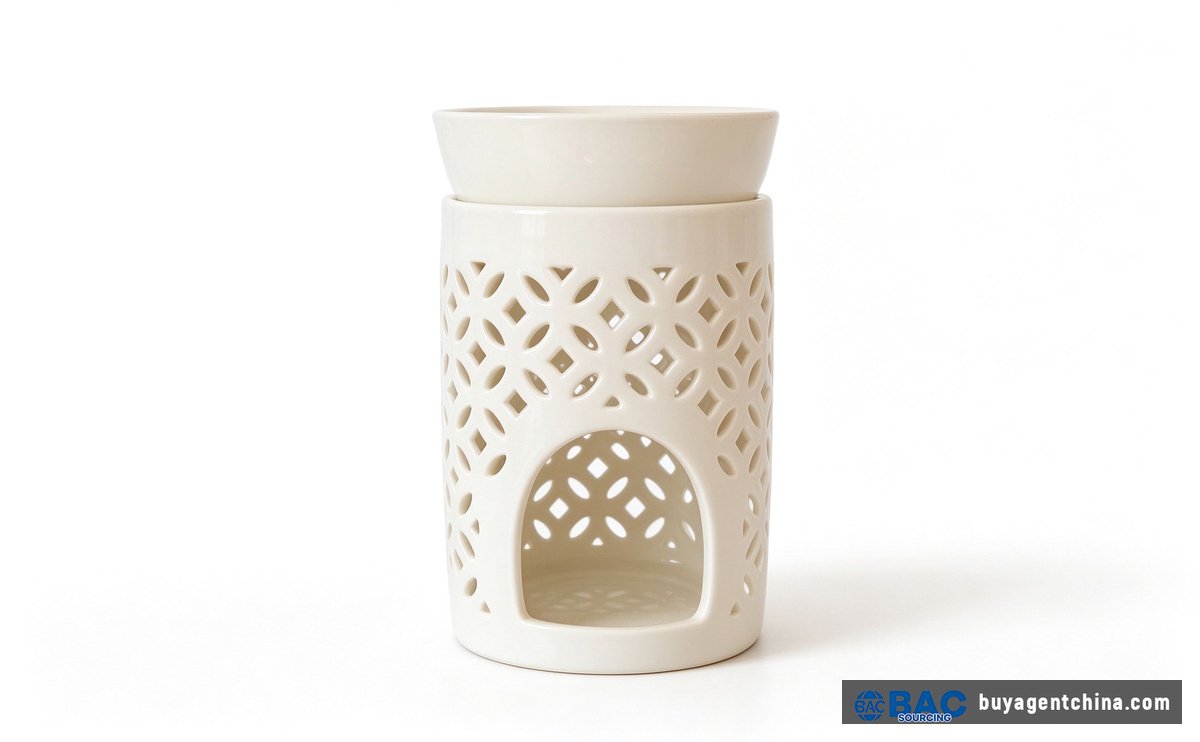
04 Hollow-cut white-porcelain oil burner — mid-range sculpted model

Hollow-cut white-porcelain oil burner — mid-range sculpted model

6.2 Large Bulk Order Plan (1,000+ pcs / Full Container)

Goal: build your own brand, lock in cost, secure supply.

Region: Dehua (mid-range volume), Chaozhou (cross-border best-sellers, electric burners), Jingdezhen (high-end craft). Model: OEM/ODM with a contract, fixed MOQ and tiered pricing — the standard structure for bulk ceramic oil burner orders.

How to execute: (1) write a clear spec sheet — glaze/material, size, weight, base type, heating method (candle or electric), packaging — in both English and Chinese; (2) sample and iterate for 2–4 rounds, then sign off on a physical golden sample, which becomes the only acceptance standard for bulk; (3) agree on T/T terms, aiming for 30% deposit + 40% after inspection + 30% before shipment, or 30/70 with the balance against a copy of the bill of lading; (4) during bulk production, arrange on-site follow-up or a third-party inspection (SGS, ITS, or your agent) — a mid-production check plus a pre-shipment check, and for ceramics verify the cartons have enough bubble wrap and dividers; (5) ship by sea FCL, book two to three weeks ahead, and avoid Chinese New Year and the National Day holiday.

Budget reference: mid-range electric aroma burners at CNY 25–70 ex-works (about USD 3.5–10 FOB); electric-heat/LED best-sellers at CNY 40–120 (about USD 6–17 FOB); Jingdezhen high-end craft at CNY 80–400+ (about USD 11–55+ FOB) depending on craft.

7. Price Ladder by Type

Price follows the heating method (candle vs electric), the craft (plain porcelain vs hand-painted glaze), the extras (copper pan / iron base) and how far you customize. The table below maps the mainstream range from volume to high-end.

TypePositioningKey traitsEx-works (CNY/pc)FOB (USD/pc)Retail ref. (USD/pc)
White-porcelain candle modelVolume entryCheap, plain/single color, tealight heating4–130.6–1.88–18
Hollow / sculpted modelMid-rangeOpenwork shapes, printed glaze8–251.2–3.615–30
Copper pan / iron base modelUpper mid-rangeCopper pan for dry-burn oil, iron base15–402–620–45
Electric aroma lamp / burnerMid-to-highElectric, no open flame, LED, dimmable25–703.5–1030–80
Electric + electronic best-sellerHigh-end volumeUSB/battery, smart temperature, cross-border supply40–1206–1745–120
Jingdezhen hand-painted craftHigh-end customHand-painted glaze, master craft, gifting/collection80–400+11–55+80–300+

Source: collated from 1688 / Made-in-China wholesale listings, 2026; FOB estimated at ex-works × ~0.14 FX plus customs/declaration costs.

8. How to Find a Sourcing Agent with Transparent Fees

The fear around agents is being “double-dipped.” So the real test is not whether they charge at all — it is whether the fee model is transparent. An agent earns their keep when they run your ceramic oil burner orders end to end, but only if you can see every dollar.

8.1 What a Transparent Agent Looks Like

CheckpointTransparent agentOpaque agent
Fee modelClearly priced: a fixed service fee or explicit commission (e.g. 3–5% of value), written into the contractClaims to be free — “the factory pays the commission” — which is usually already baked into the price
Quote logicSeparates the factory price from the agent fee, so you can see the gapGives one lump total and refuses to break it down
Payment pathGoods paid directly to the factory; agent fee paid separately (or a clear three-party agreement)Asks you to pay everything to the agent’s account
Inspection reportProvides photos, videos and an item-by-item checklistJust says “it all looked fine”
Service scopeContract states exactly what is included: quotes, negotiation, inspection, follow-up, logisticsPromises everything verbally, blames the factory when problems come

8.2 How We Recommend You Contract an Agent

Go with “fixed commission on order value plus a per-inspection fee,” and insist the commission is not folded into the factory quote — ask the agent to share the original factory quotation so you can cross-check. Request past inspection reports and the contact details of at least two factories they work with, then verify. Sign a formal agreement covering the service scope, fee breakdown, inspection standard and responsibility boundary. Finally, run the first one or two orders small to test the working relationship before scaling up.

A good agent earns their fee by cutting more off the price than their commission costs, blocking bad goods, and saving you travel and rework expenses. Counted on total cost, a transparent agent saves you money — it does not cost you money.

9. Summary: An Action Checklist for Three Types of Buyers

First-time buyers: (1) run a 5,000–20,000 pcs stock test order from Yiwu and ship by express; (2) test two or three samples for real wall thickness and dimensions before scaling; (3) strongly consider an agent or third-party inspection from the very first order.
Mid-size buyers building a brand: (1) choose Taizhou or Ningbo for OEM/ODM, sign a spec sheet and physically sign off the sample; (2) start from 50,000+ pcs and lock the MOQ and tiered pricing; (3) arrange on-site follow-up plus a pre-shipment inspection for bulk production.
Buyers who have sourced before but keep hitting on-the-ground problems: (1) hand inspection, order follow-up, supplier management and after-sales coordination to a China sourcing agent; (2) use a “transparent fees, pay the factory directly” model to turn the agent into your in-China purchasing department; (3) ask the agent to set up two or three backup factories to avoid single-supplier risk.
Sourcing drawer divider organizers wholesale from China is less about “who found the cheaper factory” and more about “who managed the hidden risks — language, inspection, lead time, quality — earlier.” Whether you buy directly or through an agent, keep the same checklist for every order, and update it after each shipment lands. May your next one arrive safely.

10.Frequently Asked Questions (FAQ)

Q1: How much does a ceramic oil burner cost at the factory?

Candle-powered white-porcelain volume models run about CNY 4–13 ex-works (about USD 0.6–1.8 FOB); mid-range with copper pan or iron base about CNY 15–40; electric aroma lamps about CNY 25–70; Jingdezhen high-end craft CNY 80–400+. Price floats with heating method, craft and customization.

Q2: Which sells better — candle-powered or electric?

Depends on your market. Traditional European and US oil burners are mostly candle-powered, cheaper and faster-moving; electric flameless models are growing faster in safety- and convenience-focused younger markets with higher price points. Many sellers stock both — candle models for volume, electric for margin.

Q3: What is the MOQ for customizing with my logo?

Logo/rebranding usually starts at 300–600 pcs; for small customization on a stock shell, many Dehua factories accept from a few dozen to a couple hundred. A brand-new mold (new shape) usually starts at 1,000–3,000 pcs plus the mold cost.

Q4: What is the HS code for a ceramic oil burner?

Candle-powered models generally fall under 6914 (other ceramic articles); electric/ultrasonic models under 8509 (e.g. 85098090, electromechanical domestic appliances); some under 3307 by fragrance-preparation definition. Whether it is electric, plus material and function, changes the code — confirm with your forwarder or agent, because a wrong code can mean a seized, fined shipment.

Q5: Should I source directly from factories or use a China sourcing agent?

If you are new, your orders are medium-sized, or you have been burned by language and inspection problems, an agent is often cheaper on a total-cost basis. Experienced buyers with big orders and a team in China can source direct for maximum margin. It comes down to your time, order size and risk appetite.

Written by BuyAgentChina, a China sourcing agent with transparent fees. We do not own factories, do not stock goods and do not mark up prices — we earn only from standardized service fees. To source ceramic oil burners from China, book a free 15-minute consultation (WhatsApp: +86 18889605489 / hello@buyagentchina.com).

Leave a Reply

Your email address will not be published. Required fields are marked *