Procurement Guides, Sourcing Tips

How to Source Car Tire Inflators from China? Full Guide

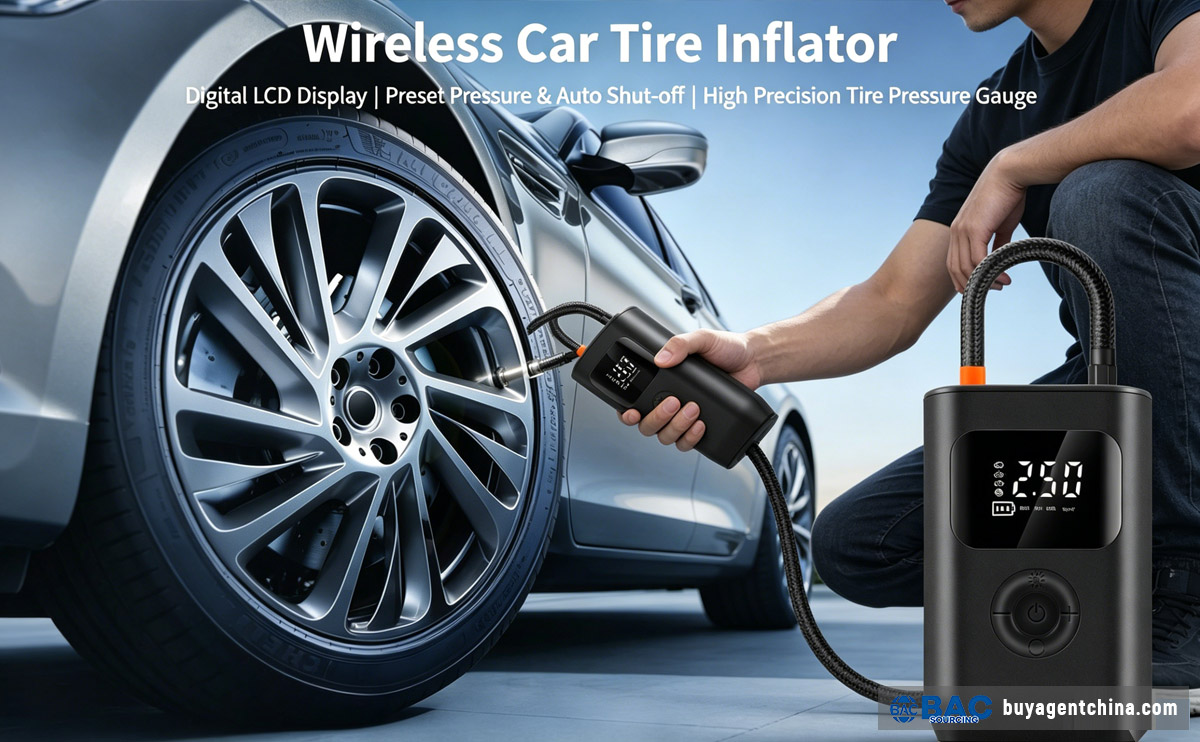
How to Source Car Tire Inflators from China 01 Wireless Car Tire Inflator

Manufacturing Hubs, Product Types & Complete Sourcing Guide

For global auto parts importers, cross-border e-commerce sellers, and automotive accessory brands, China stands as the world’s core supply base for car tire inflators. With a fully integrated industrial chain, unbeatable cost efficiency, and a full product range from entry-level emergency models to high-end smart units, it is the top destination for buyers looking to reduce procurement costs and expand their product portfolios.

However, for first-time buyers, or even experienced sellers who have repeatedly run into costly issues with Chinese suppliers, barriers like language gaps, cultural differences, customs compliance, quality control failures, and shipping delays can significantly drive up total costs and risks.

This guide breaks down China’s core car tire inflator manufacturing clusters, full product categories, and latest export market data, unpacks the key pitfalls of direct factory sourcing, compares the pros and cons of direct sourcing vs. working with a local China sourcing agent, and shares actionable tips and FAQs to help you source efficiently and with minimal risk.

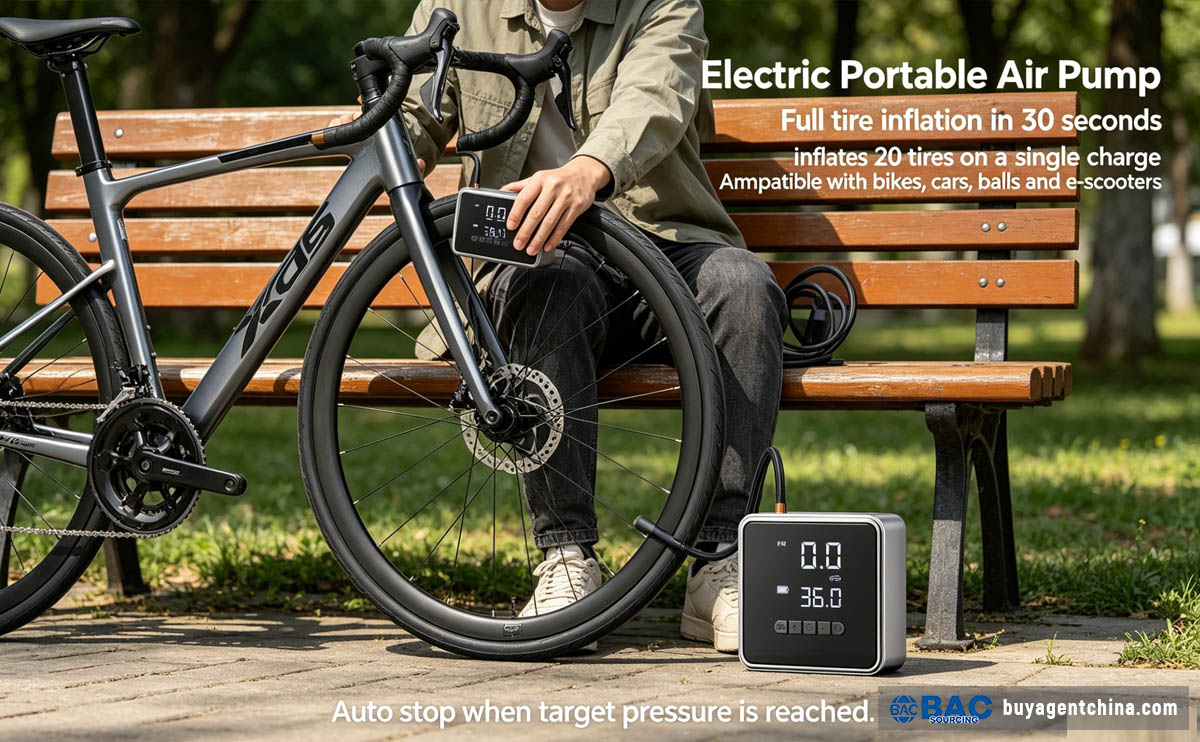
How to Source Car Tire Inflators from China 02 Electric Portable Air Pump

How to Source Car Tire Inflators from China 02 Electric Portable Air Pump

1. China’s Core Car Tire Inflator Manufacturing Hubs & Supplier Selection

China’s portable air compressor for car production is highly concentrated, with two major industrial clusters in the Yangtze River Delta and Pearl River Delta accounting for over 75% of the nation’s total output. Each region differs significantly in product positioning, core strengths, MOQ thresholds, and certification capabilities. Picking the right region is the first step to matching with qualified suppliers.

Manufacturing Hub

Core Cities

Share of National Production Capacity

Key Industry Strengths

Leading Manufacturers

Yangtze River Delta

Ningbo, Yuyao, Cixi (Zhejiang); Suzhou, Nanjing (Jiangsu)

45%

China’s largest production cluster, covering the full supply chain from mold making, injection molding, motor manufacturing to final assembly. Specializes in mid-range mass-produced models with mature supporting facilities and strong cost control.

Youlite (Ningbo), Yantu (Nanjing), Deli Group

Pearl River Delta

Shenzhen, Dongguan, Foshan (Guangdong)

30%

R&D hub for smart car tire inflators, focusing on high-end smart models and ODM/OEM services. Mature electronic control module supply chain and strong cross-border e-commerce channel support.

Ruike (Dongguan), Baseus (Shenzhen), Steel Mate

Bohai Rim Region

Qingdao (Shandong), Xingtai (Hebei)

10%

Specializes in core component supply including metal structural parts, rubber seals, and air hose assemblies. Focuses on commercial vehicle models with mature metal processing technology.

Local auto parts manufacturers in Qingdao and Xingtai

Other Regions

Xiamen (Fujian), Wenzhou (Zhejiang), Chengdu (Sichuan)

15%

Focuses on budget-tier products and export OEM services, with lower labor costs and well-established regional distribution networks.

Local auto parts firms in Wenzhou, ODM manufacturers in Xiamen

Sourcing Guidance for Overseas Buyers

• For mid-range mass orders focused on maximum cost efficiency, prioritize factories in the Yangtze River Delta (Ningbo, Yuyao, Cixi). These facilities offer low MOQs, large-scale production capacity, and are ideal for distribution in emerging markets like Southeast Asia and Latin America.
• For high-end smart car air pump models or ODM custom development, opt for manufacturers in the Pearl River Delta. With a robust electronics supply chain, they lead in digital pressure controls, lithium-ion battery solutions, and multi-function integration, making them a perfect fit for mid-to-high-end markets in North America and Europe.
• For heavy-duty commercial vehicle air compressors or standalone component sourcing (hoses, seals), consider suppliers in the Bohai Rim region.

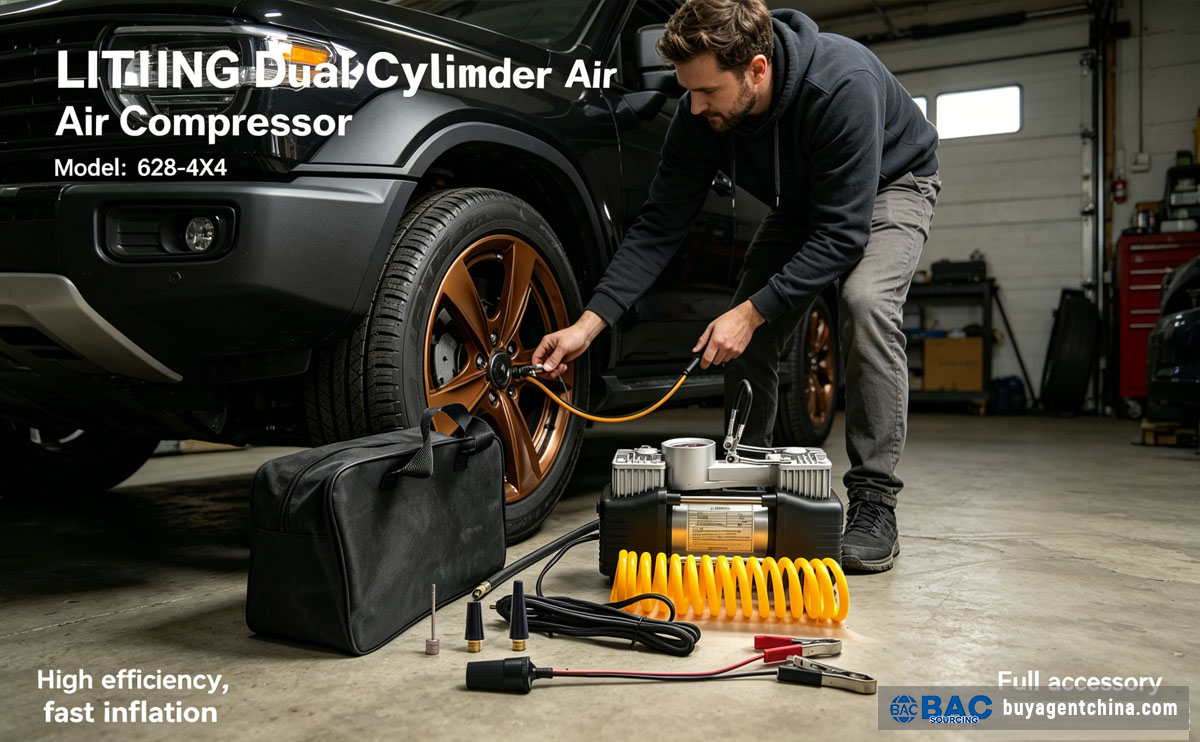
How to Source Car Tire Inflators from China 03 LITING Dual Cylinder Air Compressor

How to Source Car Tire Inflators from China 03 LITING Dual Cylinder Air Compressor

2. Full Product Catalog & Target Market Matching

Car tire inflators are categorized across four core dimensions: power supply, operating mechanism, feature set, and power rating. Best-selling models vary widely by market and sales channel, so choosing the right product mix directly impacts your sales volume and profit margins.

2.1 By Power Supply: Wireless Lithium Models Lead Global Demand

Power supply is the most critical classification, as it defines use cases and portability. Wireless lithium-ion car tire inflators now account for over 60% of the global retail market.

Category

Core Features

Typical Use Cases

Market Share

Wired 12V/24V Cigarette Lighter Models

Powered directly by vehicle onboard power, stable output, long continuous runtime, low cost

Long-haul driving, commercial vehicles, fixed-location emergency top-ups

35%

Wireless Lithium-Ion Models

Built-in high-rate lithium battery, no power cord constraints, highly portable and flexible operation

Passenger vehicles, daily emergency use, outdoor scenarios

60%

USB-C Rechargeable Models

Compatible with phone chargers and car USB ports, wide adaptability, ultra-portable

Daily home use, short trips, multi-device compatibility

5%

Market Matching Tips: Prioritize wireless lithium-ion portable air compressors for car in North American and European passenger vehicle markets, where they fit perfectly with outdoor and daily emergency use cases. For commercial vehicle channels and emerging budget markets in Southeast Asia, keep cost-effective wired models in your lineup. USB-C rechargeable models work well as a differentiated SKU for digital accessory channels.

2.2 By Operating Mechanism: Piston-Type for Mass Market Adoption

The internal mechanism determines inflation speed, noise level, cost, and service life. Piston-type car air pumps are the most technologically mature option and the default choice for most bulk orders.

Category

Core Features

Typical Use Cases

Market Share

Piston-Type

Simple structure, low cost, high inflation efficiency at high pressure, proven technology

Entry to mid-range markets, passenger sedans, regular tire pressure top-ups

75%

Diaphragm-Type

Low noise, compact size, lightweight, slightly lower inflation efficiency for low-pressure use

Ultra-portable models, compact cars, sports equipment inflation

15%

Turbine-Type

Fast inflation, strong continuous runtime, complex structure, higher cost

High-end models, commercial vehicles, large vehicle tire inflation

10%

Market Matching Tips: Choose piston-type car tire inflators for mainstream distribution — they offer proven reliability, low return rates, and predictable procurement costs. For premium channels focused on quiet operation and portability, diaphragm-type models are a strong fit. For commercial and professional rescue applications, opt for high-power turbine-type units.

2.3 By Feature Set: Digital Smart Models Drive Retail Sales

Feature sets align directly with customer needs and determine your profit margin. Digital car tire inflators with auto shut-off are the current best-sellers across retail channels.

Category

Core Features

Typical Use Cases

Market Share

Basic Emergency Models

Basic inflation only, simple structure, low price, no extra features

Budget markets, entry-level users, one-time emergency use

25%

Digital Smart Models

High-precision digital pressure gauge, auto shut-off function, pre-set pressure capability

Passenger vehicles, mainstream consumer markets, daily use

55%

Multi-Function Emergency Models

Integrated jump starter, safety hammer, LED lighting, SOS distress signal

Long-distance road trips, off-roading, full-scene emergency kits

15%

Professional Commercial Models

High power, dual-cylinder design, extended continuous runtime, compatible with multiple vehicle types

Commercial fleets, auto repair shops, professional rescue services

5%

Market Matching Tips: Make digital smart car tire inflators your core SKU for Amazon, independent sites, and other mainstream retail channels — auto shut-off is a non-negotiable feature for most buyers today. For outdoor and off-road channels, promote multi-function emergency models. For promotional giveaways and low-price channels, use basic emergency models to control costs.

2.4 By Power Rating: Mid-Range Power for Widest Compatibility

Power rating directly determines inflation speed and vehicle compatibility. Mid-power models balance performance and portability, making them the safest choice for all sales channels.

Category

Core Features

Typical Use Cases

Market Share

Low Power (<120W)

Compact, lightweight, low noise, slower inflation speed, ideal for small vehicles

Passenger sedans, daily emergencies, portable use cases

40%

Mid Power (120W–300W)

Balanced inflation efficiency, wide application range, good balance of portability and performance

Mainstream consumer market, all vehicle types, daily use

50%

High Power (>300W)

Dual-cylinder design, fast inflation, strong continuous runtime, larger form factor

Commercial vehicles, large trucks, professional rescue scenarios

10%

Market Matching Tips: Prioritize 120W–300W mid-power portable air compressors for car in the passenger vehicle segment, as they deliver the best balance of speed and portability. Choose low-power models for compact car and ultra-portable product lines, and high-power dual-cylinder models for commercial and auto repair applications.

3. China Car Air Pump Export Data & Market Trends

Understanding industry export trends helps you forecast market demand, optimize your product mix, and avoid oversaturated low-price segments. Below are core export statistics for China car tire inflators from 2021 to 2025:

Year

Export Value (Billion USD)

YoY Growth Rate

Export Volume (Million Units)

Share of Mid-to-High-End Models

2021

0.231

12.8

22.2%

2022

0.280

+21.2%

15.6

28.5%

2023

0.386

+37.9%

21.0

35.8%

2024

0.482

+24.9%

26.8

41.2%

2025

0.576

+19.5%

32.5

45%

Key Data Insights

1. Sustained High Market Growth: The export value has recorded a CAGR of over 25% in the past five years. Global demand for car tire inflators in the automotive aftermarket is rising steadily, driven further by the global shift away from spare tires in new energy vehicles.
2. Rapid Product Upgrade: The share of mid-to-high-end car tire inflator exports has doubled from 22.2% in 2021 to 45% in 2025. Global buyers are shifting from “lowest price” to “quality and features,” squeezing profit margins for entry-level basic models.

By destination, North America, Europe, and Southeast Asia are the three core markets, accounting for over 90% of total export volume:

• North America is the largest market, making up 38.2% of exports in 2025. Buyers here prefer smart wireless and multi-function emergency models, with strict requirements for certification and product quality.
• Europe accounts for approximately 30% of exports, with stringent compliance standards and a strong focus on environmental protection, safety, and product durability.
• Southeast Asia is the fastest-growing emerging market, with export value growing 132% cumulatively from 2021 to 2025, raising its market share to 22.6%. Currently dominated by budget basic models, the region offers significant room for product upgrading.

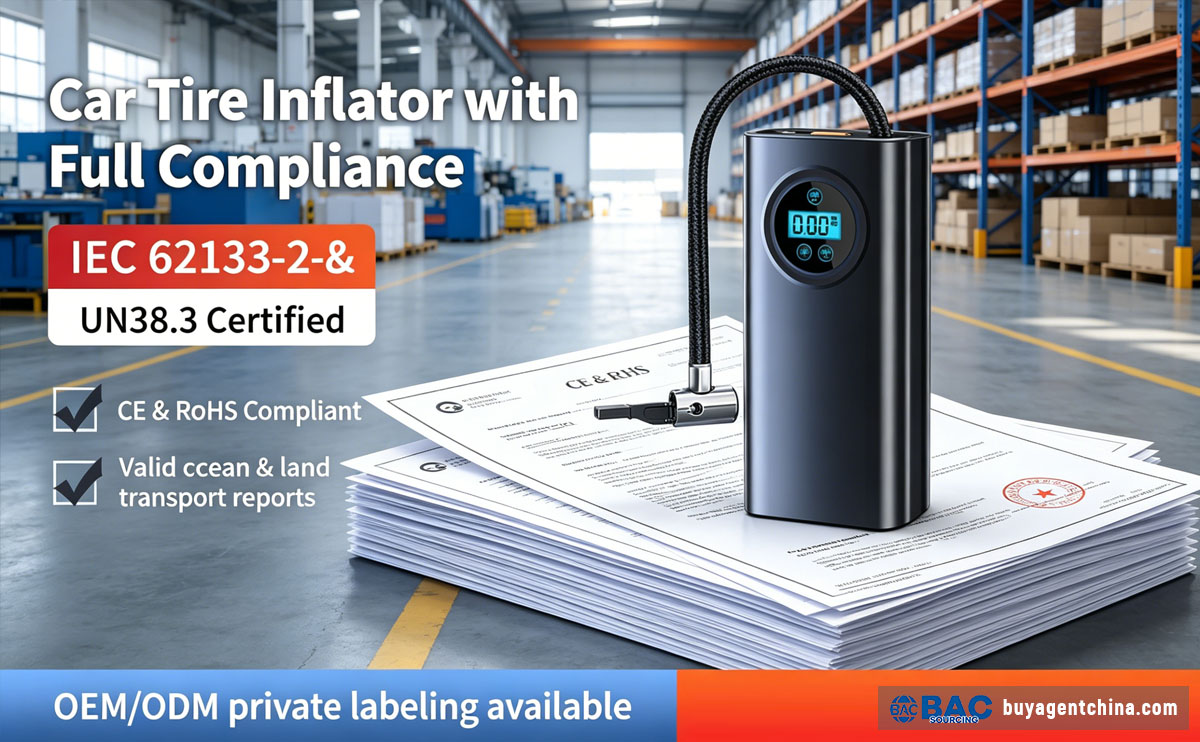
How to Source Car Tire Inflators from China 04 Car Tire Inflator with Full Compliance

How to Source Car Tire Inflators from China 04 Car Tire Inflator with Full Compliance

4. Core Pitfalls of Sourcing Directly from Chinese Factories

Despite China’s clear supply chain advantages, overseas buyers without local resources face multiple practical obstacles when sourcing directly. First-time buyers face extremely high risk of costly mistakes, and even experienced procurement teams often encounter hidden local challenges.

4.1 Language & Cultural Communication Barriers

  • Language Gaps: Most sales staff at small and medium-sized factories have limited English proficiency. Miscommunication is extremely common when discussing technical specifications such as pressure accuracy, motor materials, and custom structural designs, often resulting in mass production that does not match approved samples.
  • Cultural Differences: Chinese business communication often leans toward optimistic initial commitments, with delivery dates and production capacity sometimes overstated. Hidden costs and potential risks are rarely proactively disclosed, and issues often only surface mid-order.
  • Time Zone Delays: Buyers in North America and Europe face an 8–12 hour time difference with China. Daily communication responses are delayed, and urgent production or logistics issues cannot be addressed in real time, often leading to order delays.

4.2 Compliance & Customs Clearance Risks

  • Difficult Qualification Verification: It is hard for remote overseas buyers to verify a factory’s actual qualifications and the authenticity of certifications. Some factories provide counterfeit or expired CE and FCC certificates, leading to customs clearance failures, high demurrage fees, and return shipping costs.
  • Unfamiliar Procedures: First-time buyers often lack familiarity with Chinese export customs declaration, certificate of origin processing, commodity inspection, and destination country HS code classification and tariff policies. Incomplete documentation frequently leads to customs holdups.
  • Tax Risks: Lack of knowledge about free trade agreement tariff preferences or incorrect product classification can lead to under-declaration, resulting in customs penalties and additional tax costs.

4.3 Quality Control & Delivery Uncertainty

  • No On-Site Factory Audit: Remote sourcing relies only on photos and videos to assess factory capacity, making it hard to spot scams like trading companies posing as factories, or large factories accepting orders then outsourcing to small workshops.
  • Mass Production Quality Drift: It is a common industry issue for samples to pass inspection but mass production to cut corners — for example, replacing pure copper motors with aluminum ones, or failing to meet pressure accuracy standards. Overseas buyers cannot inspect every batch, and quality issues are often only discovered after delivery, with extremely high cross-border dispute resolution costs.
  • Unreliable Delivery Times: During peak production seasons, factories prioritize large local customer orders over small overseas orders. Sellers face stockout risks, and remote follow-ups have limited effect.

4.4 Logistics & Supply Chain Management Challenges

  • Fragmented Logistics: Shipping from factory to overseas warehouse involves multiple stages: domestic trucking, customs declaration, sea/air freight, destination customs clearance, and last-mile delivery. New buyers struggle to consolidate the most cost-effective channels, leading to high logistics costs and unpredictable lead times.
  • High Management Overhead: Managing multiple suppliers at once requires repeated communication, order follow-ups, and reconciliation, consuming significant time and labor. When defective products are found, return and replacement processes are lengthy and shipping costs are high, making after-sales costs difficult to control.

5. Direct Factory Sourcing vs. Local China Sourcing Agent: Pros & Cons

To address the pain points above, overseas buyers have two core sourcing models: working directly with factories, or partnering with a reliable local China sourcing agent to handle the full process. Each model has distinct advantages and disadvantages, suited to different buyer scales and needs.

Comparison DimensionDirect Factory SourcingLocal China Sourcing Agent
Unit CostNo intermediary service fee, lower per-unit priceCharges a percentage-based service fee, slightly higher per-unit cost. However, overall costs can be reduced through negotiated pricing, consolidated orders, and supply chain optimization.
Communication EfficiencyHigh barriers from language, time zone, and technical gaps. High communication costs and risk of requirement misalignment.Bilingual local teams operate in the same time zone, deliver accurate requirement translation, and respond quickly, eliminating losses from information gaps.
Quality AssuranceDifficult to control remotely, high quality risk, extremely high cross-border dispute costs.On-site factory audits, production line inspections, and pre-shipment inspections based on standard AQL criteria. Quality issues are resolved domestically before shipping, with local teams supporting after-sales disputes.
Compliance RiskBuyers must independently research certifications, customs regulations, and tariff policies, bearing full risk.Familiar with import/export rules and certification requirements for all major markets. Handles all procedures, verifies certificate authenticity, and significantly reduces customs clearance risks.
Time & EffortRequires significant time communicating with factories, following up on orders, and resolving unexpected issues.Full-process managed service. Buyers only confirm requirements and receive goods, saving substantial labor and time to focus on front-end sales.
MOQ ThresholdFactories set high minimum order quantities; small orders have little negotiation power.Can consolidate orders from multiple buyers to lower MOQ thresholds, and secure better pricing through centralized purchasing.
Supply Chain ManagementLimited to single-factory cooperation; expanding new suppliers carries high costs and trial-and-error risk.Access to a mature pool of pre-vetted suppliers across multiple product categories, with unified management for reconciliation, restocking, and shipping.

Who Should Choose Which Model?

  • Direct factory sourcing is ideal for: Large importers and brands placing orders of 10,000+ units per model, with dedicated procurement and QC teams that can conduct regular on-site factory audits, and long-term stable purchasing volume to manage full-process risks independently.
  • A sourcing agent is ideal for: First-time buyers, cross-border sellers placing small-to-medium multi-category orders without a dedicated China procurement team; experienced buyers who repeatedly face quality, delivery, or compliance issues and want to reduce risk and improve efficiency; and businesses that want to focus on front-end operations rather than managing supply chain logistics.

6. Core Value of a Local China Sourcing Agent

A professional and reliable China sourcing agent acts as your local procurement office in China, solving cross-border sourcing pain points at the source. Their core value covers six key areas:

  1. Precise Supplier Screening: Leverage local industry resource pools to quickly match factories that meet your budget, certification, and capacity requirements, with on-site verification of real qualifications to avoid trading companies and low-quality workshops.
  2. Requirement Alignment & Negotiation: Bilingual technical teams accurately communicate custom requirements to avoid misinterpretation. Leverage industry connections and centralized purchasing volume to secure better pricing and delivery priority than individual buyers.
  3. End-to-End Quality Control: Confirm sample standards before production, conduct regular inspections during manufacturing, and perform pre-shipment sampling/full inspection per AQL standards with detailed inspection reports, ensuring mass production matches approved samples and quality issues are resolved domestically.
  4. Full Import/Export Procedure Support: Handle all export procedures including customs declaration, certificates of origin, commodity inspection, and certification verification, and assist with preparing destination customs clearance documentation to avoid compliance and tariff risks.
  5. Consolidated Logistics Management: Integrate premium logistics providers to offer door-to-door shipping solutions. Support LCL consolidation from multiple suppliers, unified reconciliation, and centralized tracking to dramatically improve supply chain efficiency.
  6. After-Sales & Dispute Resolution: Local teams can quickly intervene in factory after-sales disputes, coordinate returns, rework, and payment deductions, avoiding the passive position of remote dispute resolution for overseas buyers.

BAC Sourcing is a trusted China buying agent specializing in automotive parts, with years of deep experience in the auto accessories supply chain. We have in-depth knowledge of factory resources and quality control standards across all major car tire inflator manufacturing hubs, providing global buyers with one-stop managed sourcing services from product selection, factory audits, quality control to customs clearance and logistics. We specialize in supporting small-to-medium batch, multi-category orders for cross-border sellers and importers seeking low-risk, efficient procurement.

7. Frequently Asked Questions

Q1: What is the typical MOQ for car tire inflators when sourcing from China?

MOQs vary significantly by region and product type. For basic wired emergency air pumps, standard MOQ at Yangtze River Delta factories is 500–1000 units. For wireless digital smart car tire inflators, MOQ typically ranges from 1000–2000 units. For ODM custom orders with new tooling, MOQ is usually 5000 units or more. For smaller order quantities, working with a sourcing agent can lower the minimum threshold through consolidated orders, with options starting from 100 units.

Q2: What mandatory certifications are required for car tire inflators exported to the US and EU?

For export to the European Union, CE certification and RoHS environmental certification are mandatory. For export to the United States, FCC certification is required by law. For sale in offline retail chains and big-box stores, additional UL safety certification is usually required. Some emerging markets require third-party quality inspection reports and certificates of origin. Always verify certificate authenticity before placing an order to avoid customs clearance risks.

Q3: How long does shipping take for car tire inflators from China to the US?

For sea freight from ports in Ningbo or Shenzhen to Los Angeles, standard ocean freight takes approximately 25–35 days including customs declaration and port pickup, while express sea freight takes 12–18 days. Shipping to East Coast ports adds an extra 7–10 days. Including domestic production, preparation, and trucking, the total lead time for standard orders is about 30–45 days, with longer lead times recommended during the Q4 peak season. Air freight typically takes 5–7 days for urgent restocks, but at a much higher cost.

Q4: How can I prevent Chinese suppliers from cutting corners and delivering goods that don’t match samples?

The most effective method is pre-shipment quality inspection: hire a local agent or third-party inspection company to conduct on-site inspections, checking core indicators like pressure accuracy, motor material, and build quality against the approved sample and AQL sampling standards. It is also recommended to clearly define quality standards and penalty clauses in the contract, and withhold a portion of the final payment until inspection is passed. For buyers without the ability to conduct on-site inspections, working with a buying agent from China to manage full-process quality control is the most cost-effective and low-risk solution.

Q5: What is the typical fee structure for a China sourcing agent?

The industry standard pricing model is a service fee charged as a percentage of total order value. For car tire inflator categories, the service fee typically ranges from 3% to 8% of the purchase amount, depending on order volume, product complexity, and scope of services. Some agents also offer on-demand services for single factory audits or one-time inspections. Reputable sourcing agents do not mark up product prices and only charge transparent service fees, and overall can help buyers reduce total procurement costs and risks.

Q6: What are the core advantages of China-made car tire inflators over other producing countries?

China is the world’s largest manufacturer of car air pumps, with three core advantages:
First, full industrial chain support: Industrial clusters in the Yangtze and Pearl River Deltas cover every stage from motors and sensors to final assembly, with local component supply rates exceeding 70%, delivering significant cost advantages.
Second, large production capacity and strong delivery capability: Annual national production exceeds 80 million units, with the ability to fulfill both small and large batch orders.
Third, fast technology iteration: Product updates for smart wireless and multi-function models far outpace European and American brands, allowing quick adaptation to evolving global market demands.

If you are planning to source car tire inflators from China and need support with supplier matching, quality control, or full-process logistics management, partnering with a reputable source agent from China can help you avoid costly mistakes and build a stable, reliable supply chain.

Leave a Reply

Your email address will not be published. Required fields are marked *