Procurement Guides, Sourcing Tips

How to Source Quality Power Strips From China?

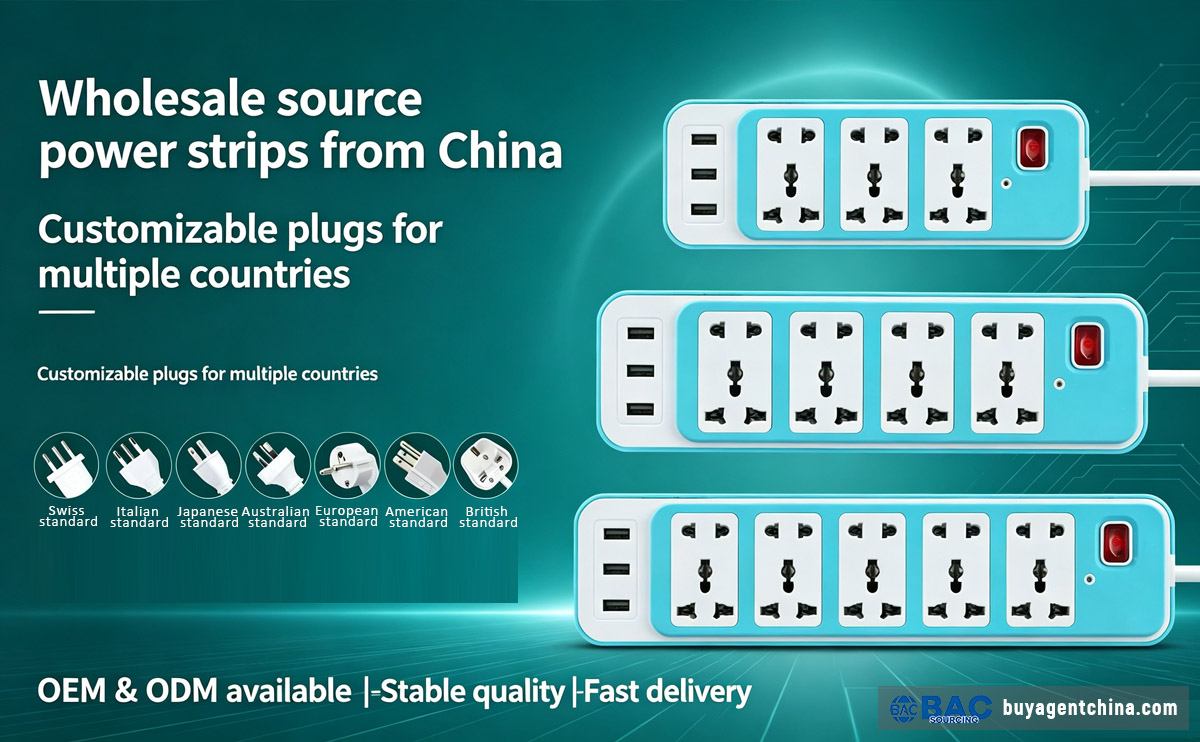
Wholesale source power strips from China 01

A Guide to Working With Local Sourcing Agents

1. The Upside and Hidden Barriers of Sourcing Power Strips From China

China is the world’s largest manufacturer and exporter of power strips (also known as extension cords and power socket strips). Three major industry clusters — Cixi in Zhejiang, Zhongshan in Guangdong, and southern Jiangsu province — host thousands of original factories covering every product category, from basic residential models to smart fast-charging units and industrial-grade solutions. With a mature supply chain and competitive pricing, sourcing power strips from China has become the top choice for importers, cross-border sellers, and channel retailers worldwide. For businesses looking to buy power strips from China or wholesale power strips from China at scale, the cost savings and product variety are unmatched.
However, for overseas buyers — especially those new to Chinese supply chains — the attractive factory prices come with hidden pitfalls. Many buyers underestimate the barriers of language, quality control, compliance, and logistics. Inexperienced importers often encounter issues like swapped materials, missing certifications, and endless delivery delays, which push total costs far above expectations. Even seasoned buyers with years of sourcing experience face ongoing pain points from remote supplier management, inconsistent quality, and limited supplier development options.
For most global buyers, partnering with a trusted local China power strip sourcing agent that understands local industry hubs, compliance rules, and quality control standards is the most cost-effective way to balance price, efficiency, and risk.

2. Five Core Pain Points of Sourcing Power Strips Directly From Chinese Factories

2.1 Language and Cultural Barriers Slow Down Communication

Time zone differences, language gaps, and varying levels of English proficiency among factory sales teams often lead to miscommunication on product specifications, certification requirements, packaging details, and other critical requirements.

In addition, Chinese factories typically prioritize large-volume clients. Small-batch buyers often get slow responses, vague quotes, and loose delivery promises. It is extremely difficult for overseas buyers to gauge a factory’s real production capacity and sincerity through online communication alone.

2.2 Information Gaps Make It Hard to Reach Real Factory Sources

China’s power strip production is highly concentrated in a handful of industrial hubs. Most suppliers found on mainstream online platforms are trading companies or middlemen, not original manufacturers. Multiple layers of markup erase much of the factory price advantage.

More importantly, ordinary buyers cannot verify a factory’s real qualifications, production scale, and quality management systems. Working with unvetted small workshops creates major quality risks down the line.

2.3 Remote Quality Control Leaves Material and Safety Risks

Power strips are safety-critical electrical products. The flame retardant rating of the housing, the material and thickness of internal conductive parts, and build quality directly determine product lifespan and electrical safety.

Some low-cost factories cut corners to reduce costs: they replace flame-retardant PC plastic with regular ABS, or replace solid one-piece copper conductors with copper-clad aluminum or thin copper sheets. Since overseas buyers cannot inspect production in person, they often only discover quality issues after the goods arrive at their destination. The cost of returns, rework, and potential regulatory penalties for non-compliant safety products can be extremely high.

2.4 Complex Compliance Rules Raise Customs Clearance Risks

Different markets have mandatory safety certification requirements for power strips: the EU requires CE-LVD and EMC certification, the US requires UL 498A certification, and many Southeast Asian countries require IEC-compliant products with local market access approval.

Most domestic Chinese factories only understand national standards and have limited knowledge of destination market regulations. Missing certifications or non-compliant technical parameters can lead to customs detention, forced returns, high port storage fees, and total product loss.

2.5 Cumbersome Logistics and Formalities Drive Up Small-Order Costs

The full import process involves booking freight, HS code classification, duty calculation, customs document preparation, and last-mile delivery — all of which require specialized expertise. New buyers often face unexpected extra duties from incorrect code classification, or customs delays from incomplete documentation.

This is especially true for small trial orders. High factory minimum order quantities, expensive per-unit shipping rates, and complex less-than-container load (LCL) consolidation often erase any expected savings from low factory prices, leaving small buyers with disappointing unit costs.

3. Direct Factory Sourcing vs. Local China Sourcing Agent: Full Comparison

Comparison CategoryDirect Sourcing From Chinese FactoriesWorking With a Local China Sourcing Agent
Communication EfficiencyTime zone and language barriers cause frequent misalignment; slow response for small ordersNative-language communication with deep knowledge of local business norms; clear requirement alignment and fast responses
Supplier NetworkLimited to publicly listed online suppliers; hard to distinguish factories from tradersDirect access to verified power strip manufacturers in China across three major hubs; skips middleman markup
Quality AssuranceRelies entirely on factory self-discipline; high risk of defective goods with no remote oversightOn-site factory audits, in-production check-ins, and pre-shipment AQL sampling to control materials and workmanship
Compliance SupportMost factories lack familiarity with international certification standards; buyer handles all compliance workDeep knowledge of global market access rules; assists factories with compliance adjustments to reduce customs risks
Small-Order SuitabilityHigh MOQs, inflated pricing, and low priority for small ordersNegotiates lower MOQs on your behalf; connects you with flexible production lines for trial orders
Time InvestmentRequires full-time work on supplier screening, communication, QC, and logisticsFull end-to-end management; you only review requirements and final results, saving over 90% of your time
Risk AllocationAll quality, delivery, and compliance risks fall on the buyer; costly cross-border dispute resolutionMitigates risks at every stage; on-site issue resolution to minimize potential losses
Upfront CostNo service fees; lower stated factory priceTransparent fixed or percentage-based service fees
Hidden CostsHigh risk of expensive rework, port detention, and certification failuresEliminates most hidden pitfalls; typically delivers lower total landed cost
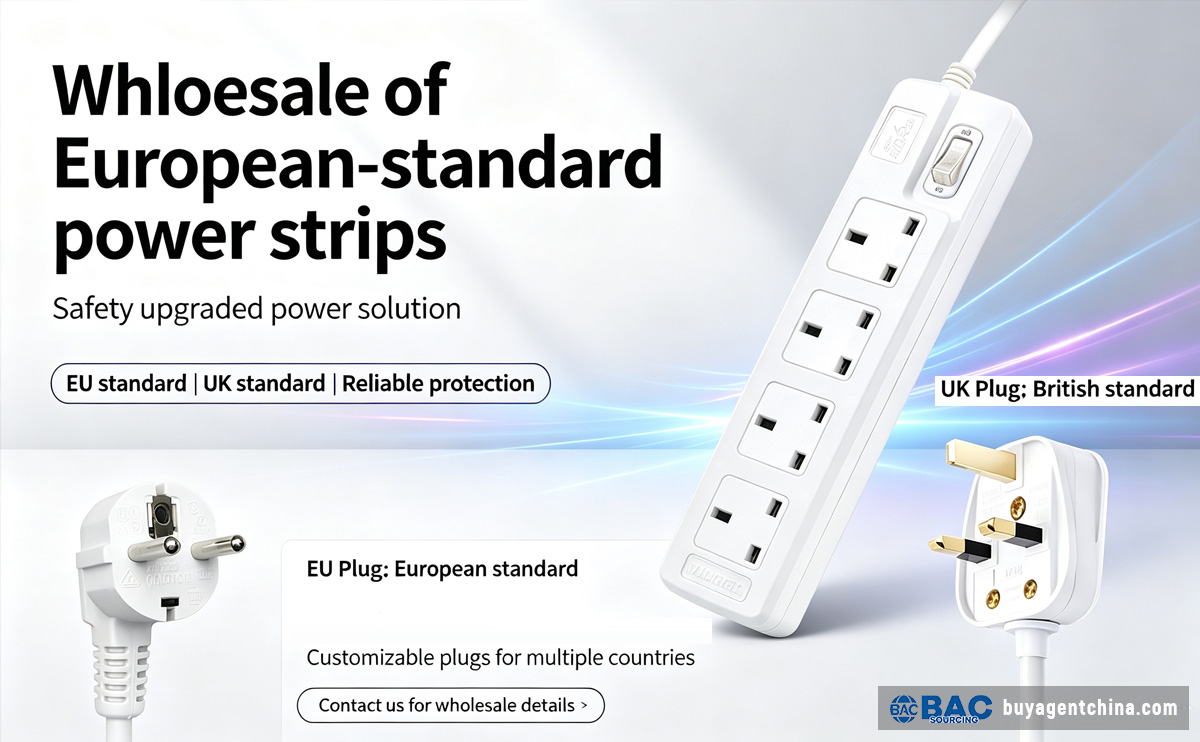
Wholesale source power strips from China 02

Wholesale source power strips from China 02

4. China’s Power Strip Industry Hubs and Product Selection Guide

4.1 Three Core Production Hubs and Their Strengths

China’s power strip manufacturing is geographically concentrated, with each hub specializing in different product segments. Choosing the right region for your needs is the first step to efficient extension cord sourcing from China.

Core RegionKey CitiesCore StrengthsBest For
Zhejiang ProvinceCixi, NingboMost complete supply chain; largest output of basic and safety-enhanced residential models; strong cost-performance ratioMass-market bulk stock, standard residential power strip sourcing
Guangdong ProvinceZhongshan, Foshan, DongguanExport-oriented clusters; fast turnaround; strong capabilities in smart fast-charging and custom productsCross-border premium sellers, mid-to-high end smart models, small-batch fast-turnaround orders
Jiangsu ProvinceSuzhou, Wuxi, ChangzhouAdvanced high-end manufacturing; leading capacity for industrial and engineering-grade power stripsIndustrial procurement, engineering projects, high-end residential built-in solutions

Taken together, these three clusters account for the vast majority of global production capacity, making them the core destinations for anyone looking to source power strips from China directly.

4.2 Main Product Categories and Target Markets

  • Basic power strips: Simple socket extension with no extra safety features. Low price, high cost sensitivity, ideal for price-driven markets and temporary use cases. Competition is fierce and profit margins are thinner.
  • Safety-enhanced power strips: Equipped with overload protection, child safety shutters, and flame-retardant housings. This is the highest-demand mainstream category for global consumer markets, with steady repeat purchase rates.
  • Smart fast-charging power strips: Integrated with USB-C PD fast charging, WiFi remote control, and energy metering. Targets mid-to-high end markets in North America, Europe, and the Middle East, with higher added value and profit margins.
  • Industrial-grade power strips: High ingress protection rating, high current capacity, wide operating temperature range, and interference resistance. For industrial facilities, data centers, and outdoor worksites. Higher entry barriers and stable order volumes.

4.3 Key Materials and Typical Factory Price Ranges

  • Safety material standards: For reliable performance, housings should use UL94 V-0 grade flame-retardant PC plastic, and internal conductive parts should use one-piece solid copper conductors. These are the core benchmarks for safety and durability.
  • Typical ex-factory price ranges: Basic models cost roughly $1.5–$5 per unit; safety-enhanced models $5–$12 per unit; smart fast-charging models $10–$25 per unit. Industrial custom models vary widely based on technical specifications.

5. Tailored Sourcing Plans: Small Trial Orders vs. Large Bulk Orders

5.1 Plan for Small Trial Orders (Hundreds to Thousands of Units Per SKU)

Best for: First-time product testing, new category launches, restocking for small and medium sellers. Common pain points: High factory MOQs, inflated quotes, neglected quality control, high per-unit logistics costs.

Recommended execution plan:

  1. Start with a deep sourcing service to shortlist 4–6 matching original factories, with verified real quotes, production capacity, and qualifications to avoid trader markup.
  2. Have your agent negotiate favorable low-MOQ terms for power strip orders from China on your behalf, coordinate sample production and international shipping, and confirm materials, functions, and appearance before placing a formal small order.
  3. Consolidate orders from multiple suppliers into one shipment to reduce per-unit logistics costs.
  4. Pair your order with a basic management service for production progress tracking, pre-shipment inspection, and logistics/customs documentation support, to ensure small orders are delivered on spec and on time.

5.2 Plan for Large-Scale Long-Term Orders (10,000+ Units Per SKU, Regular Restocking)

Best for: Large importers, chain retailers, and brand owners with ongoing demand. Common pain points: High requirements for supply chain stability, strict cost control, ongoing delivery and quality oversight, and high compliance risks.

Recommended execution plan:

  1. Choose a full-service end-to-end package covering supplier development, price negotiation, sampling, order management, payment escrow, production monitoring, pre-shipment inspection, and door-to-door logistics.
  2. Build a dedicated qualified supplier pool with regular factory audits to ensure supply stability and competitive pricing for bulk power strip orders from China.
  3. Sign up for a long-term membership plan to enjoy discounted service fees, a dedicated account manager, and priority inspection scheduling to further reduce total procurement costs.
  4. Assign on-site follow-up for core orders, with full checks at key production milestones, to keep defect rates at the lowest possible level.

6. Service Models and Pricing of China Sourcing Agents

Reputable third-party China-based electrical product sourcing agents operate on a transparent fee model: they only charge buyers openly stated service fees, never mark up factory prices or accept kickbacks from factories, with full price traceability.

For complete service details and the latest pricing, refer to the official service page:

6.1 One-Time Sourcing and Light Service Packages

  • Entry Sourcing Package ($29 per SKU): Matches 3 pre-vetted suppliers with basic quotes, MOQ details, and lead times within 3–5 business days. Ideal for new buyers doing initial price comparison and market research. The fee can be credited toward future service upgrades.
  • Deep Sourcing Package ($140 per SKU): Screens 4–6 original factories, with workshop video footage, original ex-factory quotes, material specifications, and a full supplier comparison report. No future order binding — you can work directly with the factories afterward.
  • On-Site Factory Visit ($170 per working day): Includes on-site qualification verification, face-to-face negotiation interpretation, and on-site production inspection. Local transportation and dedicated accompaniment are included, with zero factory kickbacks.

6.2 Full-Process Order Management Packages

  • Basic Service (3%–5% of order value): For buyers who already have fixed suppliers. Includes weekly production progress reports, milestone on-site checks, pre-shipment AQL 2.5 inspection, logistics and customs coordination, and after-sales dispute support. Helps you manage your existing supply chain with lower risk.
  • Growth Full-Service Package (5%–8% of order value): End-to-end turnkey solution covering all 8 stages: sourcing, sampling, negotiation, order placement with escrow, production monitoring, AQL 2.5 inspection, logistics coordination, and after-sales support. Full price transparency with access to original factory invoices. Funds are held in escrow and released to the factory only after quality passes inspection.

6.3 Membership Plans for Recurring Sourcing Needs

For buyers with ongoing purchasing needs, monthly/annual membership plans are available, including free sourcing credits, discounted service fees, dedicated account managers, priority scheduling, and supply chain health reports. Ideal for importers and brands with steady restocking demand.

7. Frequently Asked Questions

Q1: What is the typical MOQ for power strips from Chinese factories?
For standard basic power strips, typical factory MOQs range from 1,000 to 2,000 units. For smart and custom models, MOQs usually start at 500–1,000 units. By working with a sourcing agent to consolidate orders or connect with flexible production factories, MOQs can be reduced to as low as a few hundred units to accommodate small trial orders.
Q2: What mandatory certifications do I need to import power strips into my country?
  • European Union: CE certification (LVD + EMC) with RoHS environmental compliance is required.
  • United States: UL 498A safety certification is mandatory for market access.
  • Emerging markets (Southeast Asia, Middle East, Africa): Most require IEC-compliant products, with additional local certifications in some countries (such as SASO for Saudi Arabia, SONCAP for Nigeria).

We recommend confirming the latest regulatory requirements for your target market with your sourcing agent before placing orders, to avoid customs clearance risks.

Q3: Will a sourcing agent mark up factory prices to earn extra profit?

Legitimate third-party sourcing agents earn revenue only from the service fees paid by the buyer. They do not add markup to factory ex-factory prices or accept hidden kickbacks from manufacturers. Trustworthy agents share original factory invoices with buyers for full price transparency, with no hidden margins.

Q4: Is it worth hiring a sourcing agent for small orders of only a few hundred units?

Small orders are actually where sourcing agents deliver the most tangible value. When you place small orders directly with factories, you will often face inflated pricing, slow responses, and neglected quality control. A sourcing agent leverages its industry hub connections and order consolidation power to secure better pricing, ensure factories take small orders seriously, and handle all logistics and customs paperwork. The time and hidden cost savings far outweigh the service fee.

Q5: How is pre-shipment quality inspection carried out?

Standard inspections follow the internationally recognized AQL 2.5 sampling standard. Inspectors visit the factory on-site to verify product appearance, materials, electrical function, packaging markings, and certification documentation, take photos of any defects, and issue a detailed inspection report. Shipment is only arranged after the inspection passes, greatly reducing the risk of receiving defective goods.

Q6: What are typical shipping times from China to major global markets?
  • Sea freight: Around 7–15 days to major Southeast Asian ports, 25–40 days to basic ports in Europe and North America. Best for large-volume, low-cost stock replenishment.
  • Air freight / international express: Around 3–7 days to Southeast Asia, 7–15 days to Europe and North America. Best for small trial orders and urgent restocking.

Your sourcing agent can recommend the optimal logistics solution based on your order volume, timeline, and budget, and handle booking, customs clearance, and door-to-door delivery.

8. Final Thoughts

The cost and product variety advantages of China’s power strip supply chain are undeniable. However, global buyers must overcome multiple barriers — language, culture, quality control, compliance, and logistics — to complete procurement smoothly and efficiently.
Whether you are a first-time buyer testing the market or an established importer looking to import power strips from China long-term and optimize your supply chain efficiency, partnering with a reliable local China sourcing agent lets you avoid most procurement risks and dramatically improve supply chain efficiency, at a very low service cost.

Leave a Reply

Your email address will not be published. Required fields are marked *