Procurement Guides, Sourcing Tips

How to Source the Right Phone Charger Plug from China?

How to Source Phone charger plug from China 02

Source from China with a Reliable Local Sourcing Agent

1. Overview of China’s Phone Charger Industry & Export Landscape

For cross-border e-commerce sellers, digital accessory wholesalers and consumer electronics brands worldwide, phone chargers are a high-demand, fast-turnover category with steady repurchase rates. As the world’s largest producer and exporter of mobile charging devices, China accounts for over 76% of global charger exports. It boasts a complete industrial chain from upstream power chips, transformers and PCB boards to downstream assembly, certification and testing, covering every tier from entry-level white-label slow chargers to high-end GaN fast chargers.
However, sourcing phone chargers from China is not without hurdles for overseas buyers. Language and cultural gaps, mixed supplier tiers, compliance pitfalls, remote quality control gaps and complicated logistics often lead to unexpected losses for first-time importers. Even experienced buyers with years of China sourcing experience frequently struggle with quality inconsistency, delivery delays and difficult after-sales claims when managing suppliers remotely.
This guide breaks down China’s phone charger industrial structure, export market trends and the pros and cons of direct sourcing vs. local agent support, with tailored solutions for different order sizes to help you source efficiently and with minimal risk.

1.1 2024 Key Export Data of China’s Phone Chargers

China’s phone charger exports maintained growth in both volume and value in 2024, driven by ongoing product upgrading toward fast-charging and high-value models.

Table: Core 2024 Export Metrics for China Mobile Phone Chargers

IndicatorValueYoY ChangeNotes
Total export volumeApprox. 1.3–1.9 billion units+9%–19%Varies by statistical calibers
Total export valueApprox. 5.3–9.5 billion USD+12%–19%Covers all charger categories
Average export unit priceApprox. 3.0–4.2 USD per unit+3%–13%Driven by fast charger penetration
US market share23%–28%Generally stableLargest single importing country
EU market share20%–31%Steady growthDriven by USB-C mandate
Southeast Asia share20%–29%~19% growthFastest growing emerging region
USB-C port share74%~29% growthGlobal unified port trend
Fast charger share~60%+Keeps risingGlobal fast charging adoption grows

Market trends show USB-C ports have become the export mainstream. High-value categories such as GaN fast chargers and multi-port chargers are growing much faster than the industry average, and demand in emerging markets is expanding rapidly — these represent the core growth opportunities for importers sourcing from China.

2. Core Pain Points of Sourcing Phone Chargers Directly from China

Whether you are a first-time importer or an experienced buyer, sourcing directly from Chinese factories comes with inherent local barriers, concentrated in six key areas:

2.1 Language and Cultural Barriers That Slow Down Communication

Most sales staff at small and medium factories only have basic English proficiency, which easily leads to misunderstandings on technical details and customization requirements. Differences in business practices and negotiation logic also mean remote communication often requires repeated confirmation, wasting time and raising the risk of specification errors.

2.2 Overcrowded Supplier Layers and High Screening Costs

There are thousands of phone charger suppliers in China, including original manufacturers, trading companies and middlemen layered on top of one another. Overseas buyers can rarely tell real production capacity from marketing claims. Most suppliers found online are traders who mark up prices and may even outsource production to unvetted small workshops after accepting orders, leaving quality completely out of your control.

2.3 Compliance and Certification Risks in Customs Clearance

Phone chargers are a heavily regulated category, with mandatory safety, energy efficiency and environmental certification requirements in every major market. Fake certificates, borrowed certificates and exaggerated power ratings are common industry practices. It is nearly impossible for overseas buyers to verify certificate authenticity remotely. If non-compliant goods are detained at the port of destination, you may face returns, destruction or heavy fines.

2.4 Lack of On-Site Quality Control and Delivery Risks

During mass production, component substitution, skipped testing procedures and delayed delivery are widespread issues. Without on-site supervision, overseas buyers only discover quality problems after the goods arrive — by which point the cost of remediation is extremely high, and you may have to absorb the entire loss.

2.5 Complex Logistics and Hidden Import Costs

From domestic customs declaration and commodity inspection to international shipping and destination clearance, the process involves multiple professional steps such as HS code classification, tariff calculation and document preparation. New importers easily make mistakes that result in port storage fees, supplementary tariff payments and other extra costs. Choosing the wrong logistics channel can also lead to long transit times and cargo damage.

2.6 Weak Bargaining Power for Small Batch Orders

Factories generally prefer large orders of 100,000 units or more. For small trial orders or test SKUs, they often quote higher prices, set high minimum order quantities, or even refuse the order entirely. Without order volume leverage, small and medium buyers struggle to get competitive ex-factory pricing.

3. Direct Sourcing vs. Local China Sourcing Agent: Pros and Cons Comparison

Table: Direct Factory Sourcing vs. Local Sourcing Agent Support

DimensionDirect Sourcing from FactoriesLocal China Sourcing Agent
Supplier screeningLimited channels, hard to distinguish OEMs from traders, time-consumingFull access to factory resources across all clusters, directly match verified original manufacturers, skip middlemen
Cost efficiencyWeak bargaining power for small orders, prone to marked-up trader prices, high hidden risk costsSecure factory-direct prices with bulk order leverage; only charge a fixed service fee; lower total landed cost on average
Quality controlNo on-site monitoring, only inspect after delivery, hard to claim for quality issuesMulti-stage inspection before, during and after production; on-site verification of materials and craftsmanship; resolve issues early
Compliance riskHard to verify certificate authenticity, high risk of customs detention from document errorsFull verification of certification qualifications; professional team handles customs documents; controlled compliance risks
Time & effortHandle all communication, production follow-up and logistics independently, labor-intensiveDedicated contact for the full process; buyers only confirm requirements and results; greatly reduce management workload
Best fit scenarioOnly large enterprises with mature supply chains and local China teamsAll buyers: new importers, small and medium sellers, businesses needing quality and compliance guarantees

For buyers who already have fixed suppliers but struggle with ongoing production supervision and quality control, you can also entrust a local agent with standalone services such as production follow-up, pre-shipment inspection and logistics coordination to fill gaps in your remote supply chain management at very low cost.

How to Source Phone charger plug from China 01

How to Source Phone charger plug from China 01

4. Sourcing Guide: Choose the Right Production Base and Product Specs

China’s phone charger industry has distinct regional characteristics. Different production clusters excel at different product tiers and price points. Choosing the right region and product specification directly determines your market competitiveness and compliance risk.

4.1 Major Production Clusters and Matching Sourcing Scenarios

Table: Comparison of Major Phone Charger Production Clusters in China

ClusterCore CitiesCapacity ShareProduct PositioningCore AdvantagesRepresentative Enterprises
Pearl River DeltaShenzhen~40%High-end fast chargers, branded products, R&DFast tech iteration, complete supply chain, brand clusterAnker, Ugreen, Baseus, Aohai, Huntkey
Pearl River DeltaDongguan~25%Mid-to-high end OEM/ODM, mass productionLow manufacturing cost, flexible capacity, complete supporting facilitiesSalcomp, Lite-On, professional contract manufacturers
Yangtze River DeltaZhejiang (Ningbo/Cixi)~18%Entry-level adapters, foreign trade wholesaleStrong mold & injection capacity, cost-effective, mature export channelsBull Group and numerous export-oriented factories
Yangtze River DeltaJiangsu (Suzhou/Kunshan)~12%Precision manufacturing, international brand OEMHigh automation, strict quality controlLuxshare Precision and others
Other regionsFujian/Jiangxi/Sichuan~5%Entry-level, transferred capacityLow labor costSmall and medium-sized manufacturers

Sourcing recommendations by product tier:

  • For high-end GaN fast chargers, branded custom projects and multi-port chargers, prioritize Shenzhen factories
  • For high-volume OEM orders and cost-effective mid-range fast chargers, prioritize Dongguan manufacturers
  • For basic slow chargers and large low-price wholesale orders, consider Zhejiang cluster factories

4.2 Product Categories and Selection Reference for Global Buyers

Table: Full Overview of Phone Charger Product Categories

CategorySub-typeTypical SpecsMarket PositioningEstimated 2025 Market Share
Port TypeUSB-A5V2A / 9V2ADeclining legacy segment~20%
 Single USB-C20W PD / 65W PDAbsolute mainstream~55%
 Multi-port USB-C65W 2C / 100W 2C1AFast growing segment~25%
Power Level≤15W slow charging5W/10W/12WEntry-level / bundled accessories~22%
 18W–30W fast charging18W/20W/25WGlobal best-selling tier~38%
 33W–65W fast charging45W/55W/65W/67WMainstream mid-range~25%
 80W–120W ultra fast charging80W/100W/120WFlagship Android bundled~12%
 ≥150W extreme charging165W/210WGaming / flagship showcase~3%
TechnologySilicon-based (traditional)Full power rangeMainstream for entry-mid tier~65%
 GaN (Gallium Nitride)Mainly 30W+High-end / high power~35% and growing fast
ProtocolUniversal protocols (PD/QC)PD3.0/PPS/QC4+Global compatibleDominant for export
 Proprietary protocolsSCP/VOOC/SuperCharge etc.Domestic brand bundledDominant for China domestic market

Core principles for export sourcing:

  1. Prioritize USB-C ports to align with global regulations and mainstream devices; avoid USB-A models unless you have specific legacy market demand
  2. Choose universal PD/QC protocols for export compatibility; proprietary protocol products have poor overseas compatibility and higher inventory risk
  3. For mass-market listings, focus on 20W PD entry-level fast chargers; for mid-to-high end product lines, build around 65W GaN multi-port chargers

5. Tailored Sourcing Solutions for Different Order Volumes

Matching the right service model to your order volume delivers the optimal balance of cost and risk.

5.1 Solution for Small Batch Trial Orders (100–5,000 pcs per SKU)

Ideal for: New cross-border sellers, new product testing, small wholesalers Core pain points: High factory MOQ, premium pricing for small orders, sample-to-mass production inconsistency

Recommended approach:

  1. First engage a sourcing agent for deep supplier research, screening 3–6 matching original factories to get real ex-factory prices and capacity details, skipping trader markups
  2. Have the agent coordinate sample delivery and lab testing to confirm power output, certification and build quality before placing a bulk order
  3. For small quantities, the agent can consolidate similar orders across clients to lower MOQ requirements, and provide pre-shipment sampling inspection to ensure mass production matches sample quality

This model only requires a one-time sourcing fee to complete supplier screening and sample validation, making it a low-risk way to test new products or new suppliers.

5.2 Solution for Large Volume & OEM Orders (10,000+ pcs per SKU)

Ideal for: Established e-commerce sellers, brands, large wholesalers, retail chains Core pain points: Strict requirements for capacity stability, high cost optimization potential, tight quality and delivery control needs

Recommended approach:

  1. Entrust the sourcing agent with full end-to-end management, from price negotiation and contract confirmation to order escrow, production progress tracking, milestone inspection and logistics clearance, with a dedicated manager overseeing the whole process
  2. Add on-site factory audit services to verify production capacity, quality systems and compliance credentials in person, securing long-term supply chain stability
  3. Use third-party escrow payment so factories only receive payment after quality inspection passes, maximizing your capital safety

This solution allows lightweight supply chain management — you get stable, controllable sourcing performance without building your own local team in China.

6. Service Modes and Pricing of Professional China Sourcing Agents

Professional China purchasing agents do not own factories or sell products directly. They earn revenue only from standardized service fees, never mark up factory prices, and maintain full price transparency. The mainstream service models fall into three categories: one-time sourcing, order management and long-term membership.

Standard industry service packages include:

  1. Entry Sourcing Plan: Fixed fee per product SKU, delivering 3+ pre-vetted supplier quotes and basic information within 3–5 business days, ideal for initial market research and price comparison.
  2. Deep Sourcing Plan: Fixed fee per product SKU, providing 4–6 detailed factory profiles, workshop videos, original ex-factory prices and comparative analysis. No ongoing contractual obligations — you can contact factories directly afterward.
  3. Factory Visit Service: Daily rate, including on-site interpretation, negotiation support and production line verification, ideal for supplier due diligence before large orders.
  4. Basic Service Plan: Percentage of total order value, for buyers who already have suppliers, including production follow-up, pre-shipment quality inspection and logistics coordination.
  5. Full-Service Growth Plan: Percentage of total order value, covering the entire process from sourcing, sampling, negotiation, order placement, production monitoring, inspection, logistics to after-sales support.
  6. Long-Term Membership Plans: Monthly/annual subscriptions for frequent buyers, including free sourcing credits, discounted service rates and dedicated account management.

For complete service details and the latest pricing, refer to the official service page:

7. Frequently Asked Questions

Q1: What is the typical MOQ for phone chargers when sourcing from China?
For standard off-the-shelf white-label products, the regular minimum order quantity starts at 100–500 units per SKU. Custom logo printing usually requires 1,000–2,000 units per design, while full OEM projects with custom tooling start at 5,000 units and above. Partnering with a China sourcing agent can help lower MOQ thresholds by consolidating orders across multiple small buyers.
Q2: What mandatory certifications do phone chargers need for different global markets?
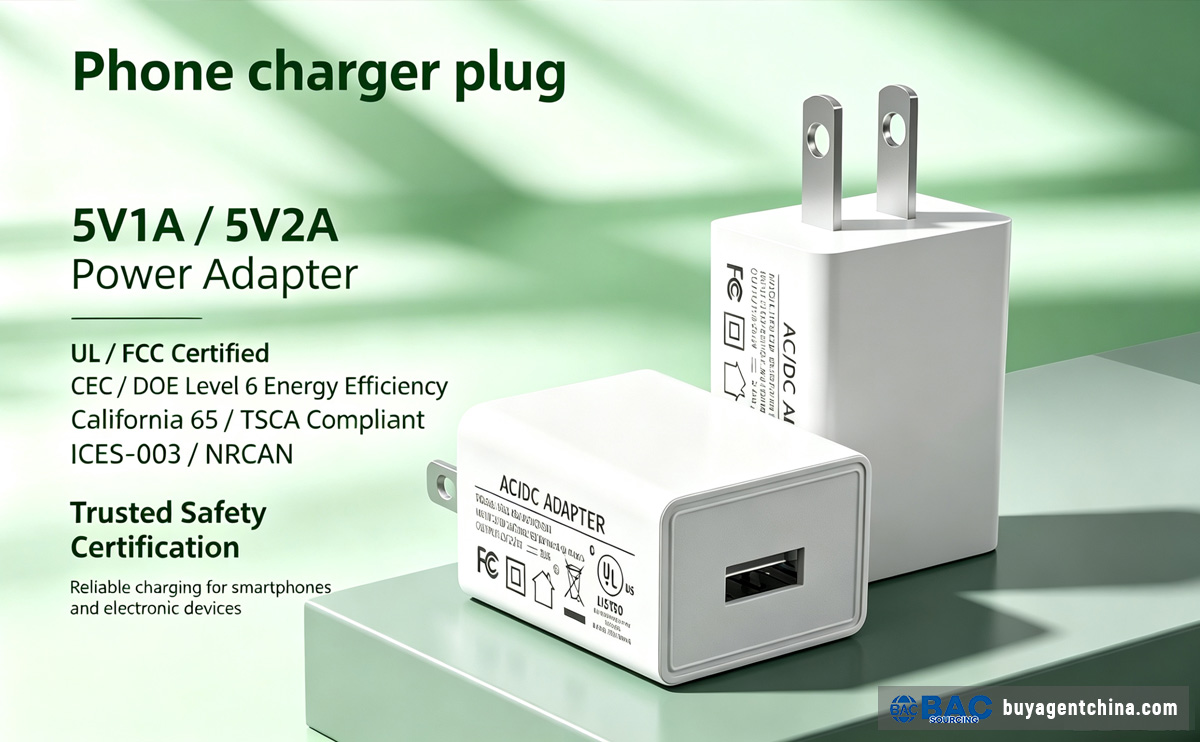
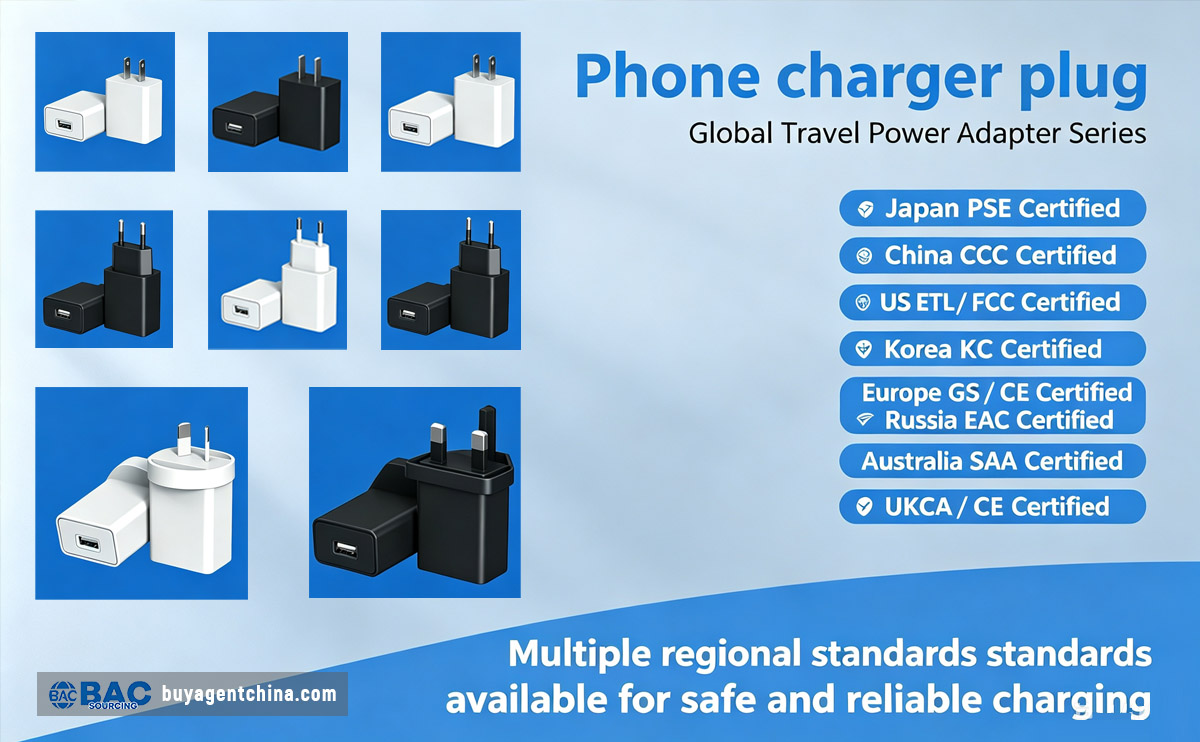
  • EU market: CE safety certification and ERP energy efficiency certification are mandatory, and all charging devices must comply with the official USB-C universal port mandate.
  • US market: Products require FCC EMC certification, UL safety certification, and compliance with the DoE Level VI energy efficiency standard.
  • Southeast Asian markets: Most countries enforce local access standards, such as TISI for Thailand and SNI for Indonesia.

Certification is a critical prerequisite for smooth customs clearance. Always verify the authenticity of certificates to avoid cargo detention caused by fake or misused certification documents.

Q3: Does working with a China sourcing agent cost more than sourcing directly from factories?

No. Reliable China sourcing agents maintain long-term, high-volume partnerships with manufacturers, so they typically secure more competitive ex-factory pricing than individual buyers. They also help importers avoid hidden losses from inflated power ratings, counterfeit certifications and component downgrades. Legitimate sourcing agents only charge a transparent fixed service fee and never add markup to factory prices. For most buyers, the total landed cost is lower when working with a professional agent.

Q4:What are the most common quality pitfalls when importing phone chargers from China, and how can I prevent them?

The most widespread quality issues in the industry include falsified output power, downgraded electronic components, fake certification labels, below-standard energy efficiency and poor port durability.
You can mitigate these risks in three ways: first, have your agent conduct testing on pre-production samples to confirm real performance; second, arrange on-site AQL standard quality inspection before shipment; third, prioritize factories with proven export experience and a track record of serving overseas clients, rather than choosing suppliers based solely on the lowest price.

Q5: What is the typical lead time for phone charger orders from China?

Ready-to-ship standard products usually dispatch within 3–7 days. Small-batch orders with custom logo printing typically take 10–15 days. For large-volume OEM custom orders, the standard production lead time is 20–30 days. Lead times tend to extend during the Q4 peak season due to tight factory capacity. An experienced sourcing agent can help prioritize your production slot and ensure on-time delivery.

Q6: How much more do GaN fast chargers cost compared to traditional silicon-based chargers?

At the same power level, GaN fast chargers cost 30%–80% more than traditional silicon-based chargers, but they are 30%–50% smaller, more energy efficient and more portable, making them a high-margin product category. The 65W GaN charger is currently the most popular specification on the global market, with steadily declining production costs, making it an ideal choice for mid-to-high end product lines in North America and Europe.

8. Final Thoughts

China’s phone charger supply chain offers unmatched product variety, production capacity and cost efficiency, making it the core sourcing base for digital product buyers worldwide. At the same time, information asymmetry, compliance risks and quality control challenges are real barriers for remote importers. Whether you are a first-time importer or an experienced buyer struggling with supply chain management, working with a reliable local China sourcing agent will significantly reduce risk, improve operational efficiency and control your total cost.

Leave a Reply

Your email address will not be published. Required fields are marked *