Procurement Guides, Sourcing Tips

How to Source Suitable Cables from China ?

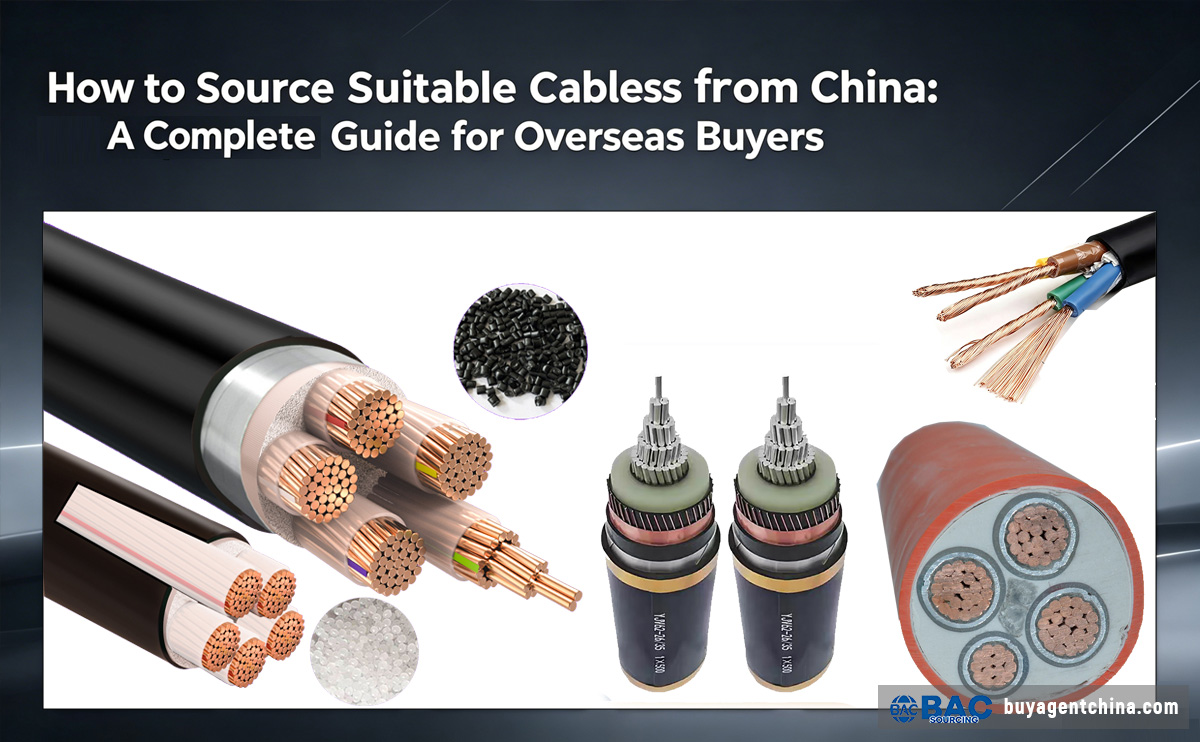
How to Source Suitable Cables from China: A Complete Guide for Overseas Buyers

A Complete Guide for Global Buyers

China stands as the world’s largest producer of wire and cable, accounting for over one-third of global manufacturing capacity. Its product range spans from residential building wires to ultra-high-voltage submarine cables and high-temperature special cables, backed by a fully integrated supply chain and unrivaled cost efficiency. For global engineering contractors, trade importers and industrial brands, sourcing cables from China has become a core strategy to reduce procurement costs and expand product portfolios.
Yet for first-time buyers navigating the Chinese market, or experienced importers plagued by repeated issues like mismatched specifications, missing certifications and customs delays, cross-border cable procurement comes with hidden hurdles. Technical terminology gaps can lead to wrong product specs, remote quality control makes it hard to detect cost-cutting shortcuts, and documentation errors can result in costly port demurrage. What seems like a low-price deal can easily turn into a high-risk expense.

This guide breaks down China’s cable industry landscape, core specification standards, and the most common pitfalls of independent sourcing, with complete comparison tables and practical FAQs. It also explains how local professional support can help you execute low-risk, high-efficiency cable procurement from China.

1. Why Source Cables from China?

Decades of industry development have built a fully self-sufficient Chinese cable supply chain, from copper and aluminum smelting to conductor processing, insulation material production and finished product manufacturing. Its supply chain responsiveness and cost control are unmatched globally. Export data in recent years reflects growing international recognition of Chinese cable products:

Period

Total Export Value

Key Growth Metrics

Market Characteristics

2023

RMB 162.57 billion (approx. USD 23.2 billion)

Record high industry output; trade surplus reached RMB 130.95 billion

2024

Approx. RMB 190 billion

YoY growth of ~14%

Rising share of high-end product exports

H1 2025

RMB 134.09 billion

YoY growth of 25.32%

Growth rate 18 percentage points higher than China’s overall goods export average

2025 Segment Breakdown

/

35–110kV high-voltage cable exports up 90.79%; optical cable exports up 39.54%

Accelerated upgrade toward high-value product structures

Source: General Administration of Customs of China, China Wire & Cable Industry Association

For overseas buyers, the advantages of sourcing wire and cable from China are clear:

1.1 Full product coverage:

Almost every specification — from standard residential wires to special submarine cables, fluoroplastic high-temperature cables and PV/storage cables — can be sourced from domestic suppliers, eliminating the need for multi-region procurement.

1.2 Significant cost savings:

Compliant products of equal specifications are typically 30–50% cheaper than European or North American domestic brands, with even larger savings for bulk orders.

1.3 Strong delivery capacity:

Mature industrial clusters have complete supporting facilities. Standard orders can be delivered in 4–6 weeks, with rush production available for urgent projects.

1.4 Improved certification coverage:

Leading factories hold full sets of international certifications including CE, UL, RoHS and IEC, meeting market access requirements for most countries.

2. Key Cable Specification Tables for Sourcing

Cables are highly customized industrial products. Their specifications directly determine application suitability, regulatory compliance and procurement costs. Before sourcing, define your required parameters and match them to the right Chinese industrial clusters and suppliers.

2.1 Voltage Ratings and Application Scenarios

Voltage rating is the core parameter for power cable sourcing and the area with the most cross-standard differences. Use the table below for initial specification matching:

Voltage Category

Rating Range

Typical Use Cases

Common Model Codes

Low Voltage

≤1kV

Building power distribution, residential wiring, industrial equipment connections

BV, BVR, RVV, YJV 0.6/1kV

Medium Voltage

3kV–35kV

Urban distribution networks, industrial parks, solar/wind power stations

YJV 8.7/15kV, YJV22 26/35kV

High Voltage

66kV–220kV

Regional grid backbones, urban underground transmission corridors

YJLW03 64/110kV, 127/220kV

Ultra-High Voltage

330kV and above

Cross-provincial energy transmission, large-scale power projects

500kV XLPE insulated power cables

By application, the five main cable categories are bare conductors, power cables, electrical equipment wires, communication optical cables and winding wires. The most heavily sourced overseas are medium/low-voltage power cables and residential building wires. PV cables and energy storage cables for renewable energy projects are the fastest-growing segments, driving most of the recent export expansion.

2.2 Major Production Regions and Sourcing Fit

China’s cable industry is concentrated in specialized industrial clusters, each with clear product positioning and competitive strengths. Choosing the right region connects you directly to origin factories, cutting procurement costs and shortening lead times.

Core Production Region

Key Industrial Hubs

Sourcing Advantages

Ideal Procurement Needs

Leading Manufacturers

Jiangsu Province

Guanlin (Yixing), Suzhou, Nantong

Most complete supply chain, leading high-end technology, full international certifications

High-voltage cables, submarine cables, special cables, optical cables

Hengtong Optic-electric, Zhongtian Technology, Shangshang Cable

Anhui Province

Gaogou (Wuwei City)

China’s largest single power cable production base; outstanding price competitiveness

Bulk medium/low-voltage power cables, flame-retardant and fire-resistant cables

Pacific Cable, Hualing Cable, Jianghuai Cable

Guangdong Province

Dongguan, Shenzhen, Foshan

Export-oriented production base; mature foreign trade support; flexible for small mixed orders

Residential building wires, electronic cables, multi-specification small-batch orders

Jinlongyu, Nanyang Cable, Xinxing Cable

Hebei Province

Ningjin County, Baoding

Largest industrial cluster in northern China; highly competitive pricing

Medium/low-voltage power cables, mining rubber cables

Yongjin Cable, Jincheng Cable

Zhejiang Province

Lin’an (Hangzhou), Wenzhou

Co-developed wire and optical cable sectors; high specialization in niche segments

Communication optical cables, EV charging cables, electrical equipment wires

Wanma Co., Futong Group, Orient Cable

Shandong Province

Qingdao, Yanggu

Convenient coastal port access; strong heavy industry supporting capacity

Medium-voltage power cables, offshore engineering cables, mining cables

Hanhe Cable, Yanggu Cable

Sourcing tip: For high-end engineering orders, prioritize Jiangsu-based suppliers for technical and certification maturity. For bulk standard power cables focused on cost efficiency, explore the Wuwei industrial cluster in Anhui. For export-oriented residential wires and mixed small-batch orders, Guangdong factories offer the best delivery flexibility.

2.3 Conductor Material Comparison

Conductors account for over 70% of total cable cost and are the biggest source of quality variance. Define material requirements upfront to avoid substandard substitutions.

Conductor Material

Industry Code

Core Features

Ideal Applications

Sourcing Notes

Pure Copper

T (omitted by default)

Low resistivity, high flexibility, strong oxidation resistance, high reliability

Indoor wiring, precision equipment, control signals, high-end projects

Beware of copper-clad aluminum or recycled copper counterfeits

Pure Aluminum

L

Lightweight, low cost, abundant resource base

Overhead transmission lines, large-section low-voltage busbars

Low mechanical strength; requires specialized joint treatment

Aluminum Alloy

LH

Balanced lightweight and mechanical performance; better creep resistance than pure aluminum

Building power distribution, long-span overhead lines, renewable energy stations

Slightly lower conductivity than pure aluminum; requires professional jointing

Aluminum Conductor Steel Reinforced (ACSR)

JL/G1A

Aluminum for conductivity, steel core for tensile strength; extremely high mechanical strength

High-voltage/ultra-high-voltage overhead transmission lines

No insulation layer; for overhead installation only

2.4 Insulation Material Comparison

Insulation materials determine a cable’s temperature rating, voltage withstand capacity and environmental adaptability. They are also heavily regulated by national environmental and fire safety standards.

Insulation Material

Product Code

Continuous Operating Temp

Core Features

Typical Applications

Polyvinyl Chloride (PVC)

V

70°C / 90°C (heat-resistant grade)

Low cost, easy processing, good flame retardancy, chemical resistance

Residential building wires, general power cables, control cables

Cross-linked Polyethylene (XLPE)

YJ

90°C (up to 250°C under short circuit)

Excellent electrical performance, high current-carrying capacity, chemical corrosion resistance

Medium/high-voltage power cables, submarine cables, renewable energy cables

EPDM / Neoprene Rubber

X / Y

60°C–90°C

Excellent flexibility, bending resistance, tear resistance, weather resistance

Rubber-sheathed cables, mobile equipment connections

Low Smoke Zero Halogen (LSZH) Polyolefin

WDZ

90°C–125°C

Low smoke emission when burned; no toxic halogen gas; environmentally safe

Metro systems, tunnels, high-rise buildings, data centers

Fluoroplastic

F

150°C–250°C

Extreme high-temperature resistance, strong corrosion resistance, excellent dielectric properties

High-temperature environments, aerospace, precision instruments

Mica Tape (Fire-resistant Layer)

NH

950°C–1000°C fire resistance

Maintains power continuity for a defined period during flame exposure

Fire safety systems, emergency lighting circuits

3. 6 Common Pitfalls of Self-Sourcing Cables from China

Despite the clear cost advantages, cross-border cable procurement carries far higher barriers than domestic purchasing. Industry data shows that over 60% of first-time overseas buyers who source cables from China independently encounter issues such as quality non-conformity, missing certifications or customs delays. The most common pain points fall into six categories:

3.1 Language Barriers and Technical Terminology Gaps

The cable industry is dense with specialized terminology, and standard naming conventions vary widely across countries. Sales staff at most small and medium-sized factories only have basic English proficiency. When discussing fine details such as fire resistance ratings, armor structures, certification standards and installation requirements, translation errors are common, often resulting in delivered products that do not match the original specification. Time zone differences further slow down emergency issue resolution and order follow-up.

3.2 Business Culture and Negotiation Norm Differences

Commercial practices at Chinese factories differ notably from Western markets. Verbal commitments carry limited weight — all pricing, delivery dates and service terms require written, stamped confirmation to be enforceable. Some factories attract orders with ultra-low quotes, then cut costs by reducing conductor cross-sections, thinning insulation layers or using recycled raw materials. Payment terms, modification rules and breach compensation also follow different conventions, often putting inexperienced buyers at a disadvantage.

3.3 Standard, Certification and Compliance Risks

Market access standards vary widely by region: the EU applies CE and CPR regulations, North America requires UL certification, and most Southeast Asian markets follow IEC standards. Many small and medium-sized Chinese factories only produce to domestic GB standards and lack experience with international certification processes, or cannot provide valid third-party test reports. Failure to verify qualifications before ordering can result in products being refused entry at the destination port, leading to forced returns or destruction and heavy financial losses.

3.4 Export Documentation and Formalities Errors

Cable export requires a full set of documents including customs declaration, commodity inspection, certificates of origin, free trade agreement certificates and fumigation certificates, with requirements varying by destination country. Buyers who coordinate directly with factories often encounter missing documents, inconsistent information or incorrect HS code classification, causing customs clearance delays, high demurrage and storage fees, and in severe cases, project schedule disruptions.

3.5 Packaging, Shipping and Cargo Damage Risks

Cables are heavy goods — single reels can weigh hundreds of kilograms. Inadequate packaging easily leads to insulation abrasion, reel deformation or water damage during loading, unloading and ocean transport. Inexperienced buyers may also overpay for freight or choose unsuitable shipping methods. Special cable specifications also carry HS code classification risks, where incorrect coding can result in unexpected tariff costs.

3.6 Quality Control and After-Sales Difficulties

Cost-cutting tactics in the cable industry are highly covert: under-sized conductors, copper-clad aluminum passed off as pure copper, and recycled insulation materials are completely undetectable via photos or videos. Remote buyers can only rely on factory-provided samples, with no way to verify bulk production quality. Once defects are discovered after delivery overseas, return shipping costs often exceed the product value, making cross-border after-sales claims practically unfeasible.

4. Why a Local China Sourcing Agent Is the Smarter Choice

For first-time buyers navigating these challenges, or experienced purchasers who consistently face quality, delay and compliance issues, partnering with a professional China-based industrial sourcing agent is the most cost-effective and low-risk strategy. Local agents are embedded in the market, familiar with industry rules and supply chains, and can eliminate most cross-border procurement risks at the source.

4.1 Core Value of a Professional Cable Sourcing Agent

4.1.1 Eliminate communication gaps and translate requirements accurately

Reputable agents employ bilingual teams fluent in cable industry terminology across Chinese, English and major standard systems. They convert your technical requirements into precise production specifications for factories, eliminating translation errors that cause product mismatches. Onshore teams also operate in the same time zone, enabling real-time order tracking and instant emergency response.

4.1.2 Pre-screen suppliers and enforce quality and compliance upfront

Agents match your target market, technical requirements and budget to pre-vetted factories with valid certifications and proven production capacity, filtering out unqualified workshops. They can also conduct mid-production inspections and pre-shipment quality checks, using professional tests such as DC resistance measurement, cross-section verification and material analysis to catch defects before goods leave the factory.

4.1.3 Handle full export formalities and reduce clearance risks

Experienced agents are familiar with customs requirements worldwide. They manage the full export document chain — customs declaration, inspection, certificates of origin, certification paperwork — to ensure document consistency and minimize clearance delays or penalties. They can also assist with free trade agreement tariff applications to reduce total landed costs.

4.1.4 Optimize logistics and reduce transport damage

Long-term partnerships with freight forwarders allow agents to select the optimal sea/air solution based on your order specifications and timeline. They also enforce proper packaging and loading standards to reduce in-transit damage, arrange cargo insurance and provide end-to-end shipment tracking.

4.1.5 One-stop supply chain management for long-term efficiency

You work with a single point of contact for factory selection, price negotiation, order follow-up, inspection, logistics and after-sales support, eliminating the need to coordinate with multiple factories, freight forwarders and customs brokers. Industry data shows that professional sourcing agents help overseas buyers reduce total landed costs by 8–20% while improving on-time delivery rates by over 30%.

4.2 Who Benefits Most From a Sourcing Agent?

First-time cross-border buyers who want to complete their first order with minimal risk and avoid costly trial and error
• Experienced importers who have worked directly with Chinese factories but face recurring quality, delivery and communication issues
• Buyers sourcing multiple product categories from different suppliers who want to reduce management overhead
• Engineering or brand orders with strict quality, certification and delivery requirements where zero defects are required
• Buyers building long-term, stable supply chains in China who need ongoing cost optimization and supplier management

Agencies like BAC Sourcing, which specialize in industrial product sourcing with deep expertise in the wire and cable sector, maintain vetted supplier networks, in-house quality inspection teams and full familiarity with global trade compliance requirements. They deliver end-to-end support from requirement matching and factory selection to order follow-up, inspection and customs clearance, helping buyers build stable, reliable Chinese supply chains at predictable costs.

5. Frequently Asked Questions (FAQ)

Q1: What is the typical MOQ when sourcing cables from China?

For standard medium and low-voltage power cable models, MOQs at large-scale factories generally range from 1,000 to 5,000 meters. Small-gauge residential building wires can have MOQs as low as several hundred meters. Custom specifications or special certification requirements will have higher minimums. Working with a sourcing agent allows you to combine orders with other buyers to lower effective MOQs for smaller batch needs.

Q2: Can Chinese cable manufacturers produce products meeting CE, UL and IEC standards?

Top-tier Chinese cable factories have full international certification capabilities and can produce products compliant with IEC, CE, UL, RoHS and other major standards. However, a large number of small and medium-sized factories only produce to domestic GB standards and lack familiarity with international requirements. Always define certification requirements upfront and select factories with valid, verifiable credentials. Note that “technically equivalent” does not equal certified — most customs and acceptance procedures require formal certification documents.

Q3: Will hiring a China sourcing agent increase my total procurement cost?r sourcing air compressors from China?

In most cases, total costs do not increase — they often decrease. Professional agents charge a reasonable service fee based on order value, but their local market leverage and industry negotiating power secure lower ex-factory pricing. They also eliminate hidden costs from communication errors, quality issues and customs delays. Industry benchmarks show that established agents reduce total landed costs by 8–20%, far outweighing their service fees.

Q4: How long does it take to ship cables from China to Europe and North America?

Ocean freight transit times are approximately 28–35 days to major European ports such as Hamburg and Rotterdam, 14–20 days to US West Coast ports like Los Angeles and Long Beach, and 30–40 days to US East Coast ports. Including production time, domestic customs clearance and destination port processing, total procurement lead time is typically 45–60 days. For engineering projects, it is advisable to plan procurement 2–3 months in advance.

Q5: How can I avoid counterfeit copper cables or under-sized conductors from Chinese suppliers?

The most reliable method is pre-shipment on-site inspection. Factory samples and photos alone cannot verify bulk production quality. Standard practice is to arrange mid-production factory audits and pre-shipment full inspections, using professional tests such as conductor DC resistance measurement, cross-section cutting and overall weight verification to confirm material and specification compliance before goods leave China.

Q6: What core documents are required for customs clearance of cable exports from China?

Standard export documentation includes commercial invoices, packing lists, ocean bills of lading and Certificates of Origin. For destinations eligible for tariff reductions, you will also need corresponding preferential certificates of origin such as Form A, Form E or Form F. Shipments with wooden packaging require fumigation certificates. Some countries also require third-party test reports, product certification documents and label compliance documentation for clearance.

How to Source Power Banks from China 08 Magnetic and Solar Portable Chargers Bulk Sourcing Guide
Sourcing Guide Conclusion

6. Conclusion

Sourcing cables from China offers access to mature manufacturing capacity at significantly lower costs, but information gaps, cultural differences and procedural barriers create real risks for cross-border buyers. Instead of investing extensive time and resources in trial and error, working with a professional local sourcing agent lets you contain risks before shipment and focus on your core market and customers.

As global energy transition and infrastructure upgrading continue to drive demand, China’s wire and cable industry will further expand its technological and capacity advantages. Finding a trusted local partner to build stable procurement channels will be the key for overseas cable importers to build cost advantages and market competitiveness.

Leave a Reply

Your email address will not be published. Required fields are marked *