Procurement Guides, Sourcing Tips

How to Source Excavators from China | Full Buyer’s Guide

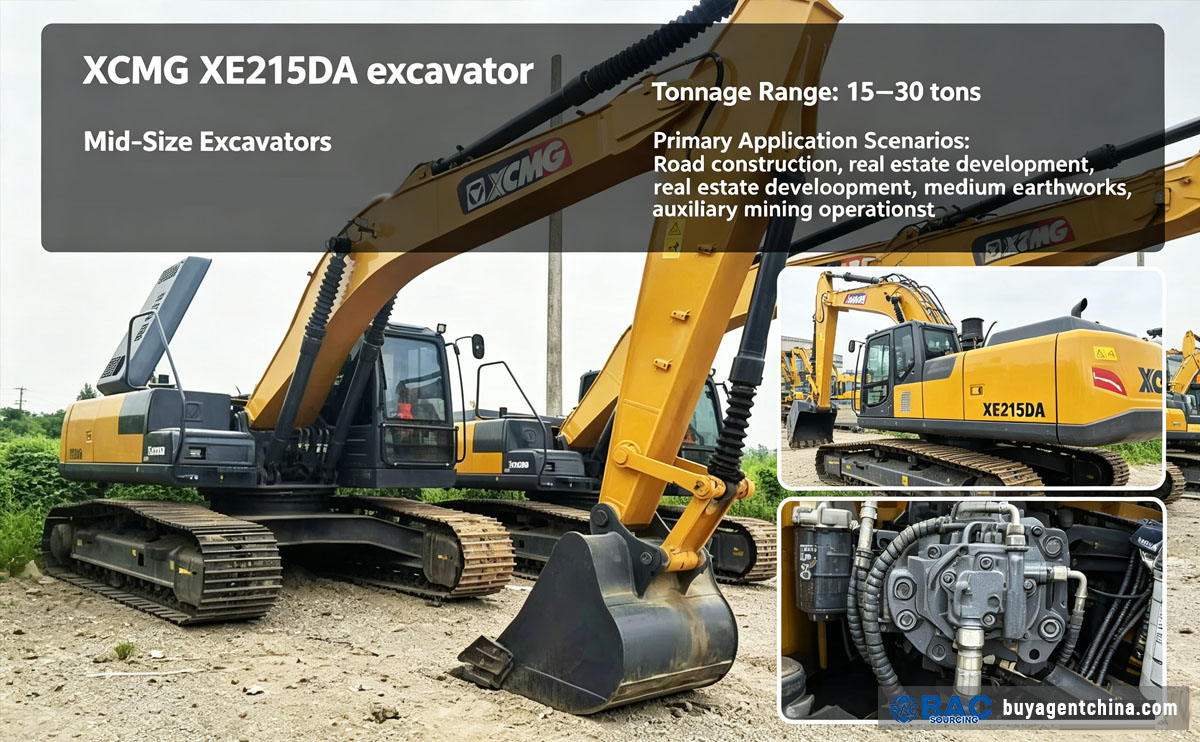
How to Source Excavators from China XCMG XE215DA Excavator 01

A Complete Guide for Global Buyers

1. Overview of China’s Excavator Market: Origins, Categories, Prices and Applications

As the world’s largest manufacturer of construction machinery, China has emerged as the go-to hub for buyers looking to source excavators from China, supported by a fully integrated industrial chain, a full-spectrum product portfolio, and outstanding cost performance. From 1-ton compact mini units to 700-ton mining behemoths, Chinese excavators are shipped to over 210 countries and regions worldwide. According to China’s General Administration of Customs, China exported 316,700 excavators in 2025 with a total value exceeding $10.71 billion, with continuously growing market share across Southeast Asia, Africa, Europe, and Latin America.

For global importers, understanding the domestic industrial layout and product system is the first step to buy excavators from China efficiently.

1.1 Core Industrial Clusters and Leading Domestic Brands

China’s excavator manufacturing sector features a clear cluster-based development pattern, with top-tier China excavator manufacturers operating complete export qualification systems and global after-sales networks.

  • Hunan / Jiangsu Cluster: Headquartered in Hunan with core manufacturing bases in Kunshan, Jiangsu, Sany Heavy Industry and Zoomlion are global industry leaders, with strengths in intelligent models and full-tonnage product lines.
  • Xuzhou, Jiangsu Cluster: Home to XCMG, which operates the world’s largest single-site construction machinery manufacturing base. Its product line covers 1–700 tons, with leading export volume of mining-grade models.
  • Linyi, Shandong Cluster: Represented by SDLG (Volvo Group) and Lingong Heavy Machinery, this cluster focuses on cost-effective small and mid-size models. All product lines are CE-certified and widely recognized in the European market.
  • Liuzhou, Guangxi Cluster: The birthplace of Liugong Group, a core player in earthmoving and mining applications. It has well-established channel and after-sales layouts along the Belt and Road, with high market penetration in Africa and Southeast Asia.

1.2 Full Product Range and Application Scenarios

Chinese excavator suppliers offer products categorized by tonnage, travel system and bucket type, with each segment tailored to specific working scenarios. Different regional markets have distinct hot-selling categories: mini excavators from China dominate North American and European residential projects, while large mining units are in high demand across Africa and Southeast Asia.

CategoryTonnage RangeTypical Chinese ModelsPrimary Application ScenariosKey Operating Features
Mini Excavators1–6 tonsSany SY16C, XCMG XE15U, Sunward SWE18UFMunicipal landscaping, yard renovation, indoor demolition, farm irrigation, pipeline layingCompact size, fits through narrow doorways, zero-tail swing for confined spaces, low fuel consumption
Small Excavators6–15 tonsSany SY60C, XCMG XE75DA, Liugong 906EUrban-rural infrastructure, real estate supporting projects, rural self-built housing, land levelingHigh versatility, flexible site transfer, low hourly operating cost, the mainstream choice for county-level projects
Mid-Size Excavators15–30 tonsSany SY200C, XCMG XE215DA, SDLG E6205FRoad construction, real estate development, medium earthworks, auxiliary mining operationsThe most versatile workhorse in the industry, with the largest installed base, balancing efficiency and flexibility
Large Excavators30–80 tonsSany SY485H, XCMG XE490DK, Liugong 950ELarge-scale infrastructure, open-pit mines, water conservancy hubs, port constructionLarge bucket capacity, high working efficiency, strong heavy-load capacity, suitable for continuous high-intensity operations
Ultra-Large Mining ExcavatorsAbove 80 tonsXCMG XE700D, Sany SY750H, Lingong Heavy Machinery E6700FLarge open-pit coal mines, metal ore mining, giant earthwork projectsPurpose-built mining design, high-strength structural components, daily output of up to tens of thousands of cubic meters per unit

Besides mainstream crawler excavators, special variants including wheeled excavators, long-arm excavators, steel grapples and breaker-equipped models are also available for customization to fit municipal works, scrap recycling, mining and other niche scenarios.

1.3 Reference Price Range for Mainstream Models (2025 FOB Benchmark)

China excavator manufacturers offer clear price tiers, with noticeable price gaps between first-tier and second/third-tier brands. Buyers can select suppliers according to budget and market positioning. Compared with European, American and Japanese brands of the same specification, Chinese models are generally 20%–30% lower in price.

Tonnage ClassPrice Range (RMB, FOB Reference)Notes
Mini (1–3 tons)50,000 – 200,000 RMBEntry-level 1-ton models: 60,000–100,000 RMB; first-tier brands with imported configurations: 120,000–180,000 RMB
Small (6–8 tons)250,000 – 500,000 RMBMainstream 6-ton models: 300,000–400,000 RMB; the most competitive price segment in the market
Mid-Size (20–25 tons)700,000 – 1,200,000 RMBMainstream 20-ton models: 800,000–950,000 RMB; the tonnage with the largest global export volume
Large (30–50 tons)1,500,000 – 3,000,000 RMB49-ton mining-reinforced versions: 2,000,000–2,600,000 RMB; price fluctuates with wear-resistant configurations
Ultra-Large Mining (Above 80 tons)5,000,000 – 15,000,000 RMBHigh degree of customization; standard 70-ton models: 5,000,000–7,000,000 RMB

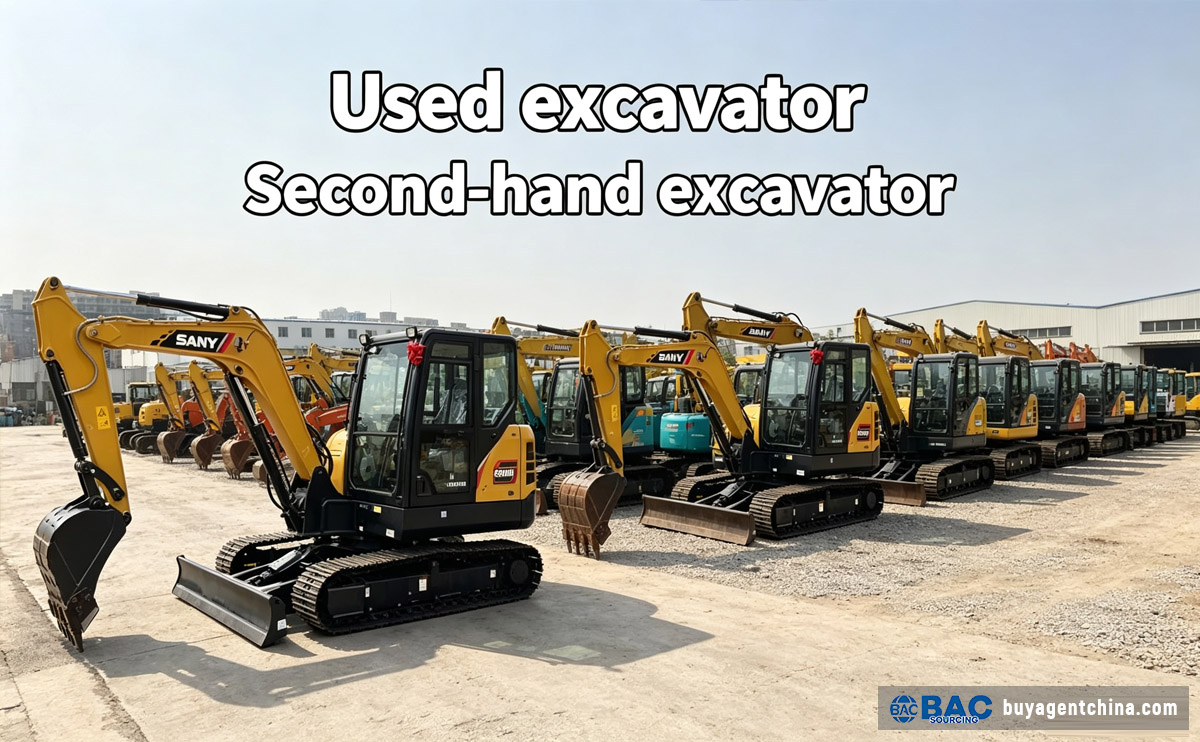
Note: Used excavators cost about 40%–70% of equivalent new units, depending on age, working hours and condition. The above are ex-factory reference prices, excluding international freight, insurance and import duties.

How to Source Excavators from China Used Excavator (Second-hand excavator) 02

How to Source Excavators from China Used Excavator (Second-hand excavator) 02

2. Five Key Challenges of Sourcing Excavators Directly From Chinese Factories

Many overseas buyers are attracted by the price advantage of Chinese excavators, but often encounter far more obstacles than expected in actual operation. For those new to excavator import from China, cost-saving expectations can easily turn into unexpected losses.

2.1 Language and Cultural Communication Barriers

Most small and medium-sized excavator factories have limited foreign trade capabilities, and frontline sales teams vary widely in English proficiency. Communication of professional terms related to hydraulic systems, engine parameters and attachment standards is highly prone to deviation. In addition, differences in business cultures often lead to mismatched expectations on delivery lead times and customization flexibility. Verbal promises on delivery windows and warranty terms are hard to enforce, resulting in extremely high communication costs.

2.2 Complex Import and Export Compliance Procedures

As large engineering equipment, excavators involve multiple regulatory requirements for import and export:

  • Export side: Commodity inspection, Certificate of Origin and export customs declaration are required; some special models need additional regulatory certificates.
  • Import side: Different countries have different access certifications (CE for the EU, EPA for the US, EAC for Russia, etc.). Incorrect HS code classification can lead to high tariffs or even cargo detention.
  • Foreign exchange settlement: Foreign exchange controls, letter of credit operations and payment milestone control carry high risks for new buyers.

Without a professional team handling documentation, incomplete paperwork and customs clearance failures are common, generating costly port demurrage and penalty fees.

2.3 High Barriers for Oversized Cargo Logistics

Excavators are overweight and oversized cargo, with a far more complicated transportation process than ordinary goods:

  • Inland transportation: Special flatbed trucks are required for transport from factory to port; some ultra-large models need to be disassembled for split shipment.
  • International sea freight: Ro-ro ships, bulk carriers or special open-top containers are required, with strict standards for lifting, reinforcement and marine insurance.
  • Destination port delivery: Customs clearance, inland transfer and unloading at the destination require coordination of multiple resources.

Inexperienced buyers often incur far higher logistics costs than budgeted, or even suffer equipment damage during transit when sourcing excavators from China independently.

2.4 Difficulties in On-Site Quality Control and Inspection

One of the biggest risks of cross-border procurement is receiving products that do not match the agreed specification.

  • Production stage: Buyers cannot track production progress in real time, and have no way to verify whether the factory purchases core components according to the agreed configuration or follows process standards for welding and painting.
  • Pre-shipment stage: Without on-site inspection by professional personnel, appearance defects, configuration downgrades and performance failures can only be discovered after the goods arrive at the port. By that time, returns and exchanges are almost impossible, and dispute resolution costs are extremely high.

2.5 Limited After-Sales Support and Cross-Border Dispute Resolution

Excavators are high-value production assets, and subsequent spare parts supply and fault maintenance directly affect project revenue. When purchasing directly from factories, cross-border communication is extremely inefficient in case of quality problems, and original spare parts have long delivery cycles and high costs. In case of batch quality disputes, cross-border litigation is hardly feasible, and buyers usually have to bear losses on their own.

3. Direct Factory Sourcing vs. Local Chinese Sourcing Agent: Pros and Cons Comparison

To address the above pain points, overseas buyers have two core paths to buy excavators from China: sourcing directly from factories, or entrusting a professional local Chinese sourcing agent to handle the whole process. The pros and cons of the two modes are compared as follows:

Comparison DimensionDirect Factory SourcingLocal Chinese Sourcing Agent
Communication EfficiencyMultiple barriers in language, time zone and technical terms; high deviation rate in specification deliveryBilingual local team for accurate transmission of technical requirements and real-time feedback
Compliance RiskSelf-handled customs declaration, certification and clearance with high error rate and extra costsFamiliar with access rules of various countries and full import/export procedures; full-process compliance control
Quality ControlNo on-site inspection; quality depends entirely on factory self-discipline; difficult post-delivery recourseOn-site factory audits, production supervision and pre-shipment AQL standard inspection available
Comprehensive CostNo service fee in theory, but prone to hidden costs such as logistics premiums and configuration downgradesTransparent service fees; secures lower factory prices via scale advantages and avoids hidden losses
Time & Energy InputRequires significant time screening suppliers and following up all process milestonesFull-process order management; buyers only confirm key milestones, saving over 80% of time and energy
After-Sales GuaranteeLimited cross-border after-sales support; extremely high dispute resolution costsLocal team assists with quality disputes and spare parts procurement; faster after-sales response
Suitable ForLarge enterprises with mature China procurement teams and years of industry experienceFirst-time buyers, small-batch trial orders, and long-term purchasers seeking reliable quality control

4. Customized Sourcing Solutions for Different Order Volumes

Excavator procurement demands vary greatly, from single-unit trial sales to bulk long-term purchasing, each requiring a different optimal solution for excavator import from China.

4.1 Small-Batch Trial Orders (1–5 Units)

This solution is suitable for first-time construction machinery buyers and small engineering contractors, with core demands of low trial-and-error cost and reliable delivery.

  • Recommended solution: First clarify the required tonnage, configuration and destination country certification requirements. Partner with an excavator sourcing agent in China to complete in-depth supplier screening, obtaining real quotations and configuration comparisons from 3–6 compliant factories. After confirming cooperation, entrust the agent to arrange pre-shipment quality inspection and coordinate the full logistics and customs clearance process.
  • Solution advantages: No need to contact dozens of factories independently; the agent controls factory qualification and product quality. With low trial cost per unit, supplier matching can be completed in 3–5 working days.

4.2 Large-Volume Long-Term Procurement (10+ Units / Annual Distribution / Large Projects)

This solution is suitable for construction machinery distributors and large infrastructure contractors, with core demands of stable supply chain, price advantage and controllable quality.

  • Recommended solution: First complete multi-dimensional factory due diligence and on-site audits via the sourcing agent to verify production capacity, quality control systems and export qualifications. Negotiate exclusive purchasing prices, delivery lead times and warranty terms. Arrange milestone-based production supervision and full pre-shipment inspection. Establish long-term supply chain cooperation with split shipments and unified logistics arrangement.
  • Solution advantages: Secures factory-level direct supply prices, full traceable quality control, and high supply chain stability, ideal for buyers building long-term local market presence.

5. Why Partner With a Local Chinese Sourcing Agent for Excavator Procurement?

For the vast majority of overseas buyers, entrusting a reliable local Chinese sourcing agent is the optimal solution balancing cost, efficiency and risk when sourcing excavators from China.

Buy Agent China (BAC SOURCING) is a professional sourcing service provider focused on China’s supply chain. We do not own any factories or earn product price margins — we only charge transparent service fees and always stand on the buyer’s side to control the whole process.

We provide one-stop services from supplier screening, price negotiation, sample confirmation, order management, production supervision and quality inspection to logistics and customs clearance, solving all problems of language barriers, geographic inconvenience, regulatory complexity and quality control difficulties:

  • Precise matching: Screen compliant factories matching your tonnage, configuration and certification requirements, share original factory quotations with full price transparency.
  • Price negotiation: Leverage local resources and industry experience to help you secure better prices, lower MOQs and more flexible payment terms.
  • Quality assurance: Production milestone follow-up and pre-shipment AQL 2.5 standard inspection with detailed reports and defect photos; non-conforming goods are not shipped.
  • Full logistics support: Coordinate inland transport, sea freight booking, customs declaration and clearance, track logistics status throughout the journey, and avoid oversized cargo transportation risks.
  • After-sales support: Assist with quality dispute resolution and original spare parts procurement, greatly reducing cross-border after-sales communication and time costs.

For our full service modes and detailed pricing, please refer to the official service page:

6. Frequently Asked Questions (FAQ)

Q1: What is the typical MOQ for excavators from China? Can I order just one unit?
The vast majority of Chinese excavator suppliers accept single-unit orders, especially for mini and small excavators — one unit is enough for production and shipment. Most factories also support single-unit customization for medium and large models, though lead times may be slightly longer. For small-batch trial orders, a sourcing agent can help negotiate lower MOQs and more flexible payment terms to reduce the threshold for first-time purchases.
Q2: What certifications are required for smooth customs clearance when importing excavators from China?

Access requirements vary by country: the EU market requires CE certification, the US requires EPA emission certification, Russia and the EAEU require EAC certification, and most Southeast Asian countries require a Certificate of Origin and commodity inspection certificate. Be sure to confirm your destination country’s access standards before purchasing. A professional sourcing agent can help you filter factories with corresponding certifications and prepare full sets of customs documents in advance to avoid clearance delays.

Q3: How long does it take to ship an excavator from China to Southeast Asia / Europe / Africa?

Sea freight lead times vary by destination: about 7–15 days to Southeast Asian countries, 30–40 days to major European base ports, 20–30 days to East Africa and 35–45 days to West Africa, and 20–25 days to the West Coast of the Americas. Including factory production, inland transportation, customs declaration and clearance, the total cycle is usually 45–90 days, depending on model customization and shipping schedules.

Q4: How can I ensure the received excavator matches the factory’s stated configuration?

The most reliable method is to arrange on-site pre-shipment inspection: professional quality inspectors check core components including engines, hydraulic systems and structural parts one by one against the agreed configuration list, test basic performance, and issue a detailed inspection report. An excavator sourcing agent in China can provide local inspection services to identify all issues before the goods leave the factory, avoiding configuration discrepancies discovered only after arrival.

Q5: How does a sourcing agent charge? Will they mark up factory prices?

Formal sourcing agents only charge transparent service fees and never add margins on top of factory ex-factory prices. For example, BAC offers both per-project supplier screening services and full-process order management services charged as a percentage of order value. Different order scales can match different packages, and all original factory quotations are shared with buyers for full price transparency. For specific pricing standards, please refer to the official service page.

Q6: How is cross-border after-sales handled if quality issues occur with the excavator?

If quality problems occur within the warranty period, the sourcing agent can assist you in negotiating claim solutions with the factory, including replacement spare parts, remote technical guidance, and on-site service by factory technicians if necessary. For non-warranty issues, the agent can also assist in purchasing original parts and cost-effective alternatives, greatly reducing cross-border after-sales communication and logistics costs.

7. Final Thoughts

China’s excavator market boasts the world’s most complete product matrix and outstanding cost-performance advantages, but cross-border procurement is never as simple as comparing prices and placing orders. From supplier screening to final delivery, every link of communication, compliance, quality control and logistics hides potential risks.

Whether you are a first-time buyer looking to buy excavators from China, or an experienced purchaser troubled by local operational hurdles, partnering with a professional local Chinese sourcing agent can significantly reduce risks, save energy, and help you obtain equipment that meets your expectations at a controllable cost.

Leave a Reply

Your email address will not be published. Required fields are marked *