Factory Verification, Procurement Guides, Sourcing Tips

How to Buy RC GPS Net-Pulling Bait Boats from China: 8 Mistakes

12V GPS drop-through bait boat on a sunset lake, with bait hopper and positioning antenna

China supplies most of the world’s RC carp bait boats; FOB prices run US$40–185 by tier, and these eight mistakes cover range, GPS, battery, hull, net hardware, compliance and checks.

1. The GPS Net-Pulling Bait Boat Supply Map in China

A bait boat is a small radio-controlled craft that carries bait, a hook, or even a fishing net from the bank out to a distant swim. A full GPS net-pulling bait boat carries a receiver antenna and night lights at the bow, an opening bait hopper in the middle, and a solenoid release hook at the stern for rigging hooks or towing a net. Twin motors and three-blade propellers drive it underwater, while a GPS/compass module on deck handles waypoints, constant-speed cruise and one-key return. Overseas buyers sort these boats into three families: plain bait-delivery boats, GPS-positioned return boats, and high-speed 12V net-towing boats with optional sonar.

On the supply side, this product is neither a plain plastic toy nor a conventional marine vessel. It is an electromechanical assembly of an injection-molded hull, an electronic control board, a traction battery and propulsion modules. Because those four parts come from different sources, the listing numbers that drift most are exactly the four you would expect: control range, positioning, runtime and load.

1.1 The Components That Decide a Bait Boat's Grade

ComponentFunction it drivesWhat to verify when sourcing
RC receiver module and antennaReal control distance, interference resistanceRadio band, antenna placement, signal-loss behavior
GPS/Beidou module and compassWaypoints, one-key return, drift correctionModule actually soldered to the board; number of saved points
Traction battery packRuntime, low-speed torque, navigation lightsCell grade/brand, rated mAh, protection board
Twin motors and propellersThrust, net towing, chop resistanceMotor voltage, propeller count and diameter, weed guard
Bait hopper and release solenoidBait delivery, hook release, net dropHopper hinge, solenoid pull force, release-point placement
ABS hull and sealsBuoyancy, waterproofing, service lifeWall thickness, stern sealing, assembly seam treatment

1.2 The 2026 Bait Boat Price Tier at a Glance

Domestic 1688 quotes run from roughly CNY 100 to CNY 1,460 per boat. Export quotes on Alibaba and Made-in-China land in a FOB band of about US$40–185 by tier, and a premium sonar sample can quote near US$265. The full ladder sits in Section 6. For now, hold one line: the spread in this category is not the hull’s spread. It is the spread in the electronics and battery above.

2. Mistakes 1–2 in Bait Boat Range and GPS Return Claims

2.1 Bait Boat RC Range versus Real-Water Control Distance

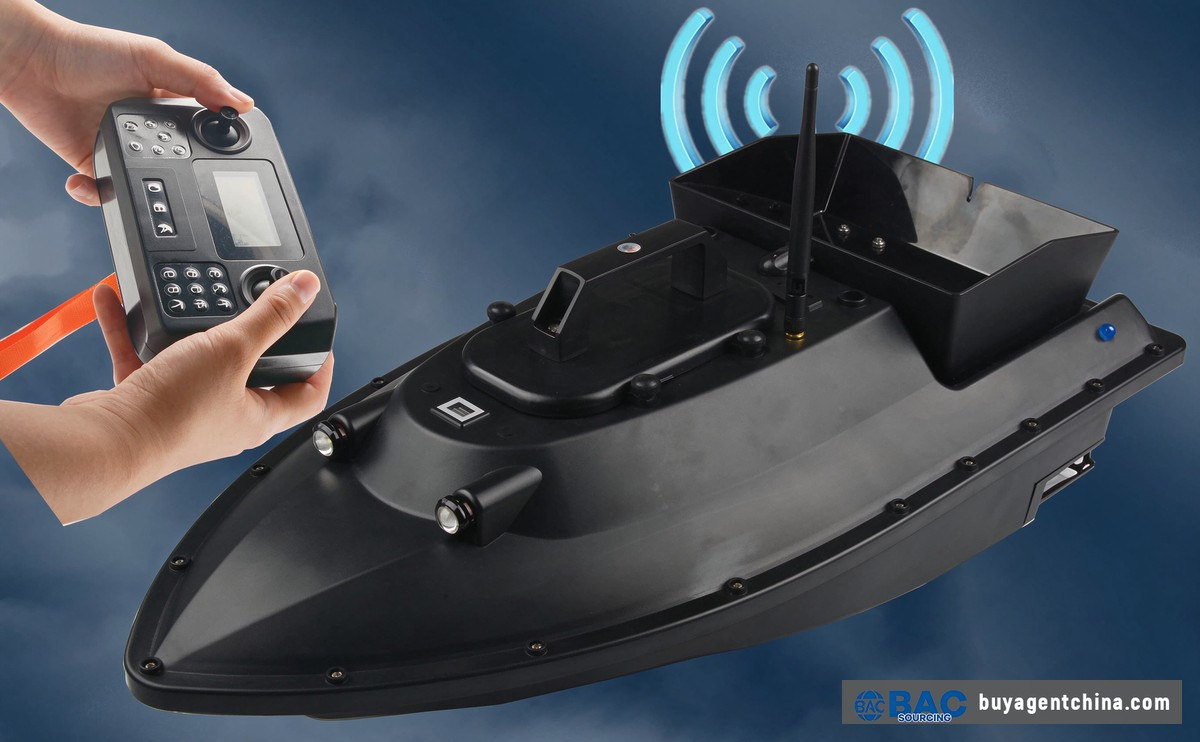
Hands holding the transmitter while steering a black bait boat, with signal waves shown beside the hull

Hands holding the transmitter while steering a black bait boat, with signal waves shown beside the hull

Mistake 1. Treating a listed 500 m or 800 m control distance as the distance your buyer gets on the lake.

Range figures are straight-line measurements taken in open, interference-free conditions, antenna upright, battery full. On real water, bank trees, sheds, metal fishing gear, other 2.4 GHz devices and the boat’s own battery sag all eat into that signal. A boat rated at 500 m will often hold half that distance on a tree-lined river; even an 800 m premium model depends on the quality of its transmitter antenna and receiver module.

When you inquire, ask three things directly: which receiver module is used, whether the antenna sits on the hull or the transmitter, and what the boat does when the signal drops — hold position, crawl back, or auto-return. Write both “open-water rated distance” and “measured practical distance” into the spec sheet. Do not leave one lone 500 m number standing as the promise.

2.2 Bait Boat "GPS Auto-Return" With No GPS Module Aboard

Mistake 2. Paying for a GPS return when the boat only drifts back on a gyroscope.

A genuine GPS return needs a GPS/Beidou module and a compass on board to record the starting coordinate and sail back to it after signal loss; higher models save 40, 99 or even 100 swims. On cheap boats, the advertised “auto return” often just drives a steady straight line back on a gyroscope. Wind drift takes it off course, and it never reaches the start. If there is no positioning module on the board, the map on screen is decoration.

Verify it this way: ask for a close-up of the main board showing the positioning chip. Request written specs for saved points, return accuracy and the signal-loss protection logic. On the sample, mark a start point from the bank, run out to open water, trigger return, and see whether it comes back near that mark. A listing photo will never show you this.

3. Mistakes 3–4 in Bait Boat Battery Runtime and Thrust Ratings

3.1 Bait Boat Battery Capacity and "Two-Hour" Runtime Inflation

Dual-hopper bait boat against a blue water backdrop

Dual-hopper bait boat against a blue water backdrop

Mistake 3. Taking a “2 h+” runtime and a large mAh figure at face value.

The battery is the single most common overstated part of this category. Like any other rechargeable electronic product, a low-price boat may pack recovered cells assembled in groups, advertising 2,000–3,000 mAh while holding half that capacity. The battery compartment looks generous, but a thinned protection board sags quickly in cold weather or under heavy load. Runtime also depends on water conditions, payload, wind and light use; it is not a static number.

Put cell grade (brand cells or A-grade equivalent), minimum capacity, battery voltage (commonly 12V) and whether two packs are included into the contract. At inspection, charge several units fully and run them until the low-battery alarm trips, recording actual sailing time rather than trusting the cell wrapper. Battery shipments also need UN38.3 and MSDS on file, or air freight and LCL booking will both be blocked.

3.2 Bait Boat Motor Thrust and Load Rating the Hopper Never Sees

Mistake 4. Matching a rated load to net-towing without checking what the motors can actually push.

Load claims split into two ideas: how much ballast the hull can carry in flat water, and how much load the motors can actually drive on the surface. Twin three-blade motors can nominally push a 2–3 kg bait load in still water without much trouble. Towing a hundred-meter net adds drag from the mesh, weeds and wind. A high-speed model quoting roughly 3,000 g of pulling force runs motors, propellers and a stern attachment at a different grade from a plain bait boat.

Orange 12V high-speed GPS net-towing bait boat at speed, 3 kg hopper and 65 cm hull

Orange 12V high-speed GPS net-towing bait boat at speed, 3 kg hopper and 65 cm hull

Clarify motor power/voltage, propeller count and diameter, rated hopper capacity, and the designed pull of the towing hook. Ask the supplier to recommend thrust for your target water — still lake versus choppy reservoir. The load number must sit on the same line as hull displacement and battery runtime, not stand alone as a selling point.

4. Mistakes 5–6 in Bait Boat Hull Sealing and Net-Towing Hardware

4.1 Bait Boat ABS Hull Wall Thickness and Transom Sealing

Mistake 5. Judging the hull by a smooth product photo, without checking wall thickness and stern seams.

A bait boat lives in water, and most failures happen at the edges: the motor cable gland at the stern, the hopper hinge, and the upper lid seal. If those are finished poorly, water seeps in after a season or two. ABS mixed with regrind turns brittle and leaves rough mold lines; one knock cracks the shell. Listing photos show neither wall thickness nor how evenly the sealant is laid.

During a factory visit or sample review, look for a clean mold line, waterproof sealing at the stern cable entries, a continuous lid gasket, and no play in the hopper hinge. Run a shallow soak and tilt check on the sample, and watch whether the electronics compartment draws water.

4.2 Bait Boat Net-Release Solenoid and Towing Attachment Hardware

Black bait boat towing a fishing net on the lake, with the stern solenoid release hook

Black bait boat towing a fishing net on the lake, with the stern solenoid release hook

Mistake 6. Using a plain bait boat’s release hook to tow a 200 m net.

The net function rides on the stern solenoid: at the chosen spot it energizes and drops the net or hook, then the boat returns. If the solenoid pull, hook steel and latch travel were designed only for a bait clip, towing can jam the release or bend the fitting. The orange float ball in photos is net marker gear, not part of the boat; what you actually verify is the stern bracket and solenoid itself.

For a net-towing model, write net length, net weight and whether trace hooks are included into the requirement. Ask for material and pull-force documentation on the hardware, and run one full drop-release-return cycle on the sample. A plain delivery boat and a net-towing boat are two different stern configurations. Do not assume one hull handles both.

5. Bait Boat Factory Clusters and Supplier Verification

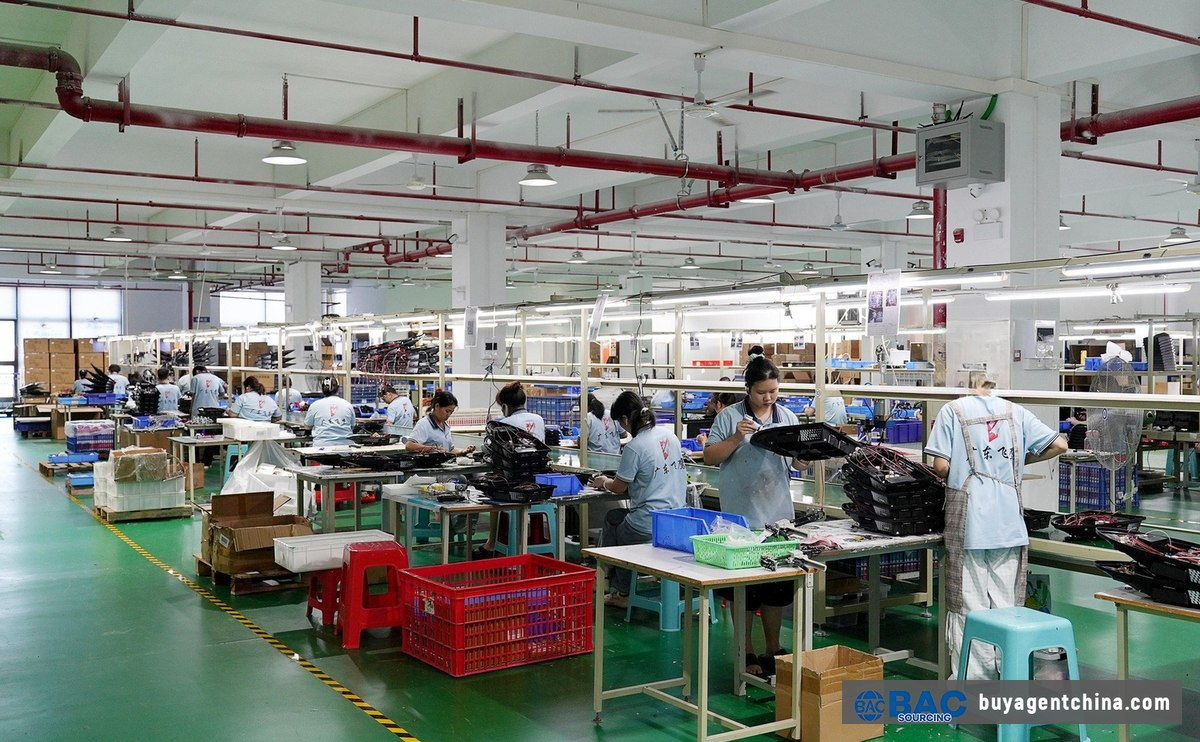
Bait boat assembly workshop, with workers building hulls and electronics at production benches

Bait boat assembly workshop, with workers building hulls and electronics at production benches

Mistake 7. Taking a “factory” that is actually a trader, where the sample is hand-picked and the bulk comes from another line.

The bait boat supply chain concentrates in two clearly different clusters, plus a layer of coastal traders. Telling a factory from a middleman cannot rest on workshop photos in an album alone: ask for workshop video, line stations, component storage and assembly progress, and clarify whether the hull is molded in-house or sourced, and whether the board is a custom design or a public mold.

5.1 Weihai, Shandong: the Carp Bait Boat Tackle Cluster

Weihai is an established Chinese fishing-gear export cluster, with bait boats, rods and reels built around the same supply base. It leans toward traditional carp-fishing models: single or double hoppers, GPS waypoints and auto return, with finishes tuned for the European carp market. Many suppliers moved over from yacht and outdoor-product companies, so the supporting supply chain is mature and stock models are stable. This cluster suits steady stock purchases and OEM exterior customization.

5.2 Shantou, Guangdong: RC Bait Boat Electronics and 12V Builders

The Chenghai area of Shantou is an RC toy and electronics assembly cluster with fast design iteration. It specializes in high-speed 12V twin-motor boats, sonar integration and large-screen transmitters, across a wide price band, often built for cross-border listings. Public-mold electronics are common, so differentiation has to come from the shell, hopper structure and accessory set. During verification here, focus on board sourcing, aging test racks, and whether the QC bench is actually in use.

RegionPositioningStrengthsBest-fit modelsVerification focus
Weihai, ShandongTackle/yacht supplyCarp styling, mature supply, stable stockGPS waypoint return, double-hopper modelsAssembly line, hull source, export order record
Shantou, GuangdongRC electronics/toy assemblyHigh-speed motors, sonar integration, fast iteration12V high-speed net boats, sonar modelsBoard design, aging rack, QC bench, cell grade
Qingdao / Shandong coastExport trade and leisure craftClean paperwork, flexible LCL mixingMixed containers, small test batchesFactory versus trader, original quote
Assembly benches along a bait boat production line, hulls stacked at each workstation

Assembly benches along a bait boat production line, hulls stacked at each workstation

Whether the workshop floor is clean and materials are zoned tells you how the line is managed; for electronics, check static protection and whether the QC station is really used. I trust audit reports, but I trust my own ten minutes in the workshop more.

6. Bait Boat Price Ladder by Model Tier

Showroom shelving displaying bait boats and transmitters in multiple colors and models

Showroom shelving displaying bait boats and transmitters in multiple colors and models

The table below organizes public quotes from 1688, Alibaba and Made-in-China, captured in November 2026, as FOB reference bands. Final pricing follows the spec sheet, order volume and accessory set; domestic CNY prices are shown for comparison only.

TierTypical configurationFOB reference bandMOQ referenceMain market
Entry stock delivery boatSingle hopper, twin motor, no GPS, basic night lightUS$40–56 (1688 CNY 102–340)1–10 pcsEntry anglers, cross-border white label
GPS waypoint return boatGPS/compass, saved swims, auto return, double hopperUS$59–108 (1688 CNY 405–600)1–20 pcsEuropean carp market, mid-tackle shops
12V high-speed net boatTwin high-speed motors, 3 kg hopper, 65 cm hull, solenoid net dropUS$110–185 (1688 CNY 774–980)20–200 pcsReservoir/coast net towing, serious anglers
Sonar flagship800 m control, sonar probe, large-screen remote, multi-point positioningUS$175–265 (sample)1–10 pcsPremium retail, professional channels
OEM/ODM custom modelShell color, hopper structure, branded packaging, manualQuoted per project, no flat rateUsually from 500 pcsBrands, tackle chains

Cheap is not a sin; chasing cheap is. An entry boat at US$40 has its own cost structure, but if you ask a US$40 boat for the thrust and runtime of a US$185 high-speed net boat, that gap comes back as returns and bad reviews. On this ladder, watch the battery, motors and positioning module — not the hull color.

7. Bait Boat Compliance, Certification and HS Classification

7.1 Bait Boat CE/FCC, Battery UN38.3/MSDS and Listed Marks

Mistake 8 (first half). Checking the feature demo but never asking for certification and battery shipping paperwork.

A product with an electronic board and rechargeable battery should consider CE for the EU (including relevant LVD/EMC requirements), and FCC compliance is common for the US market. The battery pack needs a UN38.3 test summary and MSDS; without them air freight refuses the goods and LCL booking turns down the shipment. A CE logo printed on the listing does not equal a test report. Ask for the certificate number, the matched model and the test body, and verify it yourself when the order matters. The 2.4 GHz transmitter also carries radio-frequency rules, which differ by market.

7.2 Bait Boat HS Classification: 9503 Model versus 8903 Vessel

Clean electronics assembly room, with SMT and test equipment beside a working technician

Clean electronics assembly room, with SMT and test equipment beside a working technician

Small RC bait boats sit between two tariff routes, and the classification should be pre-ruled by your customs broker before booking freight:

Possible headingWhen it appliesWatch-outs
HS 9503.00 toys/models and partsSmall boat declared as an RC recreational modelUS HTS 9503.00.00; parts classify with the whole unit
HS 8903.99 yachts/other sports vesselsDeclared as a functional small electric craftChapter 89 splits by length and power; different routes mean different duty and oversight

Classification follows the finished product’s function, size and use — not the listing photo. Battery models also carry lithium-battery shipping rules, and the HS code on the commercial invoice, packing list and customs entry must match. A wrong heading can leave a whole container sitting at the dock while your margin drains.

8. Direct Bait Boat Sourcing vs a China Procurement Agent

DimensionDirect factory/trader contactWorking with a China procurement agent such as Buy Agent China
Supplier developmentYou screen and qualify factories on 1688/AlibabaAgent matches candidates against the spec sheet, with workshop video and original quotes
Language and technical negotiationTranslation can distort specs; you verify line by lineAgent writes range, battery, thrust and hardware into one spec sheet
Production follow-up and inspectionYou track progress and arrange staged inspectionAgent tracks milestones; warehouse AQL 2.5 sampling; standalone inspection US$200 per visit
Paperwork and logisticsYou check HS, book freight and follow customsAgent coordinates booking, HTS review and document check
Fee transparencyHidden costs beyond the quote are yoursService fee fixed in contract; factory paid direct, no markup
Best fitExperienced buyers who can audit factories themselvesFirst-time importers, mixed-category containers, remote QC needs

BAC’s published rates on its website in November 2026 are: Entry sourcing US$29 (three suppliers, 3–5 business days); DIVE deep sourcing US$140 (four to six factories, workshop video and original quotes); Factory Visit US$170 per day; Basic service 3–5% of order value with a US$220 base fee; Growth all-in service 5–8% with a US$280 base fee; extra SKUs billed at US$50 / US$35 / US$20 by quantity tier. OEM/ODM customization is assessed by project and has no flat rate.

9. Two Bait Boat Order Plans

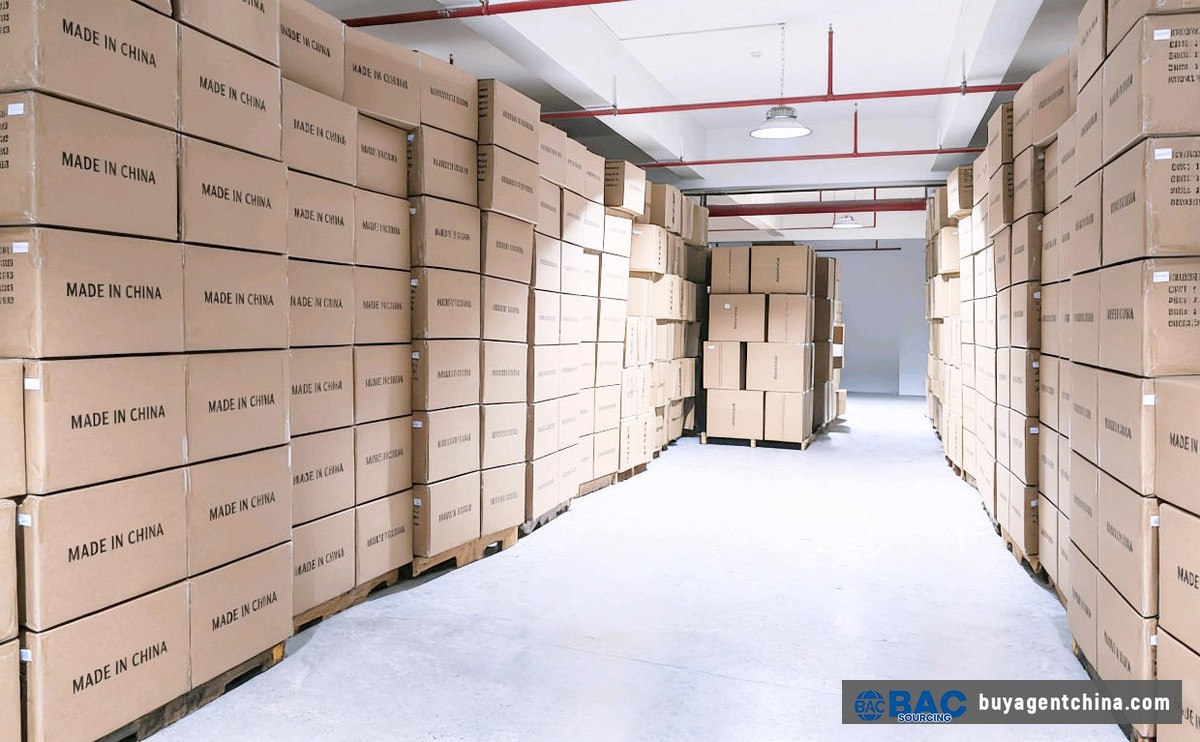
Export warehouse aisle stacked with MADE IN CHINA cartons

Export warehouse aisle stacked with MADE IN CHINA cartons

9.1 Bait Boat Small Test Order: 20–100 Units

For a first test, start from a stock tier: a GPS return model or an entry double-hopper, mixed across two or three colors, to prove the price band and return rate in your channel. The test order is about landed sample condition, transmitter feel and real battery runtime — do not open molds on the first round. Put down the usual deposit, but never pay the balance in full before the goods pass inspection. Inspection runs in three stages: 30–50% sampling, a full check of key points before release, and a final carton-load review.

9.2 Bait Boat Bulk FCL Order: Spec Sheet, Golden Sample, Staged Inspection

For a full container, lock the spec sheet first: hull dimensions, hopper capacity, range definition, battery grade and capacity, motor voltage, net-release solenoid, packaging and accessory list all written down. A signed golden sample becomes the only acceptance standard. Check mid-production in the workshop or by milestone video, then run a pre-shipment inspection, and steer clear of the pre-Spring-Festival and pre-National-Day booking windows. For FCL, verify outer carton marks, battery labels and the UN38.3/MSDS paperwork that travels with the goods.

A sample is a sample, and mass production is mass production — I have said it for fifteen years. For an electromechanical product like this bait boat, the discipline shown on the sample and the management of the bulk line are often decided on different floors.

10. Frequently Asked Questions (FAQ)

Q1. What is the usual MOQ for importing a GPS bait boat from China?

A1. Entry stock boats often start at 1–10 pieces on 1688; export models on Alibaba/Made-in-China commonly carry MOQs of 1–20 pieces, while high-speed net boats often start at 20 pieces. OEM shell and packaging customization is usually discussed from 500 pieces upward, subject to the supplier's spec sheet.

Q2. What FOB price should I expect for an exported bait boat?

A2. Public quotes captured in November 2026 run: entry delivery boat US$40–56, GPS return boat US$59–108, 12V high-speed net boat US$110–185, and a sonar flagship sample US$175–265. Quotes exclude battery options, packaging customization and international freight.

Q3. Which documents does a battery-powered bait boat need for sea or air freight?

A3. The battery pack needs a UN38.3 test summary and MSDS. Lithium batteries face stricter air-freight limits, and missing paperwork leads to refusal; LCL sea freight also requests battery shipping documentation. CE/FCC and other certifications are prepared by destination market, with certificate numbers matched to the model.

Q4. Should a bait boat be classified under 9503 or 8903?

A4. A small RC model may be classified under HS 9503.00, while a functional small electric craft may fall under 8903.99. The heading depends on finished function, length and use; have the destination broker pre-rule before booking, and do not classify from the listing photo.

Q5. For a first bait boat import, should I source direct or use a sourcing agent?

A5. If you can audit factories and verify electronics and battery files yourself, direct contact with Weihai or Shantou makers works. For a first import, remote QC or a mixed-category container, a transparent-fee procurement agent is steadier. The agent's job is to hold the spec, inspection and paperwork together — not to chase the lowest price.

Written by BuyAgentChina, a China sourcing agent with transparent fees. We do not own factories, do not stock goods and do not mark up prices — we earn only from standardized service fees. To source ceramic oil burners from China, book a free 15-minute consultation (WhatsApp: +86 18889605489 / hello@buyagentchina.com).

Leave a Reply

Your email address will not be published. Required fields are marked *