Sourcing Tips

8 Mistakes to Avoid When Wholesaling 304 Stainless Steel Insulated Water Bottles from China

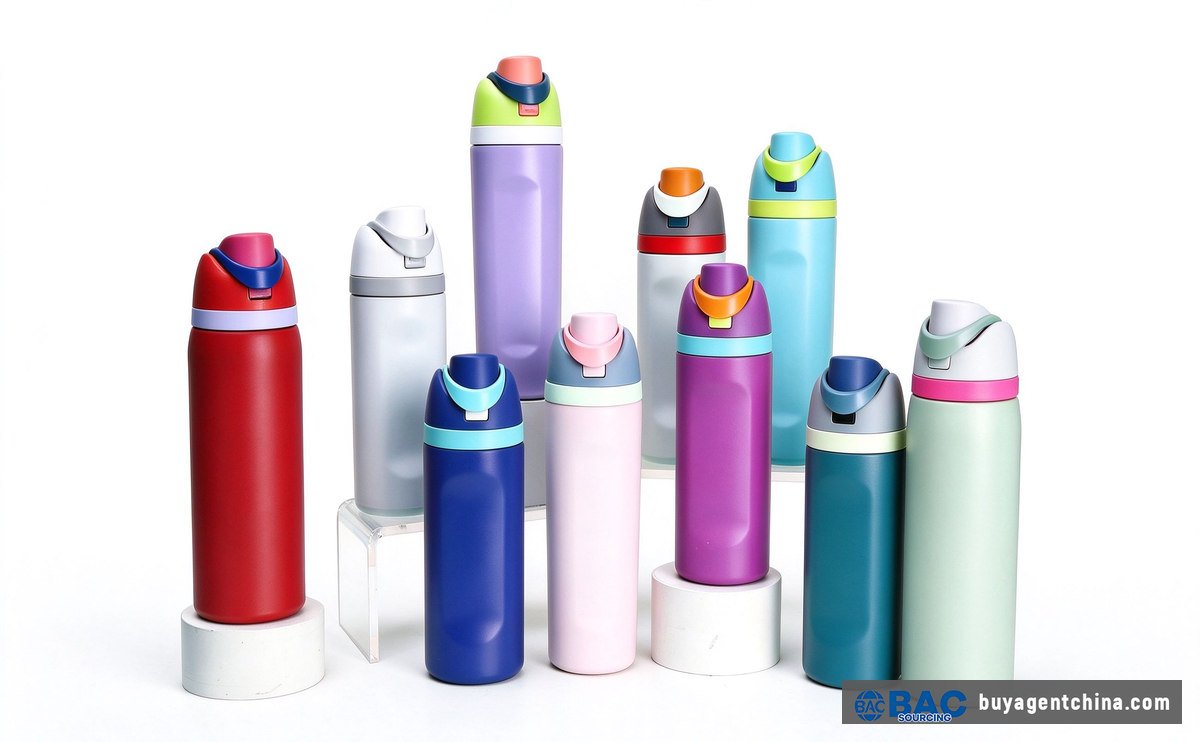
Stock/entry-tier 304 flip-lid bottle in multi-tone colorways (Source: supplier photo)

A vacuum-insulated bottle can leave a Zhejiang factory at around a dollar, yet most first-time importers burn through the margin before the first container clears the dock. China makes over 60% of the world’s insulated water bottles, and Yongkang alone accounts for roughly half of that output — which means the opportunity and the trap sit side by side.

1. Quoting the unit price, never the steel grade

Opening an inquiry with “how much per piece” is the easiest question to ask and the easiest one to get burned by. The price gap between 304 and 201 stainless may be only a few cents at the factory gate, but the difference shows up in how long the bottle keeps its promise.

1.1 Why the steel grade is the real price driver

“Stainless steel” alone is not a spec. A 304 and a 201 bottle can look identical on a shelf, yet the corrosion story under hot water is completely different.

1.2 How to pin the grade down in the quote

Put the steel grade in writing and demand a material certificate. 304 is the common food-contact choice; 201 costs less but corrodes faster, and a food-contact complaint in Europe or the US lands on you, not on the mill.

Steel gradeCorrosion resistanceFood-contact acceptanceTypical risk
304 (18/8)HighBroadly accepted (LFGB / FDA)Low if documented
201Lower — rusts fasterWeak acceptance, higher leachingHigh for EU / US exports

2. Trusting "it never leaks" without a seal test

When a supplier swears the lid is bulletproof, I start lining up a backup plan. The seal is a silicone gasket, and assembly tolerance plus aging decide whether it still holds a year from now.

2.1 What "never leaks" actually means

The lid’s guarantee is only as good as a gasket you cannot see. Assembly tolerance and silicone aging are the two silent leakers that turn a trusted claim into a return claim.

2.2 The 24-hour upside-down test before any bulk

Ask for a sample, fill it, leave it upside down for 24 hours, then talk about bulk. Leakers that come back burn your margin in freight and refunds before you count a single unit of profit.

3. Admiring the outside, ignoring the vacuum layer

The costliest, easiest-to-fail part of a bottle is invisible: the vacuum between the double walls. Whether the vacuum furnace is healthy or the weld is a fake weld — you cannot see it, only a thermal test can tell you.

3.1 Why the vacuum is the part you cannot inspect by eye

The double-wall vacuum is the whole point of the product, and it is also the part a bad batch hides best. A fake weld or a tired furnace passes every visual check.

3.2 How to demand measurable retention figures

Make the factory commit to measured retention values at 6, 12, and 24 hours and write them into the spec sheet. A quote that says “insulated” without numbers is not a quote.

Retention windowWhat a healthy bottle should holdWhat to write in the spec
6 hoursHot water still clearly warmMeasured value + test method
12 hoursWarm-to-touch, drinkableMeasured value + test method
24 hoursCool but above room temperatureMeasured value + test method
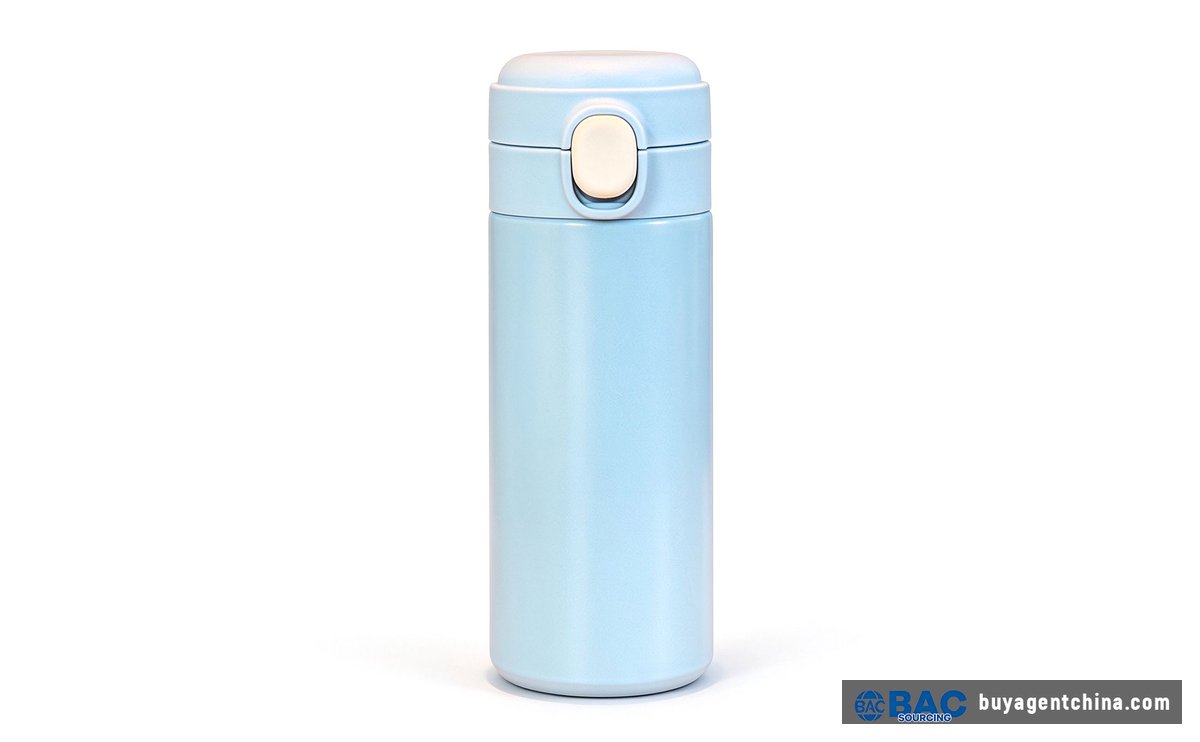
Functional daily-use 304 pop-top bottle in light blue (Source: supplier photo)

Functional daily-use 304 pop-top bottle in light blue (Source: supplier photo)

4. Sampling the prototype, skipping the line

A sample is a sample, and mass production is mass production — I have said it for fifteen years. The hand-made prototype gets hand-finished by a skilled worker; the production line turns out dozens a minute, and between them sits the whole quality-control system.

4.1 The gap between a hand sample and a line unit

A prototype is finished by hand, one at a time. The line ships dozens a minute, and the distance between those two realities is the entire QC system.

4.2 Three inspection points that protect the order

Inspect at 30-50% of production, inspect again at 100% completion, and watch the container get loaded. The cost of three inspections is far smaller than the cost of shipping a rejected batch back.

Inspection windowTimingWhat to check
Mid-production30–50% doneWelding, vacuum, gasket seat
Final100% completeSeal test, capacity, finish
LoadingAt the containerPackaging, buffer, carton condition

5. Skipping food-contact certification until customs holds the cargo

A bottle touches your mouth, so importing countries’ food-contact rules apply. The EU looks at LFGB, the US at FDA 21 CFR 177 — these are not optional, they are the ticket through customs.

5.1 Which certification your market actually needs

The EU route runs through LFGB; the US route through FDA 21 CFR 177. Know which one applies to your market before you sign, not after customs stops the container.

5.2 How to confirm the test before you order

Before you order, ask the factory whether a third-party test report (SGS, CIQ) already exists; if not, budget for one. A cargo held at the dock for a non-compliant test accrues demurrage by the day.

MarketKey certificationThird-party test
EULFGBSGS / TÜV report
USFDA 21 CFR 177SGS / CIQ report
General exportCE / CIQLab report on material
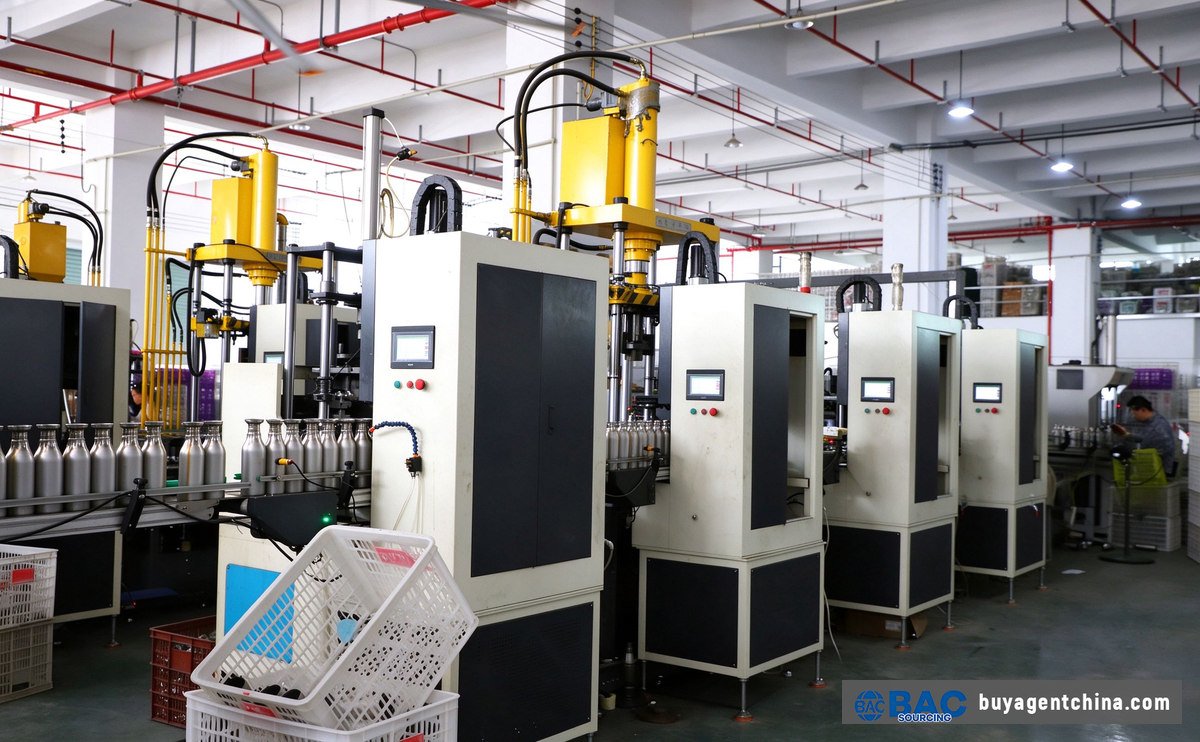
Automated stainless-steel bottle production line — QC & certification context (Source: supplier photo)

Automated stainless-steel bottle production line — QC & certification context (Source: supplier photo)

6. Paying the full balance and handing over every lever

Put down the usual deposit, but never pay the tail in full. “Balance paid after inspection passes” belongs in the contract — it is the last rein you hold.

6.1 Why the tail payment is your only leverage

Once you pay everything up front, the leverage flips entirely. They are not in a hurry; you are.

6.2 The payment terms to write into the contract

Deposit on order, balance against an inspection that passes. Keeping that sequence in writing is what keeps the factory honest after the mold is cut.

7. Guessing the HS code instead of verifying it

Vacuum flasks sit mainly in the 9617 family (961700 / 96170010 / 96170090), but a rechargeable variant, a straw-lid model, or a mixed-material build can land elsewhere. A wrong HS code parks a whole container at the port, and your profit dies there.

7.1 Where an insulated bottle usually sits, and where it drifts

The core codes live in the 9617 family, but a rechargeable, straw-lid, or mixed-material variant can fall into a different class entirely.

7.2 Getting the code confirmed in writing

Have the factory or forwarder re-confirm the code against the final product list, in writing, before customs. A wrong code is a container parked at the dock.

8. Driving a three-wheeled cart with a train license

A small order is not a shrunken big order; it is a different business. For a few hundred units, do not copy the negotiation and payment structure of a hundred-thousand-unit deal. Consolidate, share containers, split shipments.

8.1 Why a small order needs different logistics

A few hundred units do not justify the freight structure of an FCL. Consolidate, share containers, and split shipments instead of copying a million-piece plan.

8.2 Testing demand before sinking money into a mold

Test demand with a small batch first, then talk customization and MOQ. If you chase MOQ and sink money into a mold before the market has validated the product, you have lost the tooling money before the first sale.

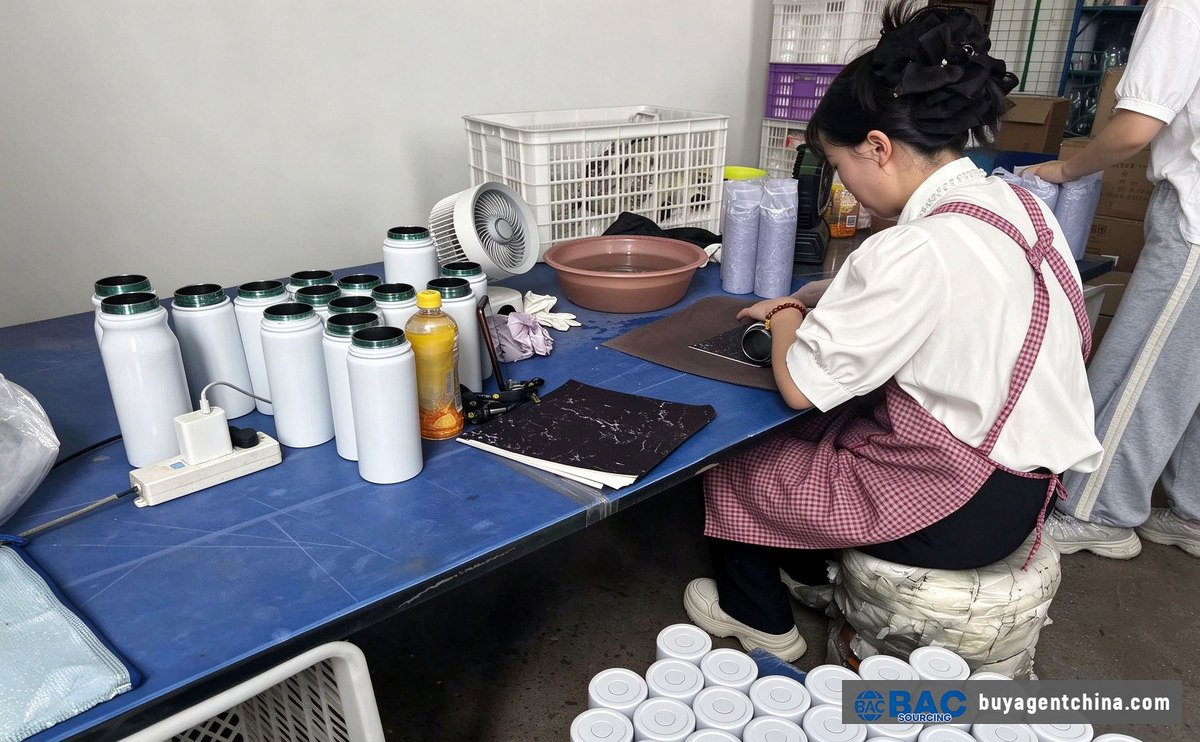
Bench assembly of insulated bottle bodies — small-order inspection context (Source: supplier photo)

Bench assembly of insulated bottle bodies — small-order inspection context (Source: supplier photo)

9. Picking the cheapest quote, ignoring the region

The Yongkang-Wuyi-Jinyun belt in Zhejiang is the heart of this industry: it accounts for over 70% of China’s cup-and-bottle output and exports, and Yongkang alone hosts more than 2,900 cup-and-bottle companies. There are factories elsewhere, but the supporting ecosystem is not the same.

9.1 What the Yongkang-Wuyi-Jinyun cluster really gives you

Over 70% of national cup-and-bottle output and exports come from this Zhejiang belt. In Yongkang you can visit three factories in a day and compare quotes and lines on the spot.

9.2 Using the region as a filter, not a price tag

Treat the region as a filter, not a price tag. In a less complete cluster, just rounding up accessory suppliers can eat a week; the supporting ecosystem is what turns a cheap quote into a deliverable order.

ClusterPositionWhat it gives a buyer
Yongkang–Wuyi–Jinyun (Zhejiang)70%+ of national output & exportsComplete supply chain; compare factories in a day
Guangdong / other hubsSmaller shareSome OEM options, less cluster density

10. Treating "cheap" as the only standard, ignoring total cost

A one-to-two-cent FOB difference per bottle is one or two thousand dollars across a hundred thousand units — but the extra inspection fees, rework losses, and return-shipping risk you take to save it are worth far more.

10.1 What total landed cost really includes

A one-to-two-cent FOB gap becomes one or two thousand dollars across a hundred thousand units — and the inspection fees, rework losses, and return-shipping risk you take to save it cost far more.

10.2 The route that keeps the numbers honest

Calculate total landed cost, not the unit price. Cheap is not a sin; chasing cheap is. A transparent agent route keeps inspection and documentation inside the number instead of hiding it.

RouteUnit priceInspection & QCDocumentation & riskBest fit
Direct factoryLowestYou manage yourselfYou own HS / clearance riskLocked supplier, self-managed QC
Transparent agent (e.g. BAC)Near factory rateAQL inspection includedFull documentation supportMulti-factory compare, small orders
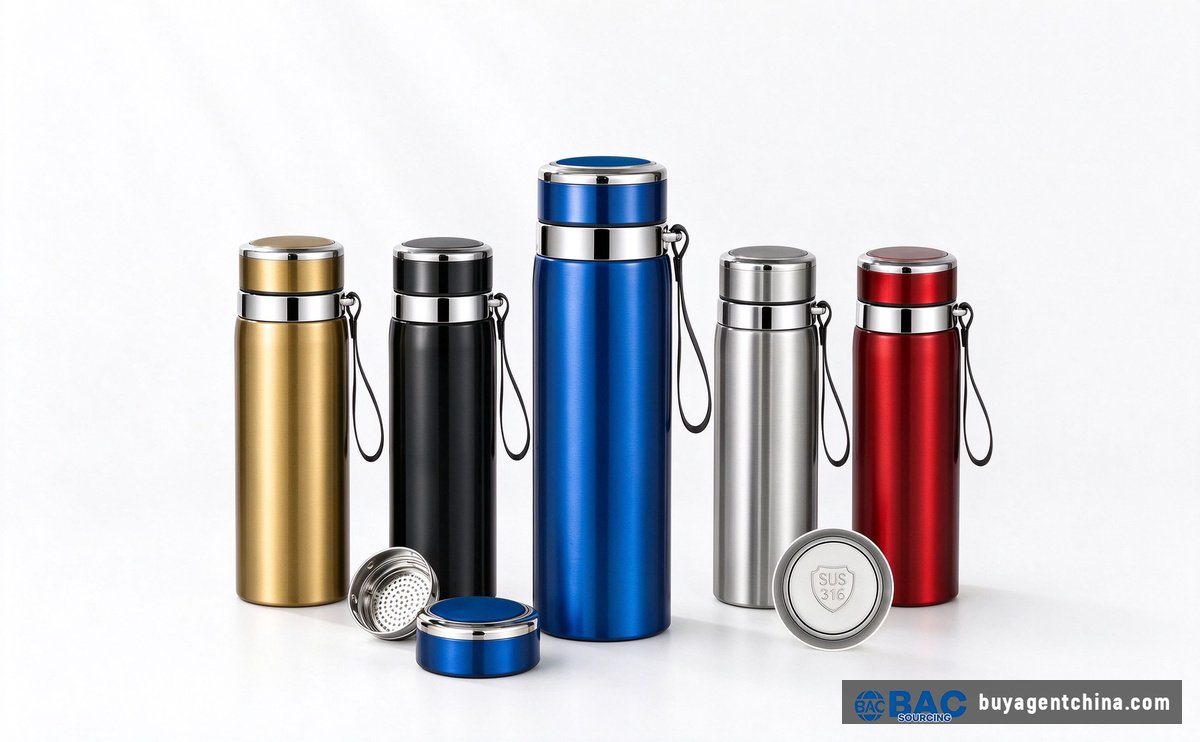
Premium 316 export-tier set — five colorways with infuser (Source: supplier photo)

Premium 316 export-tier set — five colorways with infuser (Source: supplier photo)

11.Frequently Asked Questions (FAQ)

Q1: What is the typical minimum order quantity for wholesale 304 insulated water bottles from China?

A1: Stock models commonly start around 50-500 pieces (quotes on made-in-china cluster around 100-500); custom printing or OEM usually needs 1,000 pieces up, and a custom mold is quoted separately.

Q2: What is the difference between 304 and 201 stainless steel water bottles?

A2: 304 is the common food-contact grade, more corrosion-resistant and broadly accepted by European and US food-contact rules; 201 costs less but resists corrosion worse, and long-term water contact carries a higher leaching risk for exports to those markets.

Q3: What certification do insulated water bottles need to export to Europe or the US?

A3: The EU typically looks for LFGB and the US for FDA 21 CFR 177. Ask the factory for an existing third-party report (SGS, CIQ) or budget to run one.

Q4: How long does shipping insulated water bottles from China to the US take?

A4: Sea freight usually runs 25-35 days including consolidation, loading, and clearance; peak season and tight capacity can stretch it, so leave a buffer.

Q5: Should I buy direct from the factory or use a sourcing agent?

A5: Direct buying suits buyers who already hold a locked supplier and can manage inspection themselves. For multi-factory comparison, inspection, production monitoring, and documentation, a transparent-fee agent (e.g. BAC, DIVE sourcing at $140/once, inspection at $200/day) can cut the hidden cost of rework and returns.

Leave a Reply

Your email address will not be published. Required fields are marked *