Custom Sourcing, Procurement Guides

How to Wholesale Double Sink Hotel Vanities from China

Hotel public washroom double vanity — above-counter ceramic basins in a real install

China supplies over 75% of global bathroom vanities; double sink hotel vanities wholesale from about USD 39 FOB, and most hotel orders are custom.
Most double sink hotel vanity orders do not die on price. They die three months later, when the doors swell, the stone joint splits, and the supplier’s only answer is that “the photos were for reference.” This guide starts from that failure and works backwards to the process that prevents it. It is written for one kind of reader: someone putting real money into a hotel bathroom fit-out. Owners, renovators, procurement managers — anyone who wants the vanity order to be the boring, reliable part of the project.

1. What a Failed Double Sink Hotel Vanity Order Looks Like

The market first, then the failure modes. China accounts for more than 75% of the world’s bathroom vanity exports (Accio, 2026). The United States is the single largest destination for Chinese sanitary ceramics — 28.5 million pieces in 2024 alone, per the China Building Ceramics & Sanitaryware Association. Double-sink is the fastest-growing configuration in the category — about 7.62% compound growth through 2031 (Mordor Intelligence, 2026). Double washbasins now appear in roughly 67% of new upscale hotel builds (Dataintelo, 2026).
The trend is easy to explain. Hotel bathrooms are small, occupancy pressure is high. Two basins let two guests brush teeth and pack at the same time — no queueing at the mirror. That sounds like a trivial detail until you run a 300-room property where the bathroom is the first thing a guest reviews. Commercial bathroom fixture installation in hospitality grew about 13.2% a year between 2023 and 2025. The hospitality segment is forecast to grow fastest of all through 2034, driven by boutique hotels and resorts in Asia Pacific, the Middle East and North America (Dataintelo, 2026).

The demand is real, and so are the traps. In fifteen years of sourcing, I have never once seen a vanity order die at the negotiation table. It always dies in one of these five places:

Failure pointWhen it shows upWhere it startedThe check
Swollen doors, lifting edge banding2–3 months after deliveryLow-density core, skimped waterproofingBoard grade and moisture rating in the contract; check banding and hinge holes at inspection
Countertop joint crackingAt install or in useToo-thin stone/sintered board, weak seam workConfirm board thickness and backing ribs; inspect the seam on the sample
Basin glaze crazing or seepageWeeks into useFiring defects, once-fired passed off as twice-firedRing test + glaze light check; ask for kiln batch info
Dimensions miss the rough-inOn site at installCustom sizes never written into the contractTolerance clause in writing; golden sample as the only acceptance standard
Damage on arrivalAt unpackingThin foam, flat-loaded boardsPackaging spec: foam + wooden frame, upright loading
Any one of these wipes out the margin and the schedule together. So the first step of the correct process is not finding the cheapest factory. It is locking down what you are actually buying — the material, the countertop, the tolerances — before a single quote is compared.

2. Step One: Lock the Cabinet Material and Structure

A bathroom vanity lives in a wet room, and the material decides whether it is still standing in two years. Four cabinet bodies dominate the market:

Cabinet materialTypical range (FOB)Moisture resistanceBest forBiggest risk
PVC / engineering plasticUSD 39–89 per unitBestEconomy hotels, volume projectsCheap grades age brittle; looks "project-grade"
MDF with PVC film / melamineUSD 90–180 per unitDepends on banding and paintMid-chain hotelsSkimped banding → swollen edges
Multi-layer wood, PU paintUSD 150–400 per unitGood, if the paint line is honestMid-premium hotels, boutique staysMoisture content and uneven lacquer
Aluminum frame + stone/glassUSD 250–900 per unitVery goodDesign-led hotels, public washroomsHardware and structure quietly downgraded
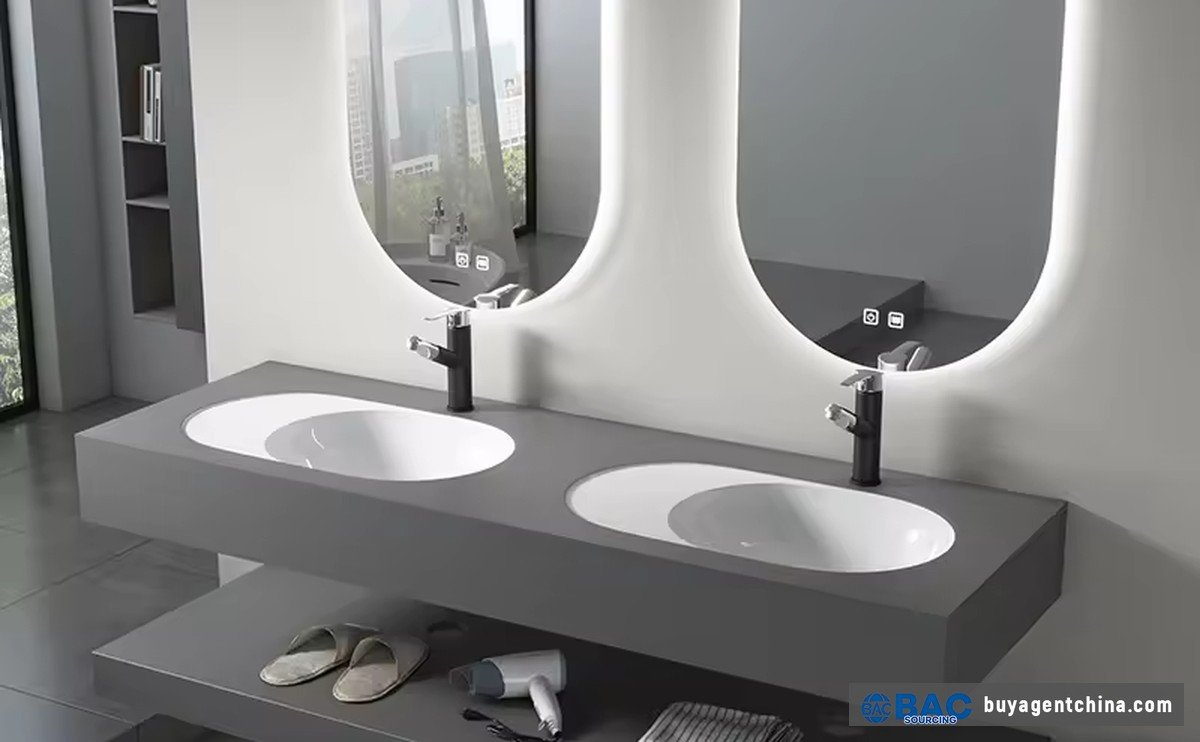
Modern floating double sink vanity with backlit mirrors — the look hotel projects order most

Modern floating double sink vanity with backlit mirrors — the look hotel projects order most

2.1 PVC / Engineering Plastic

PVC units are the workhorse of economy hotels — lowest ex-works cost, best water resistance, and a look you can’t mistake for anything else. The catch hides in the resin grade. Cheap PVC ages brittle and yellows within a couple of years. A unit that costs USD 39 today can cost you a guest complaint tomorrow. Ask which resin grade the cabinet uses and put it in the contract; the difference between grades is small money at the factory and a large difference in the bathroom.

2.2 MDF with PVC Film / Melamine

MDF with PVC film covers the mid-market, and the entire product lives or dies on banding and paint: lifting edge banding is the most common death of this type. Moisture climbs into the exposed edge, the board swells, and the door stops closing flush. Check the banding width on the inside of the doors — not the outside, where it always looks neat — and ask how many coats of waterproof primer the cut edges get before the film goes on.

2.3 Multi-Layer Wood with PU Paint

Multi-layer wood goes into mid-premium projects. This is the tier where the paint line decides everything: moisture content of the wood, number of PU coats, hardness of the finish. A bathroom cabinet should never look like furniture that happens to live near water; it should be built like furniture that expects to be splashed daily. Ask for the moisture-content spec of the board and the paint schedule in writing. Check the paint hardness on the sample with a fingernail — if the finish scratches, the hotel’s cleaning crew will find out within a month.

Multi-layer wood double vanity with PU paint — boutique tier, dark wood with brass detailing

Multi-layer wood double vanity with PU paint — boutique tier, dark wood with brass detailing

2.4 Aluminum Frame + Stone

Aluminum-frame units run the boutique route. Do not stare at the frame profile; hinges, slides and drawer-bottom thickness are where the real cost sits. A 1.0 mm aluminum frame with steel ball-bearing slides is a different product from a 0.8 mm frame with stamped wheels, and both will photograph identically. Count the slides, weigh the drawer bottoms, and read the hinge brand off the sample.

I trust audit reports, but I trust my own ten minutes in the workshop more. Look at the edge-banding line and the countertop polishing line — a cabinet that lives in a wet room dies at its edges, and neither swelling doors nor a cracked joint ever shows in a listing photo.

3. Step Two: Pick the Countertop and Basin System

The second cost center is the countertop and basin, which often outweighs the cabinet itself. Four systems matter:
Countertop / basin systemPrice referenceStrengthsWatch out for
Ceramic one-piece basin (counter + basin)CNY 1,008–2,060 per set (1688, 2026)Durable, easy to clean, mature processGlaze firing defects, transit breakage
Sintered stone thermoformed basinfrom CNY 428–620 per set (1688, 2026)Seamless one-piece, hotel-project mainstreamThin board passed off as thick; thermoforming crack rate
Quartz top + under-mount basinroughly USD 40–90 per linear meterScratch-resistant, controllable seamsResin content, backing ribs
Natural stone (travertine / marble)USD 900–1,500 per set (Made-in-China, 2026)Premium look, lobby-gradeColor deviation, fissures, needs sealing
Beige stone double vanity with gold wall faucets — mid-premium stone tier

Beige stone double vanity with gold wall faucets — mid-premium stone tier

3.1 Ceramic One-Piece Basin

Ceramic one-piece basins come mainly from Chaozhou and Foshan. The process is mature and the price is friendly, but the product is only as good as the firing. Inspection basics: ring test on the basin wall, a glaze light check for pinholes and crazing, and a look at the kiln batch records. A once-fired basin can look identical to a twice-fired one in a photo and behave completely differently in service. Glaze crazing and seepage show up weeks after install — exactly when nobody is watching anymore.
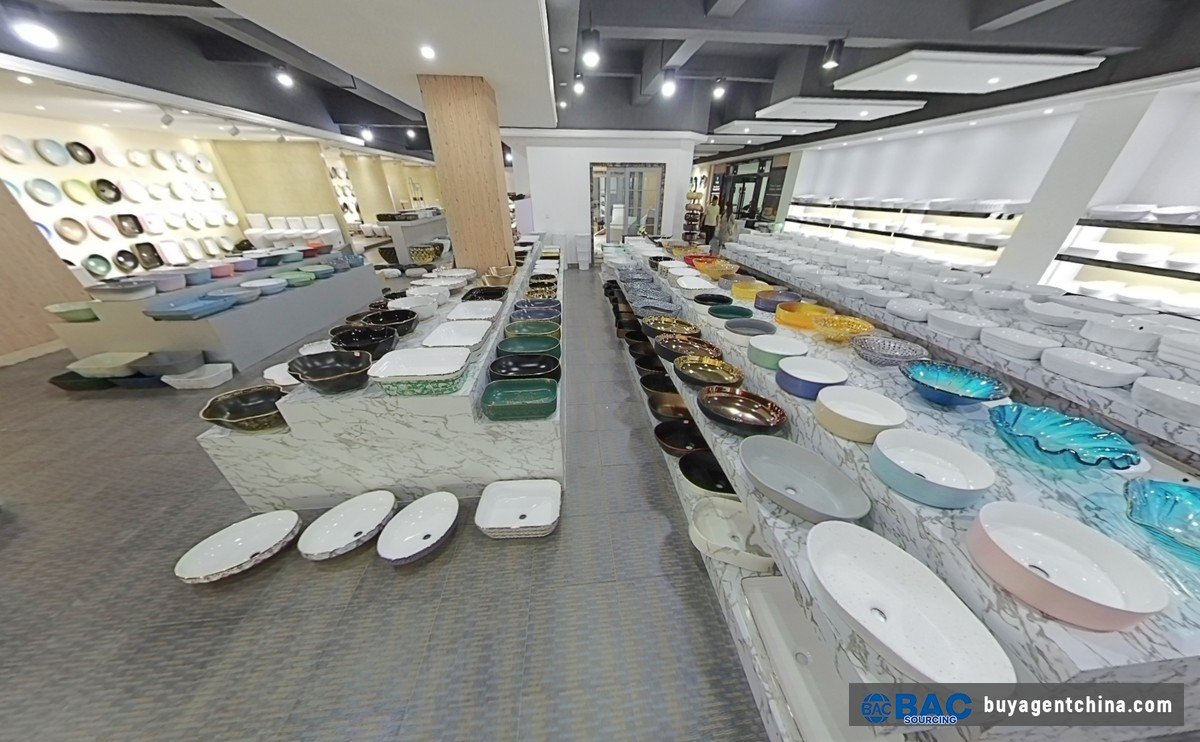
Ceramic basin showroom display — the basin range behind Chaozhou-style double-sink sets

Ceramic basin showroom display — the basin range behind Chaozhou-style double-sink sets

3.2 Sintered Stone Thermoformed Basin

Sintered stone thermoformed basins are the current mainstream of hotel projects — 1688 hotel-project units start around CNY 428 — with source factories in Hangzhou and Foshan. Two questions decide the order: what is the actual board thickness, and what is the thermoforming crack rate on the production line? A 6 mm board presented as 12 mm is the classic swap, and a hot-bent basin that cracks at 3% on the line will crack at a similar rate in the container. Ask both numbers in writing.

3.3 Quartz and Natural Stone

Quartz and natural stone belong to the upper tier. Stone is quoted per linear meter, so the real negotiation is about thickness, edge treatment and backing ribs, not the meter price. Natural stone should be a batch that has already been sealed against seepage — travertine in particular drinks water and stains fast. Color deviation between batches is normal for natural stone; the contract should name the acceptable deviation, or the hotel lobby will be the place you discover it.

Sintered stone can die once at firing and again in transit — I have seen both: a thin foam wrap at the factory and a flat-loaded container. The packaging clause is not a detail; it is the difference between a clean arrival and a claims case.

4. Step Three: Match the Factory to Your Order

China’s bathroom vanity production sits in a handful of clusters. Pick the right one and you save half the effort:

ClusterPositioningScale referenceBest for
Foshan, GuangdongNational vanity production center12M+ sets/yr capacity; 3,200+ companies (2026)Full price ladder; mid-premium custom, big projects
Chaozhou, GuangdongSanitary-ceramics capital + vanity clusterGuxiang town: 500+ sanitary ceramic firms, 50M+ pieces/yrCeramic basins, double-sink combos, value
Hangzhou, ZhejiangSintered-stone and smart-bathroom hubSeamless sintered basin source factoriesSintered stone basins, smart mirror cabinets
Quanzhou, FujianStone-processing capitalMature stone sanitary exportsTravertine, marble double-sink units
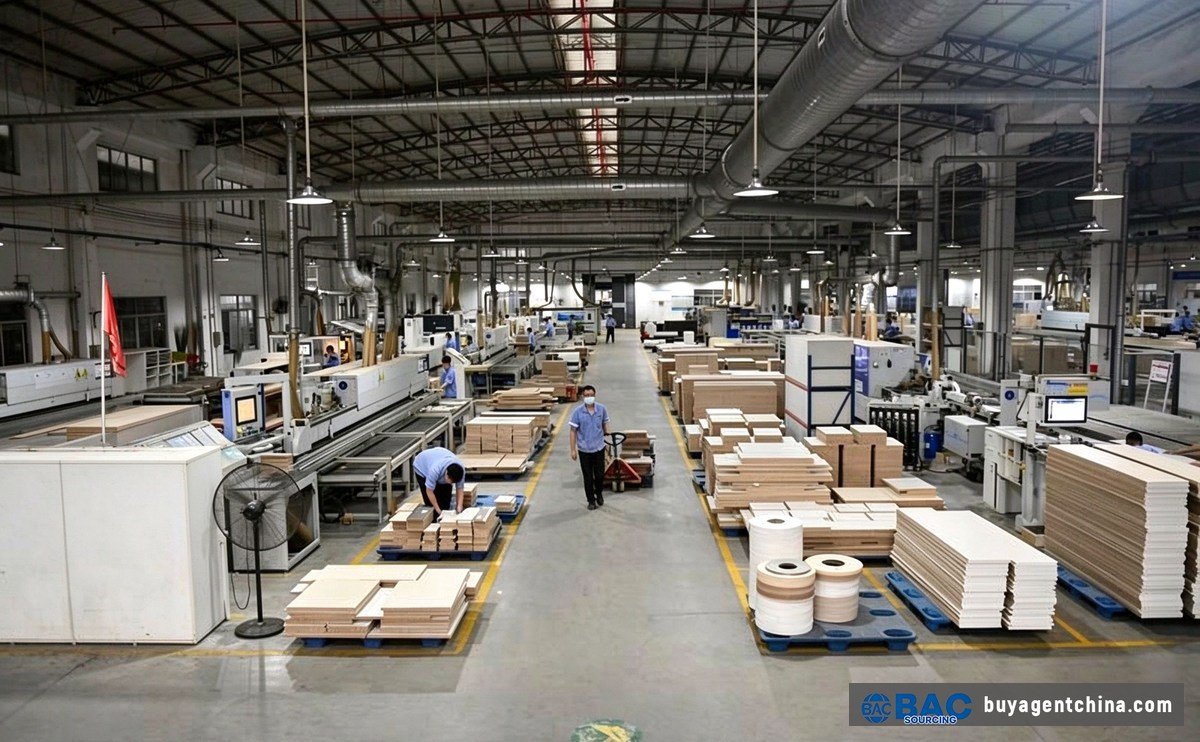
Bathroom cabinet workshop with workers on the line — what a factory audit actually looks like

Bathroom cabinet workshop with workers on the line — what a factory audit actually looks like

4.1 Foshan — the Full-Ladder Cluster

Foshan is the “capital of bathroom products” in China. The belt’s annual capacity passed 12 million sets with more than 3,200 companies (2026), spanning everything from budget units to top custom work. If your project mixes stock economy units and custom mid-premium units, Foshan is where one cluster can cover both. Its scale also means deep competition — the same spec sheet will come back at meaningfully different prices from two Foshan factories, which is exactly why you send it to three clusters, not one.

4.2 Chaozhou — Ceramics and Value

Chaozhou’s Guxiang town is China’s “No.1 sanitary ceramic town”: 500+ sanitary ceramic producers, 50 million-plus pieces a year, and the country’s largest ceramic sanitary export volume. Chaozhou sanitary exports grew from CNY 2.38 billion in 2021 to CNY 4.34 billion in 2024 (China Customs, 2025). For double-sink combos built around ceramic basins, this is the value center. The basin cost is lower here than anywhere else, and the surrounding supply chain — stone, mirrors, packing — has matured with the export trade.

4.3 Hangzhou and Quanzhou — Specialist Niches

Hangzhou owns the sintered-stone and smart-mirror niche; seamless sintered basin factories cluster there, and smart mirror cabinets are a specialty. Quanzhou owns natural stone: travertine, marble and granite processing at export scale, with the sealing and packing experience that stone demands. Use these two for the products they specialize in, not for commodity PVC cabinets.

The method is simple: every cluster reads the same spec sheet differently — prices, MOQs and even the meaning of “waterproof” will differ, so run the same drawing through three of them before you pick. Ask each shortlisted factory for a workshop video of its banding line and polishing line. A real factory can produce one in a day. A trader cannot. When a supplier says “absolutely no problem,” I am usually already lining up a backup.

5. Step Four: Read the Price Ladder, Not the Quote

Double sink hotel vanities span two orders of magnitude in price, and most of the margin is decided after the quote is signed.
TypePrice band (FOB)MOQ referenceNotes
PVC hotel-project double vanityUSD 39–89 per set1–30 setsProject custom, volume
European-spec PVC double vanityUSD 60–65 per set5 setsExport-standard unit (Accio, 2026)
Wood double vanity + smart mirrorUSD 94–144 per set2 setsChaozhou / Dongguan output (Accio, 2026)
LED-mirror double vanity setUSD 94–114 per unit2 unitsMirror included (Made-in-China, 2026)
Wall-mounted double vanity + smart mirrorUSD 250–420 per set1 setPremium custom (Alibaba, 2026)
Sintered stone hotel-project basin setfrom CNY 428 per setsmall batches OK1688 source price (2026)
Travertine / marble double vanityUSD 900–1,500 per set2 setsQuanzhou stone cluster (2026)
Custom double sink vanity in production — dark wood cabinet with marble countertop, factory floor

Custom double sink vanity in production — dark wood cabinet with marble countertop, factory floor

Three questions before you compare quotes. Is the price tax-inclusive? Does it include local trucking to the port? Is it EXW or FOB? A lot of “cheap” prices are naked ex-works figures. The forwarder adds everything back later. Vanities are bulky, low-density cargo: a double-sink set is roughly 0.5–0.9 CBM once packed, so sea freight can equal 15–30% of the FOB value on smaller orders. That is why the landed-cost math must include the freight per cubic meter, not the per-unit freight — a cheap quote on a bulky product is often just a quote with the freight hidden.

Negotiation works the same way it does for every Chinese product. Do not ask “how much per unit”; ask for the ladder: 10, 50, 200, 500 sets. The factory will quote each step, and the spread between steps is your first real negotiation data. Then compare those ladders across your three clusters before you name a target price. Cheap is not a sin; chasing cheap is. Compare the landed cost, not the quote.

6. Step Five: Classify It Right — the US Wood-Cabinet Trap

This is the most expensive section of this guide, so the conclusion goes on top: for the US market, wooden vanities carry anti-dumping and countervailing duties; PVC, aluminum-frame and other non-wood units sit outside the orders.

Component / codeClassificationKey point
Wooden vanity / cabinet9403.60 (94036091 / 94036099)US AD/CVD orders apply (see below)
Ceramic basin / washbasin6910.10 (porcelain)US MFN duty about 5.8%
Aluminum sanitary cabinet7615.20Aluminum-body classification
Stone countertop6802 / 6810 seriesDepends on processing stage
Sintered stone / ceramic slab top6907 seriesClassified with ceramic boards

6.1 The Rule of Classification

Classify the finished set, not the sales photo. A double-sink set usually clears as several lines — cabinet body, countertop, basins — each under its own code. The ceramic basins sit under 6910.10 (about 5.8% US MFN duty), the stone top under the 6802/6810 families, and the cabinet under the furniture codes. Get the breakdown right before you ask for a freight quote; forwarders quote on the whole picture, and an incomplete classification always comes back as a surprise bill or a hold at the dock.

6.2 The US Wood-Cabinet Orders

For the US, the anti-dumping and countervailing duty orders on “wooden cabinets and vanities and components thereof” from China went through a five-year review instituted in March 2025. Commerce concluded in July 2025 that revoking the AD order would let dumping resume at a 262.18% margin, and the CVD “all others” rate sits at 18.17% (US Federal Register, July 2025). What that means in practice: a wooden vanity shipped to the US carries double-digit cash deposits on top of the normal duty. It is often the hidden answer to “why is my wood vanity 30% more expensive than the competitor’s.” Buyers routinely design around it — PVC, aluminum-frame and stone-top units sit outside the scope. But “wooden” includes mixed constructions, so confirm the scope with a customs broker before you book. Not after.

Outside the US, the paperwork is lighter but still real. EU buyers want CE documentation on anything with electrical parts (mirror lights). Middle East markets commonly ask for SASO-type certification. Southeast Asia mostly accepts standard export documentation. Get the HS code wrong, and a whole container sits at the dock while your margin disappears. In this category, the most expensive paperwork mistake is a wood cabinet aimed at the US market.

7. Step Six: Two Order Plans — Test Batch and Project Bulk

Vanity orders behave differently from consumer goods. A double sink hotel vanity is part of a construction project, so the order logic changes with scale.
DimensionSmall test batch (1–20 sets)Hotel project bulk (50–500+ sets)
GoalValidate supplier, materials, price gapsLock the line, lock the lead time, push the unit price
MOQ1–5 sets negotiable; most factories take samplesCustom orders commonly from 50 sets; FCL better value
SamplingInspect stock or single-set sampleGolden sample signed; tolerances written into the contract
Production windowStock: 3–15 daysCustom: 15–30 days sampling + 20–45 days production
InspectionSelf-check on arrivalThree-stage: 30–50% + 100% + loading supervision
Payment30% deposit; balance after inspectionStaged payments; final balance tied to inspection report
Double basin vanity after install — white basins with a backlit smart mirror

Double basin vanity after install — white basins with a backlit smart mirror

The test plan: order 1–5 sets first and verify the board thickness, the banding, the hardware and the packing. A sample is a sample, and mass production is mass production — I have said it for fifteen years. With vanities the gap between the two is wide: the tenth door in the batch, not the first one, shows you how the line really runs. Unpack the test sets yourself. Measure the tolerances against the spec sheet. Splash water on a door edge and watch what happens in ten minutes. That ten-minute test tells you more than the whole quotation.

The bulk plan: write every line into the contract — dimensions, materials, countertop build, hardware brands. Keep the signed golden sample as the only acceptance standard. Run the three-stage inspection: mid-production at 30–50%, a 100% check before packing, and loading supervision at the container. For stone and sintered tops, specify the packing clause in writing: foam protection, wooden frames, upright loading. Flat-loaded boards are the single biggest source of claims in this category. Time the order to avoid the Chinese New Year window, when capacity and prices both move against you.

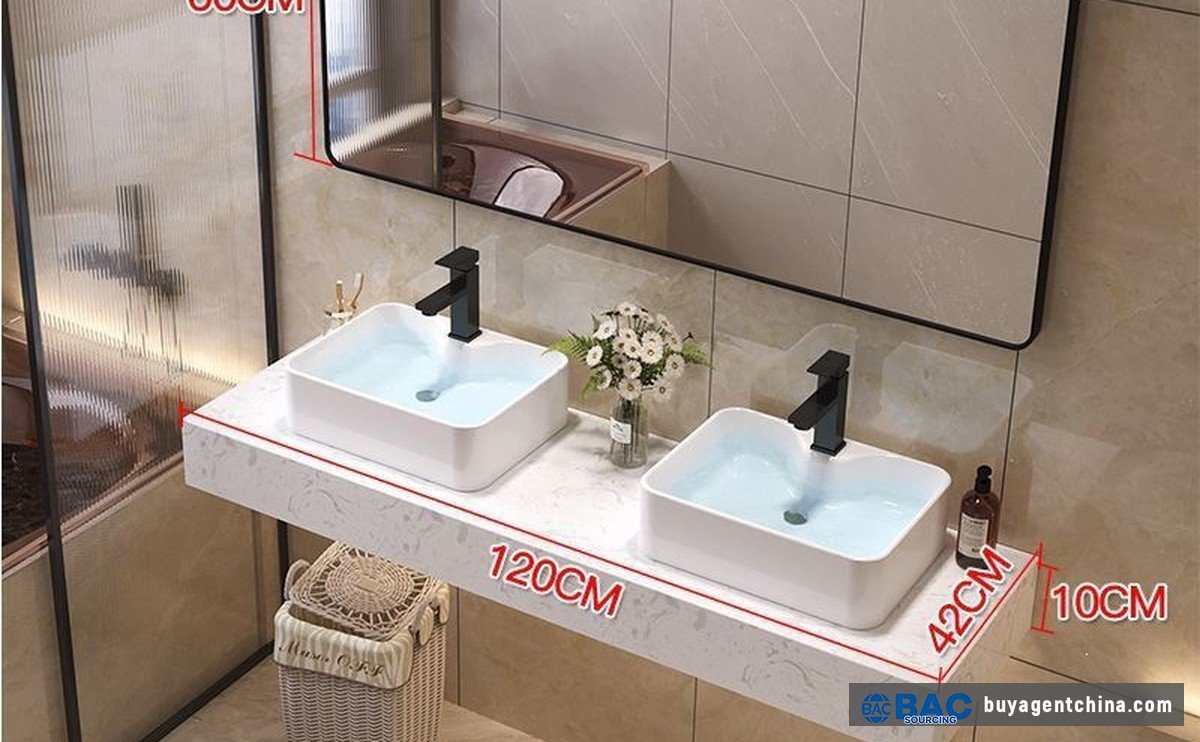
Dimensioned double sink vanity drawing — dimensions locked into the contract before production

Dimensioned double sink vanity drawing — dimensions locked into the contract before production

8. Step Seven: Direct or Agent — Who Checks What

The last decision is execution. Direct sourcing sounds cheaper, an agent sounds easier, and both claims deserve a skeptical look.

DimensionDirect from factoryWith a transparent agent
CostNo service fee; you eat every mistakeFixed, transparent service fee
Factory audit / QCFly in yourself or trust a reportOn-site audit + three-stage inspection
CommunicationTechnical specs get distorted in translationLocal team verifies every spec line
Paperwork / classificationErrors are yoursClassification and document checks supported
Best forExperienced buyers, stock standard unitsFirst orders, custom projects, no time to supervise
Direct makes sense when you already know the product, the factory and the documents — a repeat buyer ordering stock PVC units who has been burned enough to have learned the checklist. It stops making sense the moment the order is custom, the supplier is new, or the project deadline is fixed, because the failures in this category are invisible until months later. A hotel project cannot absorb a three-month failure; it needs someone on the ground checking the banding line and the packing clause while the order is still in production.
Putting the spec in the contract beats sending a smile across the dinner table. BuyAgentChina’s pricing is public on the services page: USD 29 for the Entry sourcing plan, USD 140 for the DIVE deep-sourcing plan, USD 170/day for factory visits. Order management runs 3–5% on Basic and 5–8% on the full Growth plan (current standard, July 2026). Paid up front, written into the contract. For very small budgets, the honest advice is to skip the agent and shop Taobao yourself under USD 1,000. Between USD 1,000 and USD 10,000, a China buying agent on 1688 pays for itself. Above USD 10,000, full-service management is usually the cheapest insurance in the project. A transparent agent’s value is not “buying for you”; it is checking. That distinction is what saves a hotel project, not the discount.
Five checks before you commit: is the board thickness and basin sourcing written down? Is the cabinet material and moisture rating written down? If US-bound, is it wood — and is the AD/CVD cash deposit in your landed-cost math? Is the golden sample signed? Is the final payment tied to the inspection report? Answer all five with paper, not promises, and the double sink hotel vanity becomes the boring, reliable part of the fit-out it was always meant to be.

9. Frequently Asked Questions (FAQ)

Q1. What is the MOQ for double sink hotel vanities from China?

A1. For stock PVC double vanities, 1–5 sets is a workable start; hotel-project custom orders usually begin at 50 sets, and stone models quote from 2 sets on B2B platforms.

Q2. How much does a double sink hotel vanity cost wholesale from China?

A2. Roughly USD 39–89 FOB for PVC project units, USD 94–144 for wooden units with a smart mirror, and USD 900–1,500 for natural stone sets (2026 market ranges).

Q3. Should I buy stock vanities or customize them for my hotel project?

A3. Customize when you need specific dimensions, colors or countertop cutouts — most hotel projects do. Test the supplier with a small stock order first, then sign a golden sample before bulk production.

Q4. Does the US anti-dumping duty apply to all Chinese bathroom vanities?

A4. No. The US AD/CVD orders cover wooden cabinets and vanities; PVC, aluminum-frame and other non-wood units fall outside the scope. Confirm the product scope with your forwarder before booking.

Q5. How long does a custom hotel vanity order take from sample to delivery?

A5. Sampling usually takes 15–30 days, bulk production 20–45 days, then ocean transit. Plan 8–12 weeks total for a custom order, and avoid the Chinese New Year window.

Leave a Reply

Your email address will not be published. Required fields are marked *