Procurement Guides, Sourcing Tips

How to Buy Yoga Grip Socks in Bulk from China: 2026 Guide

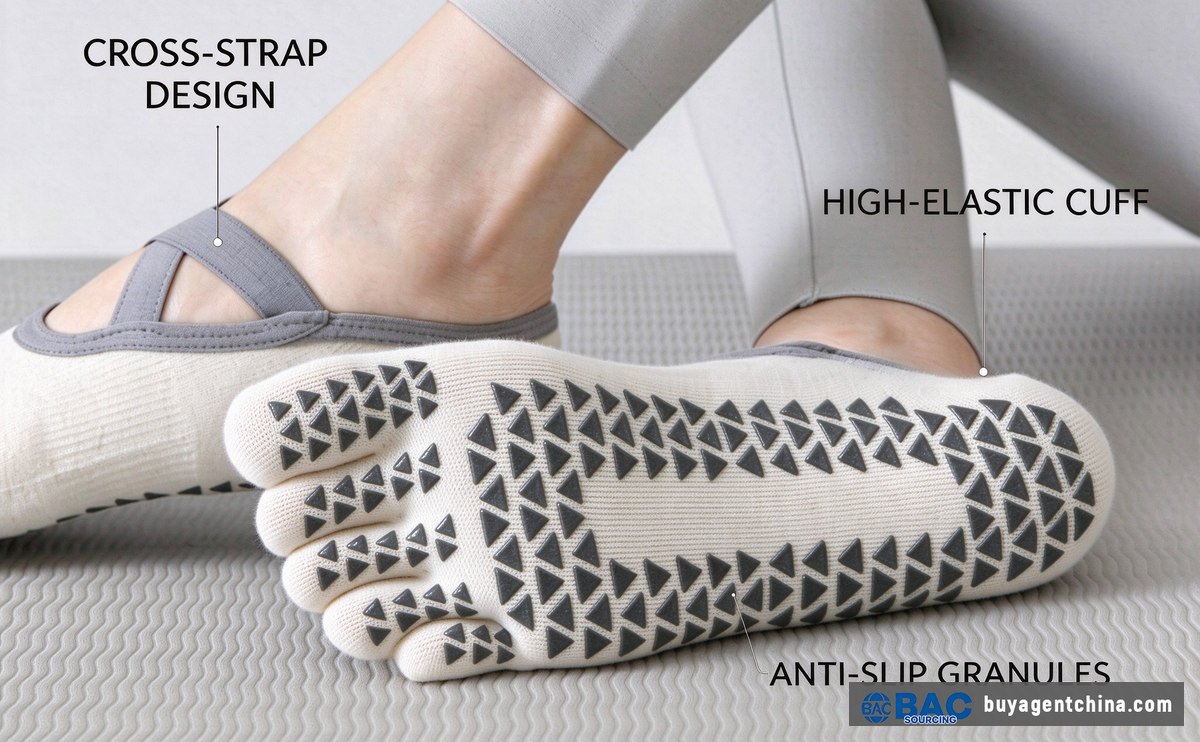
Grip-sock detail: cross-strap, elastic cuff and anti-slip sole granules

Every reformer studio from New York to Sydney starts the same way — the instructor waits at the door until every member has grip socks on.

Yoga grip socks wholesale from China from about ¥1.05 per pair on 1688 or US$0.85–2.98 FOB; the category is a USD 280M market growing at 5.3% a year (October 2026).

1. Why Yoga and Pilates Grip Socks Became a China-Sourced Category

The yoga and Pilates socks market was worth USD 280.7 million in 2025 and is projected to reach USD 470.4 million by 2035, growing at a 5.3% CAGR (Global Market Insights, September 2026 report). The wider anti-slip grip sock segment moves faster still — roughly 7.8% a year between 2024 and 2030, heading past USD 2.1 billion by 2030 (Grand View Research).

The demand side is a studio culture, not a fashion blip. Reformer, barre and hot-yoga studios in North America and Europe have turned grip socks from an optional extra into a door requirement. Polished wood gets slick when sweaty, and studios need hygiene boundaries between members. That combination makes grip socks a repeat-purchase consumable, which is exactly why they behave differently from a normal sock line. A studio with 40 classes a week burns through pairs; a member who likes the brand rebuys three or four times a year.

The supply side is one name: Zhuji. Datang township in Zhejiang, marketed as the “international sock capital,” reported more than CNY 75 billion in sock output value in 2025, over 10,000 sock-making enterprises, and annual output above 25 billion pairs — about 70% of China’s socks and roughly a third of everything made on the planet (Zhuji Economy & IT Bureau, August 2026). Grip socks are just one variant running down those same circular knitting machines.

What that means for a buyer is a full price ladder, not a single “cheap” answer. The same studio-grade five-toe sock that wholesales for a couple of dollars FOB can sit in a US studio boutique at USD 15–25 retail. The entry stock tier on 1688 starts below one yuan. The margin exists — but only for whoever manages the two traps that sit right beside it. Compliance is one: fiber labeling, chemical limits, and stricter children’s rules if you touch kids’ lines. The other trap is inspection: a grip that looks perfect on the listing photo but washes off after three cycles. This guide is for the buyer who wants the price ladder without stepping on the traps: stock or custom first, then region, then the grip itself, then price, paperwork, and the direct-vs-agent decision. Every number below is checkable and dated.

2. Step One: Stock Wholesale vs OEM/ODM Customization

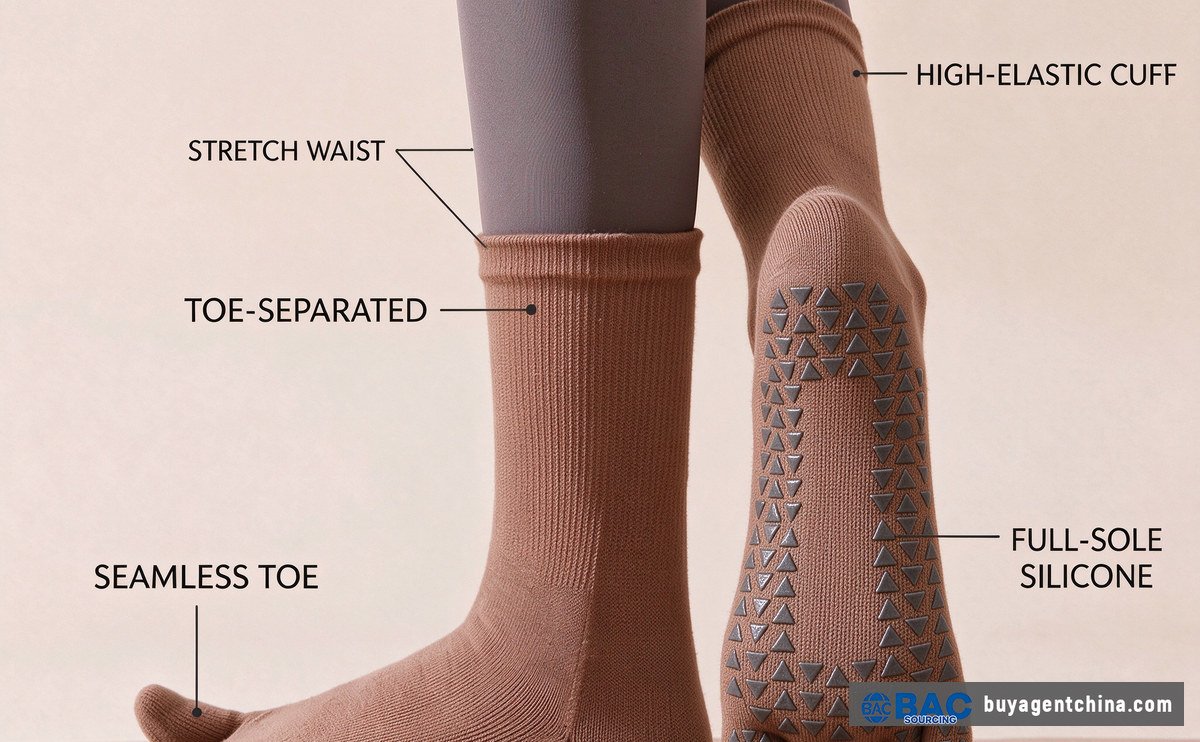
Five-toe yoga grip socks with full-sole silicone dots — common studio stock model.

Five-toe yoga grip socks with full-sole silicone dots — common studio stock model.

Most new buyers treat “sourcing grip socks from China” as one task. It splits into two clean models. Picking the wrong one can cost you three months or an entire bad batch.

2.1 Stock Models: Buy What the Factory Already Makes

The factory has already designed the model and sits on inventory. You buy existing SKUs, at most swapping a color or slapping on a logo. For anyone testing the water, stock is the fastest route to a first sale — and on 1688 the entry tier is genuinely low: silicone sole socks from ¥1.05–1.18 a pair, which is roughly US$0.15–0.25. You can hold a first test order for less than the price of a few studio memberships.

2.2 OEM/ODM: Build Your Own Version

OEM means producing to your drawings or sample; ODM means the factory rebuilds a proven shell with your colors, fabrics and details. Five-toe construction, mesh uppers, crossover straps — all of that lives in this tier. If you want your own brand and a real margin, this is the only path. The catch is lead time and commitment: sampling runs 7–15 days and bulk production 25–45 days on top, and a new toe structure or pattern pushes the starting quantity to 1,000–3,000 pairs.

2.3 One Line to Decide: Test Stock, Customize Later

Start with stock, and let the sales numbers decide when you customize. I have been saying this for fifteen years and I have not had to change it yet.

AspectStock WholesaleOEM/ODM Customization
Best forDropshippers, test runs, promo and gift channelsImporters building a private label
Minimum orderLow — most factories quote from 100–300 pairs300–600 pairs for logo/color work; 1,000–3,000 for a new design
Lead timeFast — 3 to 15 days7–15 days sampling plus 25–45 days bulk production
PriceCheapest (no design or development cost)Higher (sampling, pattern, management)
DifferentiationAlmost none — dozens of sellers carry the same modelFive-toe, straps, packaging, fabric all customizable
Biggest riskCommodity price warsNew design flops, bulk differs from sample

3. Factory Map: Where Grip Socks Are Actually Made

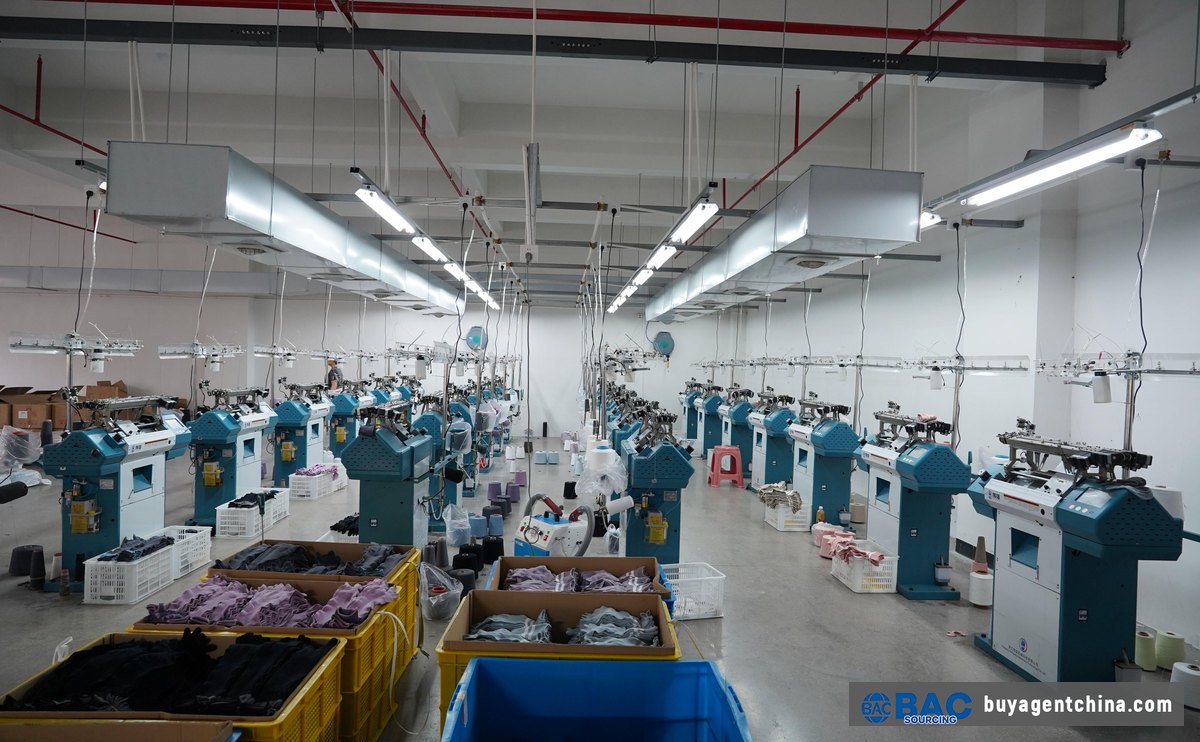
Circular knitting machines inside a Zhuji sock factory

Circular knitting machines inside a Zhuji sock factory

Picking a region is not about the nearest port. It is about what a factory knits every day, because a plant that makes dress socks all year will not get your yoga grip details right on the first try. The good news is the map is short, and it is a short map you can hold in your head.

- Zhuji, Zhejiang

— the sock capital and the center of gravity for athletic, yoga and kids’ sock production. When you want a factory that is already knitting yoga models, this is where you start.

- Yiwu, Zhejiang

— a short drive from Zhuji, strong on e-commerce small orders and fast private-label turnaround. Dropshipping, 48-hour dispatch and mixed-color mixed-size cartons come from here.

- Foshan, Guangdong

— home base for competitive sports socks: basketball and terry-cushion anti-slip styles, with volume listings around ¥4.75 on 1688.

- Hengshui, Hebei, and Jinjiang, Fujian

— recurring supplier bases for pilates and five-toe socks on Made-in-China, frequently quoting mid-range FOB in the US$0.72–2.39 band.

One way to remember it: volume orders land in Zhuji, e-commerce quick-turn buyers work out of Yiwu, and specialty private-label sits with Jinjiang and Hengshui. If you plan to visit factories, note that Zhuji and Yiwu are within an hour or so of each other, so a single trip can cover the two biggest bases.

RegionPositionEvidenceStrengthBest suited for
Zhuji / Datang (Zhejiang)International sock capitalCNY 75B output value, 25B+ pairs (2025)Full-category athletic/yoga/kids capacityBulk orders, custom, any volume
Yiwu (Zhejiang)E-commerce quick-turnFive-toe strap socks ¥7.6, dropship (1688)Small orders, private label, mixed cartonsTest orders, resellers
Foshan (Guangdong)Competitive sports socksBasketball/anti-slip from ¥4.75 (1688)Functional athletic socksSports-focused lines
Hengshui / Jinjiang (Hebei/Fujian)Mid-range export basePilates socks US$0.91–2.41 FOBExport private label, five-toeMid-tier FOB orders

4. The Product Is the Grip: Sole Designs, Materials and QC Traps

The most valuable part of a grip sock is not the sock — it is the sole. You are not selling “a sock”; you are selling “a sock that will not let you slip.” That single difference changes what you inspect, what you pay for, and where you put your quality control.

4.1 Three Main Grip Designs

- Silicone dots:

Grip points spread across the footbed. Best balance of grip, quiet movement and breathability, and the default for yoga and pilates studios. A studio-grade five-toe model carries 150-plus contact points on the sole.

- Full-sole silicone coating:

Covers the whole bottom. Maximum grip for trampoline and aerobics styles, at the cost of some breathability. This is the construction you see on kids’ and hospital-style non-slip socks.

- Straps plus dots:

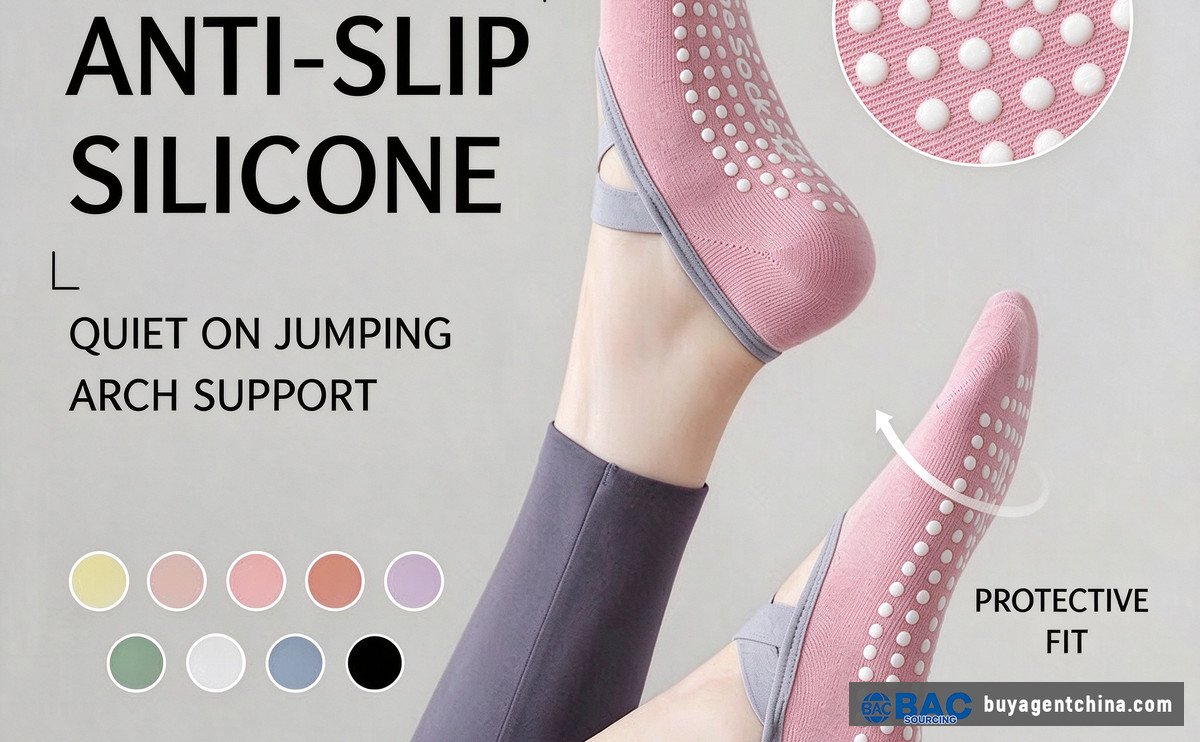
A crossover band over the instep stops heel slip, combined with dot grip — the dance, ballet and barre style.

4.2 Materials

Combed cotton carries sweat and breathes; bamboo fiber sells the antibacterial angle on five-toe models; nylon-spandex blends supply stretch and durability. Textiles come with three old traps — false gram weights, shrinkage, and batch-to-batch color drift. Ask for the combed-cotton percentage and grams per pair in writing, not for a vague “it is thick.” A sock that is 70% cotton and one that is 40% cotton can look identical in a photo. They differ by a third in cost.

Silicone is a coating, not a fabric, so it has its own chemistry: ask what the dots are bonded with, and whether the factory runs the application line in-house or buys pre-coated soles. In-house application usually means you can negotiate better adhesion and a cleaner edge.

4.3 What to Check at Inspection

Four invisible defects cost buyers most. Silicone adhesion — grip that washes off after three cycles is no grip at all, so run a wash test before you commit. Fake five-toe — protruding threads and rough toe seams that a listing photo will never show. Calf band elasticity that sags into a bag after two weeks. And for kids’ lines, China’s Class-A infant standard applies — no fluorescent brighteners, no formaldehyde — plus stricter EU/US children’s textile rules. When I check a batch I still spend ten minutes in the workshop myself — I trust audit reports, but I trust my own ten minutes in the workshop more.

TypeGrip methodStrengthsWeaknessesCore buyers
Five-toe yoga socksFull-sole silicone dotsGrip, toe separation, hygiene angleCostlier, fake five-toe commonYoga/pilates studios
Open-toe socksForefoot and heel dotsBreathable, summer weightToe zone grips lessSummer yoga, casual
Calf-length strap socksCrossover strap + dotsNo heel slip, leg lineSlower to put onDance, barre, ballet
Kids’ anti-slip socksFull-sole siliconeFall protection, Class-A standardStrict compliance, many sizesTrampoline parks, homes

5. Price Ladder and Export Numbers: Which Number You Should Actually Compare

Calf-length strap grip socks — typical mid-tier custom line

Calf-length strap grip socks — typical mid-tier custom line

Quotes for grip socks run from one yuan to three dollars, and the spread is not about the sock. It is about which tier you are actually buying. Below is the ladder as of October 2026, from 1688 wholesale and B2B platform FOB quotes.

5.1 Price by Type (researched October 2026)

Model1688 wholesaleFOB (USD/pair)MOQ
Entry silicone yoga sock (stock)¥1.05–1.18~US$0.15–0.25From wholesale lot
Kids' trampoline/anti-slip sockFrom ¥1.15 (custom 1.1–1.5)US$0.31–0.382,000 pairs (FOB quotes)
Calf-length yoga sock¥4.00–6.88US$0.55–1.0100–300 pairs
Five-toe strap yoga sockFrom ¥7.60US$0.72–2.39100 pairs
Pilates tube sock—US$0.91–2.41100 pairs
Custom (logo/color/new design)¥2.20–15.18US$0.85–2.98100–3,000 pairs

A rough landed-cost example: 500 pairs of calf-length socks at ¥5 each ex-works is about US$350 at October 2026 exchange rates. Add air freight on a light textile shipment — roughly US$2–3 per kg, and 500 pairs weigh about 15–20 kg packed — plus a US duty of 14.6% on synthetic-fiber socks. Toss in a small inspection fee, and the unit lands in the US in the US$0.85–1.05 range, before your markup. The point of the exercise is simple: compare landed cost per pair, not the quote per pair.

5.2 HS Codes, Duty and the Export Picture

Knitted socks with silicone grip soles classify under HS 6115 (hosiery). A UK HMRC advance ruling places polyester-elastane trainer socks with silicone grips on the sole at 6115.96.99 (in force September 2026). Into the US, synthetic-fiber socks (6115.96) sit around 14.6% and other textile materials (6115.99) around 18.8% (USITC HTS). Whether yours is cotton or synthetic, and whether the sole is coated or sewn, can move the code — get the HS code wrong, and a whole container sits at the dock while your margin disappears.

The export picture is broad. Zhuji’s top three export markets in 2025 were the United States (CNY 6.71 billion), India (CNY 4.54 billion) and Russia (CNY 1.41 billion) (2025 Zhuji statistical bulletin). Datang’s self-managed exports grew 11% year-on-year to CNY 3.11 billion in the first half of 2025. Socks are a ground-level staple: North America and Europe anchor demand, and emerging markets are closing fast.

Fiber / constructionHS subheadingUS duty (approx.)
Synthetic fiber socks (6115.96)6115.96~14.6%
Other textile materials (6115.99)6115.99~18.8%
Cotton socks6115.95Lower rate than synthetics (HTS)
Polyester-elastane with silicone grip sole6115.96.99UK HMRC advance ruling (Sept 2026)

One more detail that changes your numbers before the first PO: packaging. Socks shipped loose in polybags pack flat and cheap, while a hang card triples the carton volume and lifts your freight line. Decide the packaging form at the quoting stage, not after the factory has packed the first lot.


6. Buy Direct or Hire a China Buying Agent?

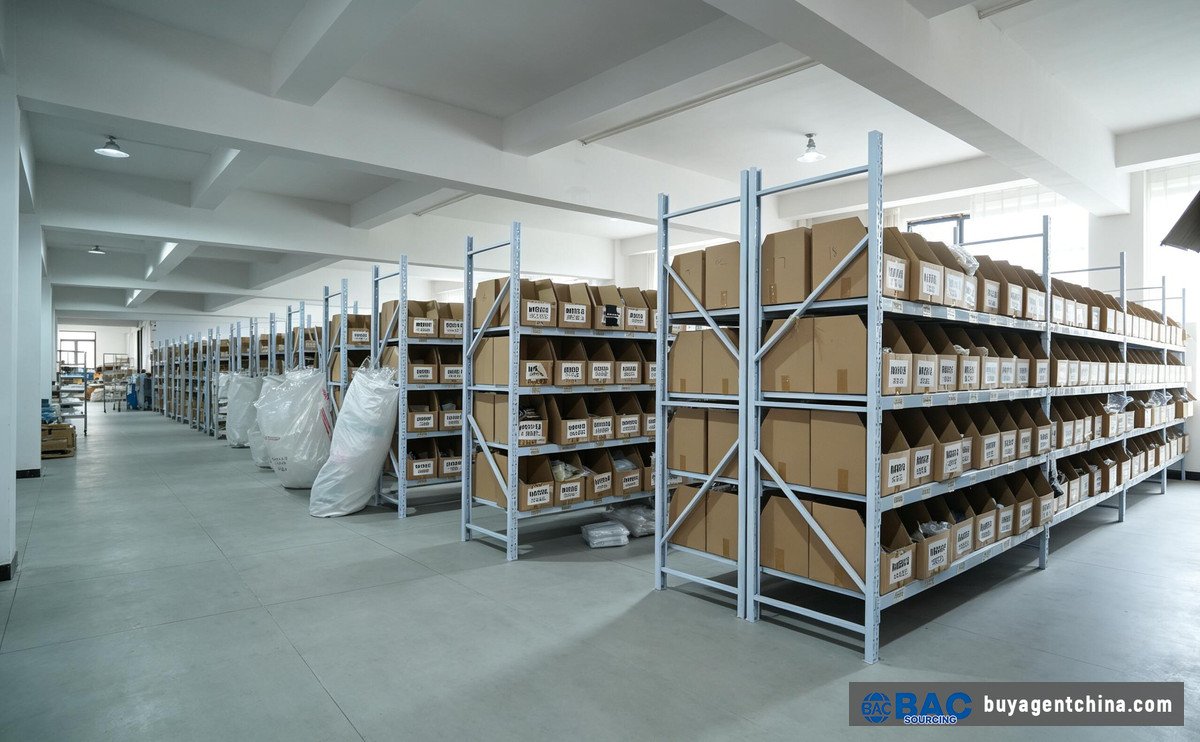
Cartons of finished grip socks stored on warehouse racks before shipping

Cartons of finished grip socks stored on warehouse racks before shipping

Direct sounds cheaper and an agent sounds easier, and both claims deserve a skeptical look. Going direct means you personally absorb four jobs. Language is one — technical specs warp in translation. Factory checks are another — you fly over or trust photos. Then follow-up (who visits at 30–50% of production) and paperwork (who confirms the HS line). Drop any one of those and the commission you saved is less than the cost of one bad shipment.

A transparent-fee agent model fixes the fee in the contract, pays the factory directly, never touches your money, and earns only from standardized service fees. BuyAgentChina’s current published standard (services page, dated July 16, 2026): three supplier quotes on the Entry plan at US$29; four to six factories with original quotes and workshop videos on the DIVE plan at US$140; factory visits at US$170 per day; order management on the Basic plan at 3–5% commission (US$220 base), and the full eight-step process on the Growth plan at 5–8% (US$280 base). Custom projects are quoted by difficulty — SKU count, sampling rounds, audit frequency — never as a fixed one-size price.

Who should go direct: buyers with their own China-based team, or repeat volume on a single SKU where the numbers justify hiring locally. Who should not: first-time importers, anyone managing more than a couple of SKUs, and buyers who cannot afford a bad batch — for those, a fixed-fee agent usually costs less than the mistakes it prevents.

DimensionGoing DirectTransparent-Fee Agent
CommunicationTranslation drift, time zonesBilingual, on the ground
QuotesUsually a single priceOriginal factory quotes to compare
Factory checksExpensive, infrequentScheduled per project
InspectionFactory's word30–50%, 100%, loading stages
PaperworkYou classify, errors hurtAgent double-checks HS and docs
FeesNo service fee, hidden costsFixed rate, factory-direct payment
Best forExperienced, large volume, own China teamFirst imports, small/mid orders, many SKUs
Which of these steps can you actually run from 8,000 miles away? If the answer is “not all of them,” start with our guide to finding reliable Chinese wholesale suppliers. It covers the verification basics you will need on either route.

7. Sizing Your First Order: Test Lot or Bulk Run

7.1 Small Test Order (100–3,000 Pairs)

Pull two or three models from 1688 stock or a Yiwu quick-turn factory, 100–300 pairs per model, mixed colors and sizes, and ship by air or consolidated LCL. The goal is not profit; it is answers: does your market eat five-toe models, what does the size curve look like, which colors actually move. Concretely, pick the five-toe studio model, a calf-length strap model and one kids’ style. Ask each supplier for a wash-test sample of the silicone grip, and log the size distribution from your first 50 sales before ordering the next round. Budget reference: at ¥4–7 per pair for stock, 500 pairs including freight lands in the US$350–650 range. Whatever model you test, write the spec down even for a stock order — color code, size run, grams per pair — so the second order is compared against the first, not against your memory.

7.2 Bulk Order (10,000+ Pairs / LCL-FCL)

Lock a Zhuji factory: a spec sheet that names the combed-cotton percentage, grams per pair, grip construction and band structure; a signed golden sample kept as the acceptance standard; the usual 30% deposit; and the balance only after inspection. Inspect in three stages — one pass at 30–50% of production, one at 100%, one at loading — and if the order is big enough, run the third-party check against AQL 2.5. A sample is a sample, and mass production is mass production — I have said it for fifteen years, and grip socks deserve the caution more than most: silicone adhesion and five-toe defects rarely all show up on the sample.

DimensionSmall Test Order (100–3,000)Bulk Order (10,000+)
Channel1688 stock / Yiwu quick-turnZhuji direct factory
Starting MOQ100 pairs10,000 pairs per spec
Price¥4–7/pairUS$0.55–2.5 FOB by model
PaymentSmall prepayment30% deposit, balance after QC
InspectionSamplingThree-stage + AQL 2.5
ShippingAir / consolidatedLCL / FCL
Risk profileLow cost to testSample-to-bulk drift risk

8.Frequently Asked Questions (FAQ)

Q1. What is the MOQ for yoga grip socks from China?

A1. Stock models commonly start at 100–300 pairs, and some 1688 suppliers ship from a few dozen. Logo or color custom work usually requires 300–600 pairs, while a brand-new design (toe structure or pattern) runs 1,000–3,000 pairs.

Q2. How much does it cost to import yoga grip socks in bulk?

A2. As of October 2026, entry silicone grip socks run about ¥1.05–1.18 per pair on 1688 (roughly US$0.15–0.25), mid-range stock about ¥4–7, and custom five-toe or calf-length models about US$0.72–2.98 FOB. Landed cost adds freight, US/EU duty of roughly 14.6%–18.8% on HS 6115 depending on fiber, and inspection.

Q3. What is the HS code for yoga grip socks with silicone grips?

A3. Knitted grip socks fall under HS 6115. A UK HMRC ruling classifies polyester-elastane socks with silicone grips on the sole at 6115.96.99; cotton versions go to 6115.95 and other textile materials to 6115.99. Confirm with your forwarder — fiber content and sole construction move the code.

Q4. Should I buy five-toe or open-toe yoga socks?

A4. Five-toe socks grip better and separate the toes for hygiene, and they carry the highest price and margin, but fake five-toe defects are common. Open-toe socks are lighter and more breathable for summer, with weaker toe grip. Run a small order of each before committing.

Q5. How can I verify a grip socks supplier is a real factory?

A5. Ask for workshop video of the circular knitting machines and the silicone application line, match the business license to your product category, request a material certificate and a wash test on the grip, and for larger orders have a third party inspect at 30–50%, 100% and loading.

Leave a Reply

Your email address will not be published. Required fields are marked *