Procurement Guides, Sourcing Tips

Teach you Buying Household Toolboxes from China: Sourcing Guide & Tips

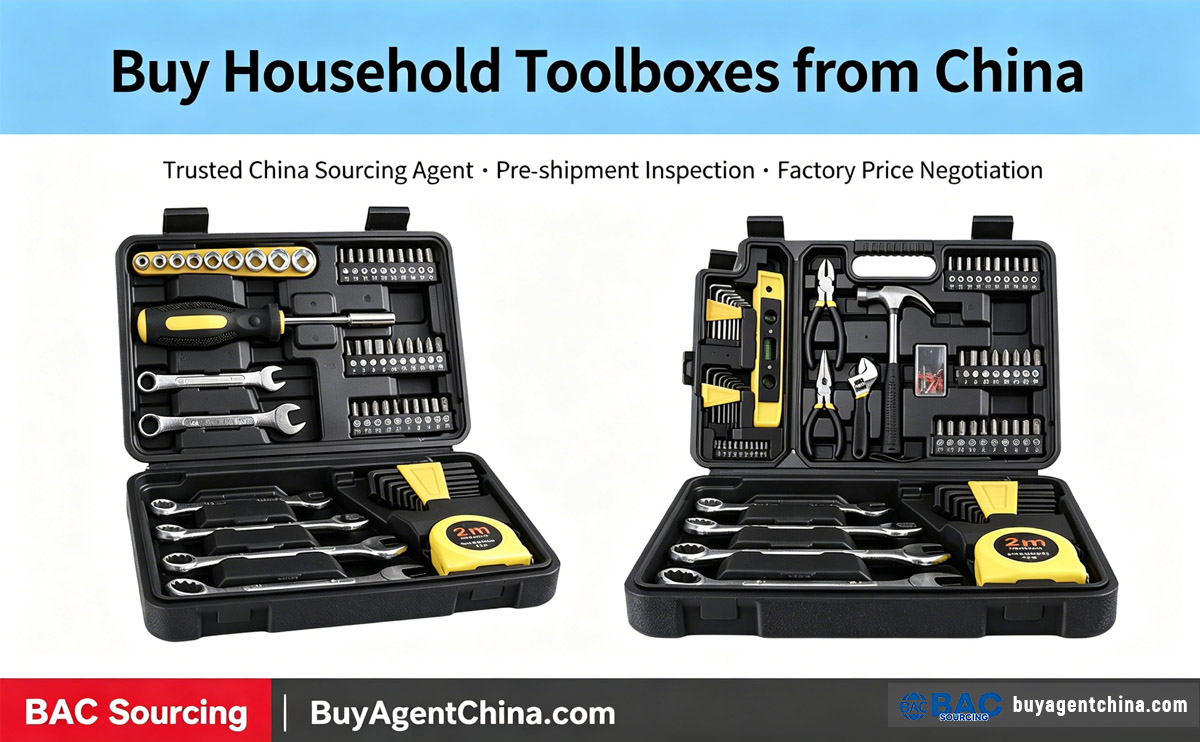
Buy Household Toolboxes from China 03

A Complete Buyer's Guide (2026 Update)

1. Why Source Toolboxes from China in the First Place?

Before diving into the “how,” let’s establish the “why.” China manufactures more than half of the world’s household hardware toolboxes, and the numbers tell a compelling story.
 
According to China Customs data, in 2024 alone, exports under HS code 82060000 (retail tool sets) reached USD 1.104 billion by value and 202 million kilograms by volume — accounting for roughly 54% of global exports in this category. When you factor in empty toolboxes (plastic, metal, and aluminum) shipped separately, the actual scale is even larger.

1.1 The Core Advantages of China-Made Toolboxes

  • Unbeatable pricing: Factory-door prices typically run 20%–35% of Western retail. A 150-piece household tool set that retails for $79–$129 on Amazon US can be sourced FOB China for $8–$18.
  • Enormous capacity: Over 1,500 toolbox manufacturers operate nationwide. Yongkang, a single county-level city in Zhejiang, hosts 300+ related businesses and produces 28.5% of China’s total toolbox output.
  • Complete supply chain: Everything from cold-rolled steel coil and PP resin to screwdrivers, pliers, and wrenches is available within a 50-kilometer radius of the major production hubs.
  • Full product range: From RMB 5 mini metal boxes to RMB 5,000 smart tool workstations — every price tier and use case is covered.
Buy Household Toolboxes from China 02

Buy Household Toolboxes from China

1.2 China's Major Toolbox Production Hubs at a Glance

RankProvinceKey ClustersNo. of MakersProduct TierBest For
1ZhejiangYongkang, Taizhou, Wenzhou, Jiande380Entry-to-mid, moving upmarketHousehold sets, folding boxes, OEM
2GuangdongFoshan Nanhai, Dongguan, Zhongshan, Shenzhen295Mid-to-high, export-orientedQuality plastic boxes, smart storage, brand OEM
3JiangsuDanyang, Nanjing, Zhenjiang185Mid-to-high, precisionProfessional-grade cases, instrument boxes
4HebeiAnping, Yongnian, Cangzhou158Entry-level, industrial / agriculturalLow-cost metal boxes, heavy cabinets
5ShandongLinyi, Qingdao, Yantai125Entry-level, distributionBulk wholesale, regional distribution

1.3 Household Toolbox Price Reference (China Factory FOB)

Price Band (RMB)Product TypePiece CountTypical UseFOB (USD)
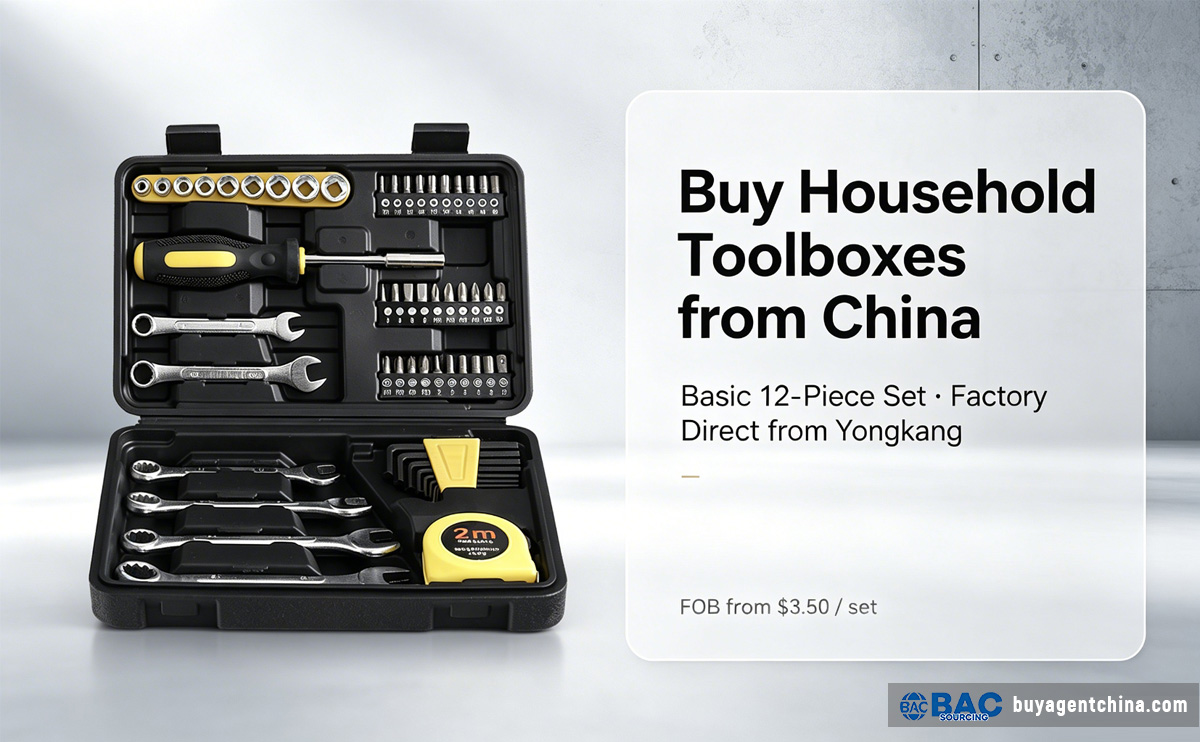
5–30Mini metal box / basic set8–30 pcsPromotional gifts, entry household$1–5
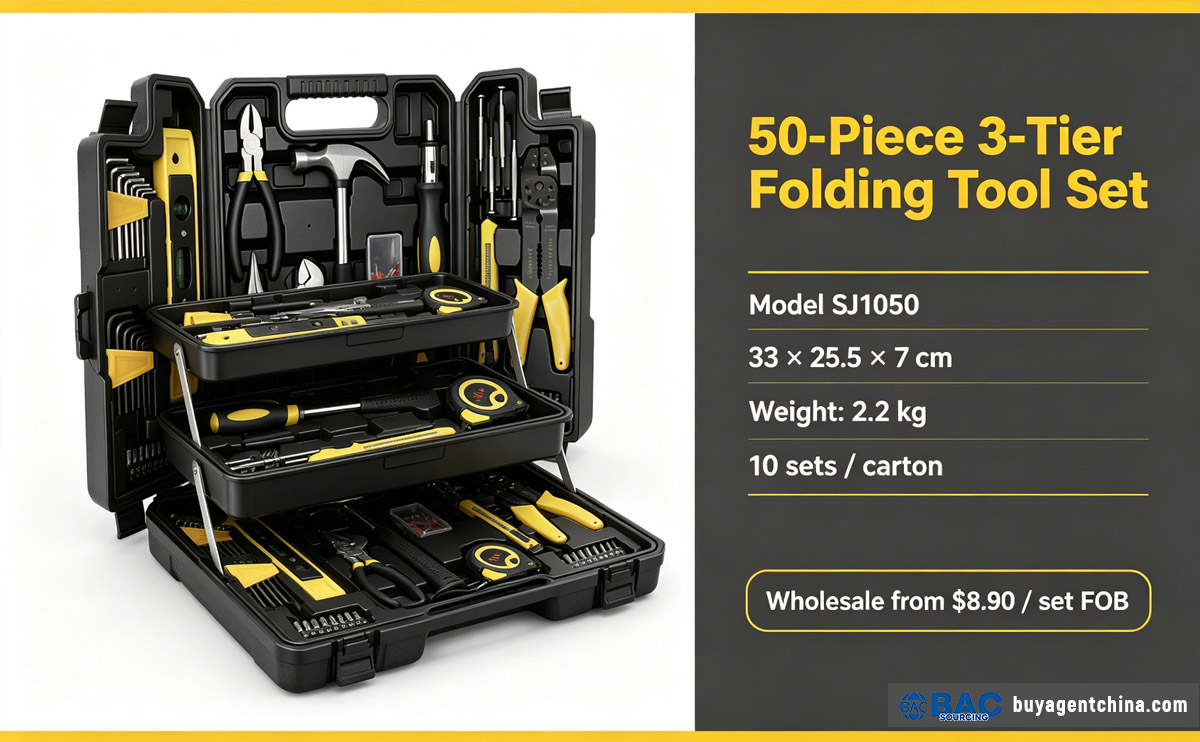
30–1003-tier folding set / electrician set30–120 pcsHome DIY, daily repairs$5–15
100–300Comprehensive household set / drawer cabinet120–250 pcsRenovation owners, property maintenance$15–45
300–800Rolling toolbox / industrial set250–500 pcsProfessional repair, construction$45–120
800+Tool cabinet / smart workstation500+ pcsWorkshops, auto shops, factories$120+

2. The Real Challenges of Sourcing Toolboxes from China

Many first-time buyers assume the process is: find a supplier on Alibaba → send an inquiry → pay a deposit → wait for delivery. In reality, you’ll hit layers of obstacles at every stage.

2.1 Language Barriers: It's Not Just About Speaking English

China’s toolbox factories are concentrated in county-level cities and towns across Zhejiang and Guangdong, and English proficiency on the factory floor is limited. You’re likely to encounter:
  • Slow, vague email replies: Sales reps may rely on translation apps, leading to misinterpreted specifications. What you confirmed in writing can look completely different in mass production.
  • Phone calls are nearly impossible: Factory owners and production managers rarely speak English. When a shipment is delayed and you need answers, a phone call gets you nowhere.
  • Technical terminology doesn’t translate cleanly: You say “powder-coated cold-rolled steel” — they hear “painted iron sheet.” You specify “EVA foam insert” — you receive ordinary sponge.
  • WeChat dominates communication: Chinese factories live on WeChat, while overseas buyers prefer WhatsApp or email. Critical confirmations often exist only in chat screenshots with no formal paper trail.
Real example: An Australian buyer ordered 500 “stainless steel toolboxes” from a Yongkang factory found on 1688. On arrival, the boxes were ordinary steel with a stainless-steel-colored paint finish. The factory insisted, “We call this stainless color here.” The buyer meant 304-grade stainless material. The entire shipment was unusable.

2.2 Cultural Differences: How Chinese Business Actually Works

Chinese commercial culture operates on a different logic from the West. Not understanding these unwritten rules is expensive:
  • “No problem” doesn’t mean it’s actually fine: Chinese suppliers default to reassuring phrases — mei wenti (no problem), fangxin ba (rest assured) — rather than flagging risks early. This is politeness, not a guarantee.
  • Relationships trump contracts: In China, guanxi (personal connection) often outweighs contract terms. Factories prioritize “old friends” over new accounts — your order may get bumped, or substandard materials may be substituted, if you’re not a known buyer.
  • The lower you push the price, the more quality shrinks: Chinese factories often quote below cost to win the order, then recover margin by thinning the steel, reducing accessory counts, or downgrading packaging.
  • Rigid payment terms: Most factories demand 30% deposit + 70% before shipment (T/T). Letters of credit and PayPal are generally rejected, leaving the buyer carrying most of the financial risk.
  • After-sales support is essentially nonexistent: Once goods leave the factory gate, accountability ends. Quality issues discovered at destination rarely result in refunds — at best, a discount on the next order.

2.3 Trade Compliance: Exporting Is More Than Loading a Container

Shipping toolboxes out of China involves a web of regulations and documentation:
  • HS code classification: A toolbox may fall under 8206 (tool sets), 3926 (plastic articles), 4202 (travel goods), or 7326 (iron / steel articles). Each carries different duty rates and export rebates. Misclassification can get your shipment seized.
  • Export tax rebate: Toolboxes under HS 8206 qualify for a 13% export rebate — but only factories with general taxpayer status can issue the VAT invoices needed to claim it. Small workshops can’t, which means you either pay a trading company extra or forfeit the rebate.
  • Destination certifications: The EU requires CE / UKCA, the US needs FCC (for electronic components) and Prop 65 warnings, Germany demands GS / TÜV, Australia requires RCM. Many Chinese factories have never heard of these and won’t provide them unless explicitly managed.
  • Certificates of Origin: CO, Form A, and Form E can reduce import duties in destination countries, but factories rarely prepare them proactively.
  • Commodity inspection: Products with lithium batteries (e.g., power tool combo sets) require mandatory inspection — a process that routinely trips up newcomers.

2.4 International Logistics: Heavy, Bulky, and Expensive

Toolboxes are a mixed freight profile — dense metal combined with bulky plastic — making logistics costly and error-prone:
  • Freight eats into margin: A 10 kg tool set can incur ocean freight equal to 20%–40% of its FOB value, depending on the destination and bunker surcharges.
  • Volumetric weight penalties: Metal boxes are heavy but compact; plastic and rolling cabinets are “fluffy” (large volume, low weight). Courier and air freight charge by volumetric weight, which can double or triple the cost.
  • LCL vs. FCL: Small volumes go LCL (less than container load), which incurs high destination fees and higher loss risk. Full containers (FCL) are cheaper per unit but require precise loading calculations — under-loading is wasted money.
  • Packaging damage: If the outer carton isn’t reinforced, toolboxes arrive dented, with broken latches and tools scattered inside.
  • Customs delays: Destination customs that question your HS classification or suspect under-valuation will hold the container for inspection, triggering demurrage and storage charges.

2.5 Quality Control: What You Can't See Will Hurt You

Toolbox quality problems usually surface only after unboxing — by which point the goods are thousands of kilometers away:
  • Steel gauge shrinkage: Promised 0.8 mm cold-rolled steel arrives at 0.5 mm — thin enough to flex under hand pressure.
  • Accessory downgrades: Screwdrivers and wrenches made from substandard carbon steel chip after two uses; promised CR-V chrome-vanadium becomes plain carbon steel.
  • Piece-count inflation: A “150-piece set” counts every individual bit and socket separately, meaning the number of genuinely useful tools might be 80.
  • Surface finish shortcuts: Powder coating is replaced with spray paint that chips and rusts within six months.
  • Negligent packaging: No inner boxes, no bubble wrap — tools collide in transit, scratching finishes and bending shafts.
Industry open secret: Many factories produce a “golden sample” for buyer approval that uses premium materials and careful assembly. The mass production line then switches to cheaper inputs. Without a third-party inspector on the ground, you’ll never know the difference until the container arrives.
Buy Household Toolboxes from China 01

Buy Household Toolboxes from China

3. Why a China-Based Sourcing Agent Is Usually the Smartest Move

Faced with all of the above, overseas buyers have two paths:
Path A: Do it yourself — Spend 3–6 months learning Chinese trade practices, fly to China twice to audit factories, negotiate with a dozen suppliers over broken English, and carry the full quality and payment risk. You might save 10% on unit cost, but the time, travel, and stress cost far more.
Path B: Engage a local China sourcing agent — Pay 3%–8% of purchase value as a service fee, and get end-to-end management: factory selection, price negotiation, production monitoring, pre-shipment inspection, and logistics coordination. Risk drops dramatically.
For most overseas buyers — especially the two profiles below — Path B delivers a far higher ROI.

3.1 Who Benefits Most from a Sourcing Agent?

Profile 1: First-time China buyers
  • New to importing from China and unfamiliar with factory operations and trade procedures
  • Limited Chinese / English negotiation capacity for deep technical discussions
  • No on-the-ground network to verify which factories in which industrial belts are reliable
  • Smaller order volumes (1–3 containers) that factories don’t prioritize, making self-negotiated prices uncompetitive
  • Prefer a one-stop solution rather than juggling freight forwarders, customs brokers, and testing labs
Profile 2: Experienced buyers who keep hitting walls
  • Already imported from China several times but consistently face quality issues or delivery delays
  • Cycled through multiple suppliers without finding a stable, long-term partner
  • Find flying to China for factory audits too expensive (flights, hotels, translation easily cost RMB 20,000–30,000 per trip)
  • Manage several Chinese suppliers simultaneously, with communication overhead and information chaos
  • Need someone “on the inside” to monitor production and ensure mass production matches approved samples
  • Want to optimize the entire supply chain — not just chase a lower unit price

3.2 What a China Sourcing Agent Actually Does

StageAgent’s RoleProblem Solved for Buyer
Supplier screeningOn-site factory audits across production belts; verify licenses, capacity, QC systemsAvoids “brass plate” traders and backyard workshops
Price negotiationDirect negotiation with factory owners in Chinese; leverages industry knowledge and volumeSecures lower prices than self-sourced inquiries
Sample approvalVisits factory to inspect samples; photo / video documentation of materials, finish, dimensionsPrevents “sample vs. mass production” mismatch
Production trackingRegular shop-floor visits; real progress reports; early issue detectionPrevents delays and covert material substitution
Pre-shipment inspectionAQL 2.5 sampling; detailed inspection report; rejects non-conforming lotsStops defective goods before they leave the factory
Logistics managementCompares forwarders; optimizes routing and rates; handles customs documentationReduces freight cost and avoids clearance failures
Certification supportCoordinates with third-party labs for CE / UKCA / FCC and other marksEnsures regulatory compliance in destination markets
After-sales liaisonRepresents the buyer in claims and rework negotiationsBridges language and time-zone barriers for dispute resolution

4. Introducing BAC Sourcing (BuyAgentChina.com)

Among China’s many sourcing agents, BAC Sourcing (BuyAgentChina.com) stands out for its deep specialization in hardware tools and home improvement products — making it particularly well-suited for household toolbox procurement.

4.1 Why BAC Sourcing for Toolbox Sourcing?

Deep roots in hardware production belts

  • The team is based in Yongkang (Zhejiang) and Foshan (Guangdong) — the two most important hardware manufacturing clusters in China — with firsthand knowledge of hundreds of toolbox factories.
  • They know which factory excels at metal boxes, which offers the best value in plastic folding cases, and which can deliver smart storage solutions.
  • Long-standing relationships with leading manufacturers mean priority production scheduling and preferential pricing.

Full-process management, performance-based fees

  • Service fees typically range from 3%–8% of purchase value (scaled by order size and service scope), with no hidden charges.
  • No factory kickbacks — the agent works exclusively for the buyer. This is the fundamental difference between a sourcing agent and a trading company.
  • Accepts small starting orders (minimum around USD 5,000), ideal for trial orders and smaller importers.

Professional quality inspection capability

  • In-house inspection team conducts pre-production, during-production, and pre-shipment checks.
  • Sampling follows international AQL 2.5 standards, with detailed reports including photos and video.
  • Non-conforming lots are rejected directly at the factory; rework is supervised until compliance.

Zero-friction communication

  • Bilingual team fluent in both Western business culture and Chinese factory dynamics.
  • Multi-channel synchronization across Email, WhatsApp, and WeChat — every critical confirmation is documented in writing.
  • Time-zone coverage: China hours for factory liaison, with overlap for European and North American clients.

Supply chain management beyond a single order

  • Not just a “one-off buying service” — BAC helps build and manage your entire China supplier base.
  • Can coordinate multiple factories simultaneously (e.g., toolboxes from Yongkang, power tools from Ningbo, packaging from Yiwu) and consolidate into a single container shipment.
  • Provides annual procurement planning, cost-optimization recommendations, and backup supplier development.

4.2 Typical Toolbox Sourcing Workflow with BAC Sourcing

Step 1: Requirements briefing → You provide specs, quantity, target price, destination port

Step 2: Supplier matching → BAC shortlists 3–5 qualified factories and obtains quotes

Step 3: Sample confirmation → BAC visits factories, inspects samples, sends photo / video

Step 4: Price negotiation → BAC negotiates on your behalf for optimal terms

Step 5: Contract signing → Specifications, lead time, payment terms formalized

Step 6: Production monitoring → Regular shop-floor visits, progress reports, issue resolution

Step 7: Pre-shipment inspection → AQL sampling, inspection report, rework if needed

Step 8: Logistics & shipping → Customs declaration, booking, insurance, BL and tracking

Step 9: Post-arrival support → Destination customs assistance, after-sales coordination

5. Self-Sourcing vs. Using an Agent: A Cost Comparison

Many buyers assume an agent adds cost. When you run the full numbers, the opposite is usually true. Below is an illustrative comparison for a 20-foot container (approximately 5,000 household tool sets):

Cost ItemSelf-SourcingWith BAC SourcingDifference
Goods (FOB)$50,000$47,000Agent negotiation saves $3,000
Agent service fee$0$2,820 (6%)+$2,820
China travel (audit + inspection)$4,000$0Saves $4,000
Translation / communication$1,500$0Saves $1,500
Quality rework / loss (est. 10%)$5,000$500 (inspection intercepts)Saves $4,500
Logistics optimization$0–$1,000Saves $1,000
Total cost$60,500$49,820Saves $10,680 (17.7%)
Note: Figures are estimates and vary by order size and product type. The core logic: savings from negotiation, inspection, and logistics optimization typically exceed the agent fee — not counting your saved time and reduced stress.

6. Frequently Asked Questions

Q1 ‑ What is the typical minimum order quantity (MOQ) for household toolboxes from China?
MOQs vary significantly by factory and product type. General reference:
  • Empty toolboxes (plastic / metal): usually 500–1,000 units
  • Household tool sets (with tools included): usually 300–500 sets
  • Custom logo / color: may require 1,000+ sets
  • Small factories or off-peak season: MOQ can drop to 100–200 sets
  • Consolidated ordering through a sourcing agent: multiple buyers' orders combined for production, further reducing effective MOQ
If your order is small (e.g., a 100-unit trial), working with a sourcing agent that can access ready-stock factories or consolidate orders will yield much better unit pricing than approaching a factory directly.
Q2 ‑ What payment methods do Chinese toolbox factories accept? Which is safest?
The mainstream payment methods in China's toolbox industry:
  • T/T telegraphic transfer (most common): 30% deposit, 70% before shipment. Higher buyer risk — once the deposit is paid, delays or quality issues leave you with little leverage.
  • L/C letter of credit: Accepted by larger factories but generally rejected by smaller ones due to complexity and bank fees.
  • PayPal / credit card: Only for small sample fees (under $1,000); not used for bulk orders.
  • Alibaba Trade Assurance: Platform-protected ordering, relatively safe, but carries 2%–5% platform fees.
  • Payment through a sourcing agent: You pay the agent (via multiple methods), and the agent disburses to the factory according to production milestones, with the agent absorbing intermediate risk — the safest model for small and medium buyers.
Q3 ‑ How much does it cost to ship a container of toolboxes from China to the US or Europe? How long does it take?
For a 20-foot container (approximately 15–18 CBM, 15-ton payload):
  • Ocean freight to US West Coast (Los Angeles / Long Beach): $1,500–$3,000, transit 14–20 days
  • Ocean freight to US East Coast (New York / Savannah): $2,500–$4,500, transit 25–35 days
  • Ocean freight to Europe (Rotterdam / Hamburg / Felixstowe): $1,200–$2,800, transit 25–35 days
  • Ocean freight to Australia (Sydney / Melbourne): $1,800–$3,500, transit 15–25 days
These are ocean freight only, excluding destination clearance, duties, drayage, and insurance. Duty reference: after Section 301 tariffs, US combined duty on Chinese toolboxes (HS 8206) ranges roughly 7.5%–25%; EU MFN rates are approximately 3.7%–8%. Exact rates depend on the specific HS code and current trade policy.

Q4 ‑ How do I verify whether a Chinese toolbox factory is legitimate? What are the red flags?
New buyers can assess factory reliability through these dimensions:
  1. Check the address: If it's in an industrial park in Yongkang, Foshan, or Danyang, it's likely a real factory. If it's in an office building or residential complex, it may be a trading company.
  2. Review the business license: The business scope should include "hardware tool manufacturing," not just "hardware tool sales."
  3. Request a live video factory tour: Ask for a real-time video walkthrough of the production line, warehouse, and QC area — not just a brochure.
  4. Ask for client references: Which brands have they produced for? Do they have export experience to Europe or North America?
  5. Scrutinize the quote: If one factory quotes 30% or more below the competition, be very cautious — the gap is almost always recovered through material and process degradation.
  6. The most reliable method: Have a China-based sourcing agent conduct an on-site audit. Seeing the workshop, verifying qualifications, and meeting the owner face-to-face beats any online assessment.
Q5 ‑ What if I receive defective goods and the Chinese factory won't respond?
This is one of the most common pain points in China sourcing. Prevention is far more effective than remediation:
  • Pre-shipment inspection is the only effective defense: Problems discovered before goods leave the factory will be fixed because the factory still wants its final payment. Once the container is onboard, accountability evaporates.
  • Keep all written evidence: Contracts, spec confirmation emails, sample photos, production photos — everything must be documented.
  • Use the final payment as leverage: Under T/T 30/70 terms, pay the 70% only after inspection passes. Never settle the balance without an inspection.
  • Work through an agent: Agents have ongoing relationships with factories, and manufacturers won't risk damaging those relationships — one call from an agent carries more weight than ten emails from a distant buyer.
  • Legal action is prohibitively expensive: Cross-border litigation can cost hundreds of thousands of RMB and take 1–2 years — completely uneconomical for small and medium orders. This is why "prevention before shipment" matters 100 times more than "remedies after arrival."
Q6 ‑ Can I do private label (OEM/ODM) with Chinese toolbox factories? What should I watch for?
Yes — Chinese toolbox factories have mature OEM/ODM capabilities. Most global brands (including certain Stanley and Bosch product lines) are manufactured in China. Key considerations:
  • OEM (private label): Use the factory's existing molds and designs with your logo. Lower MOQ (500–1,000 sets), no mold fees.
  • ODM (custom design): New molds built to your design. Mold fees range $2,000–$10,000+, MOQ typically 2,000+ sets, development cycle 60–90 days.
  • IP protection: Specify in the contract that mold ownership belongs to you and the factory cannot sell the same design to third parties. In practice, design copying is common, so registering a Chinese design patent is advisable.
  • Custom packaging: Color boxes, manuals, and EVA inserts can all be customized, but you must provide design files (AI / PDF) — factory design capability is generally weak.
  • An agent adds significant value here: They can review mold drawings, track mold progress, and approve first-article samples, preventing costly mold failures.
Q7 ‑ How does China's export tax rebate work? Can I benefit from it?
Toolboxes (HS 8206) enjoy a 13% export rebate — a Chinese government policy to encourage exports. However:
  • The rebate is paid only to Chinese enterprises with export qualifications (factories or trading companies). Overseas buyers cannot claim it directly.
  • Factory FOB quotes typically already factor in the rebate, so the price you see is "rebate-inclusive."
  • If you export through a trading company or sourcing agent, the rebate is claimed by that entity — some agents pass a portion back to the buyer in the form of a lower purchase price.
  • Small workshops cannot issue VAT invoices and therefore cannot claim the rebate. Their quotes may look cheaper, but you're effectively losing the 13% rebate value.
  • Choosing a factory with general taxpayer status (able to issue 13% VAT invoices) results in a lower total cost, even if the quoted price is slightly higher.

7. Final Thoughts: Let Specialists Handle What They Do Best

Sourcing household hardware toolboxes from China is fundamentally about capturing China’s manufacturing dividend — obtaining equal or better products at a significantly lower cost. But the path is littered with language gaps, cultural misunderstandings, procedural complexity, quality risks, and logistics headaches. The “tuition” for learning these lessons the hard way usually exceeds any savings.
Whether you’re a first-time buyer testing the China sourcing waters or an experienced importer exhausted by recurring on-the-ground problems, a reliable China-based sourcing agent can help you:
  • Eliminate the cost and time of flying to China for factory audits
  • Secure better factory pricing than you can negotiate independently
  • Intercept quality issues before shipment
  • Simplify the entire journey from product selection to delivery
  • Build a stable, manageable China supply chain
BAC Sourcing (BuyAgentChina.com) has years of deep experience in hardware tool production belts — from metal toolboxes in Yongkang to smart storage solutions in Foshan. They handle trial orders from USD 5,000 up to annual seven-figure supply chain management programs. If you’re considering sourcing household toolboxes from China, or if you’re already sourcing but struggling with persistent issues, reach out for a free requirements assessment. Let the local experts handle the complexities of China procurement — so you can focus on your market and your customers.

This article is based on 2025–2026 China Customs export data, China Hardware Products Association industry reports, and on-the-ground research across major production belts. It is intended as a practical reference for overseas buyers sourcing household hardware toolboxes from China. For a customized procurement plan tailored to your specific products and order volumes, we recommend a one-on-one consultation with a professional sourcing agent.

Leave a Reply

Your email address will not be published. Required fields are marked *