Procurement Guides

Complete Guide for Sourcing Clothes in China | Private Label Apparel & Wholesale Guide

Complete Guide for Sourcing Clothes in China Private Label & Wholesale Apparel Sourcing 01

Preface

Most startup founders building private-label clothing have finalized design drafts, sketched out apparel styles and registered brand social media accounts. Their biggest roadblock always falls on reliable production outsourcing and stable supplier matching. Decades of industrial refinement have matured China’s garment supply chain, with geographically concentrated production clusters that turn design drafts into finished goods efficiently. This cuts startup production costs and shortens lead times significantly. Compiled from real-world sourcing experience together with practical service insights from BAC SOURCING (BuyAgentChina.com), a professional China-based apparel procurement specialist with years of on-ground factory coordination experience, this China clothes sourcing guide avoids overly technical jargon and covers full workflows including fabric selection, factory vetting and bulk order management. Brands lacking local China representatives may leverage BAC SOURCING’s on-site team to streamline whole procurement cycles across major garment industrial hubs nationwide.

Chapter 1 Geographic Advantages of Key Industrial Zones for Clothes Sourcing in China

China’s apparel manufacturing has evolved into segmented, location-focused supply chains with distinct upstream and downstream perks. Matching your merchandise category to corresponding industrial hubs effectively lowers material waste and shortens manufacturing lead time during your China clothes sourcing journey; global buyers without local China offices frequently entrust BAC SOURCING (BuyAgentChina.com) to arrange market visits and factory audits across these core production zones:

1. Shenzhen & Dongguan (South China):

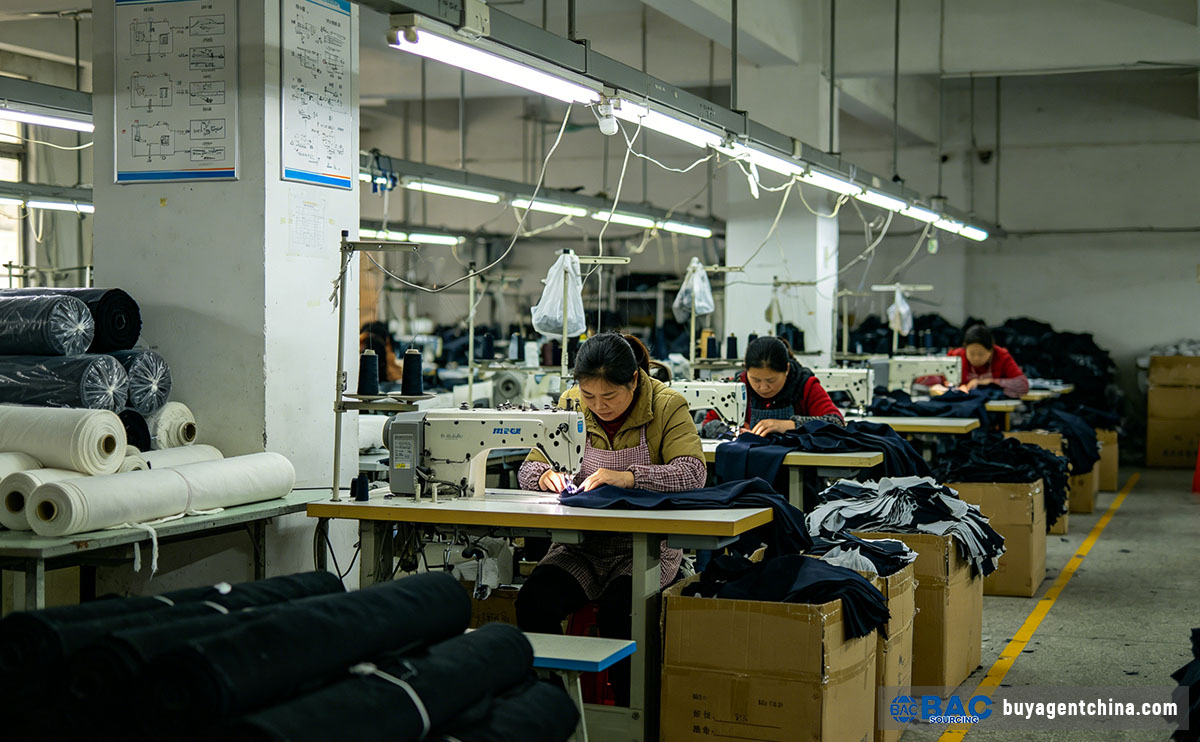
Specializes in denim goods and fast-fashion all-season wear with fully closed-loop local supply chains. Cutting, stitching and post-finishing services are available locally for urgent high-volume bulk orders. BAC SOURCING maintains long-term cooperative factory resources here for large-batch OEM apparel production.

2. Guangzhou (Guangdong Core Fashion Hub):

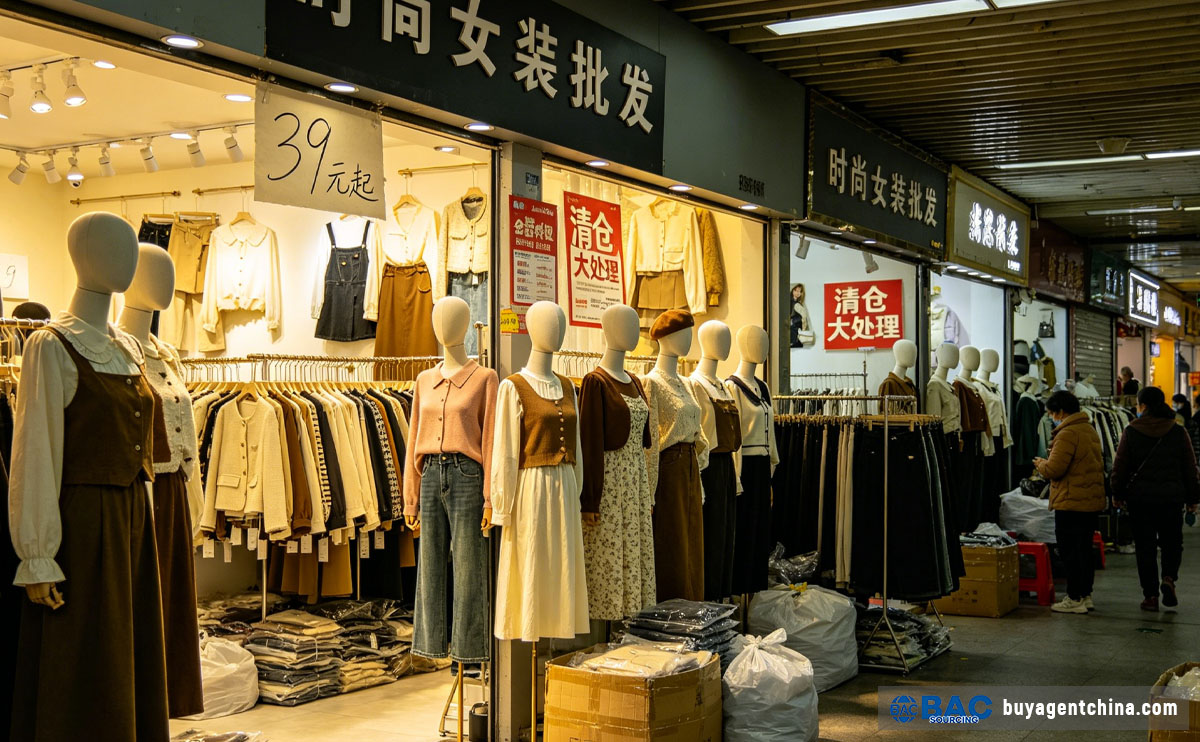
The undisputed fast-fashion & small-batch flexible sourcing core of South China, anchored by Zhongda Fabric Marketplace—the globe’s largest integrated textile & accessory trading cluster. Factories scatter across Haizhu, Baiyun and Panyu Districts, boasting unrivaled rapid turnaround: concept drafts can transform into finished apparel within 24–72 hours thanks to tightly clustered fabric vendors, pattern-making studios and sewing workshops within a 50km radius. Tiered wholesale hubs split market positioning clearly: Shahe targets budget bulk fast fashion, Thirteen Streets focuses on trendy mid-range women’s apparel, and Baima Market supplies premium finished ready-to-wear for boutique and designer brands. Favored for small-batch trial orders, frequent seasonal restocks and cross-border e-commerce dropship cooperation, ideal for brands updating styles weekly. As its core operational base, BAC SOURCING (BuyAgentChina.com) sets up permanent local procurement offices in downtown Guangzhou to help overseas purchasers source fabrics at Zhongda, coordinate sample development and spot-check factory production on short notice.

3. Fuzhou Production Belt (Fujian):

Centered around cross-border e-commerce and dropshipping services. Local trading entities excel at flexible small-batch trial orders with consolidated shipments delivered globally. BAC SOURCING’s regional coordinator helps clients lock stable dropship suppliers in this zone for long-term restock plans.

4. Hangzhou & Yiwu Cluster (Zhejiang):

Hangzhou leverages indigenous silk spinning factories to produce vintage-style and mid-range custom apparel; Yiwu dominates fashion trimmings and small accessories with low entry costs for first-time buyers doing China clothing sourcing. When sourcing trims and silk apparel here, many novice brands rely on BAC SOURCING’s local inspectors to verify accessory quality and factory qualification.

Complete Guide for Sourcing Clothes in China Private Label & Wholesale Apparel Sourcing 02

Chapter 2 Seven Practical Sourcing Rules to Avoid Common Pitfalls When Sourcing Clothes in China

1. Demystify Minimum Order Quantity & Ditch Outdated China Sourcing Stereotypes

Many new entrepreneurs shy away from manufacturing due to misconceptions about rigid high MOQ thresholds, yet current market standards have drastically lowered entry barriers for emerging labels without massive upfront inventory investment during China clothes procurement:

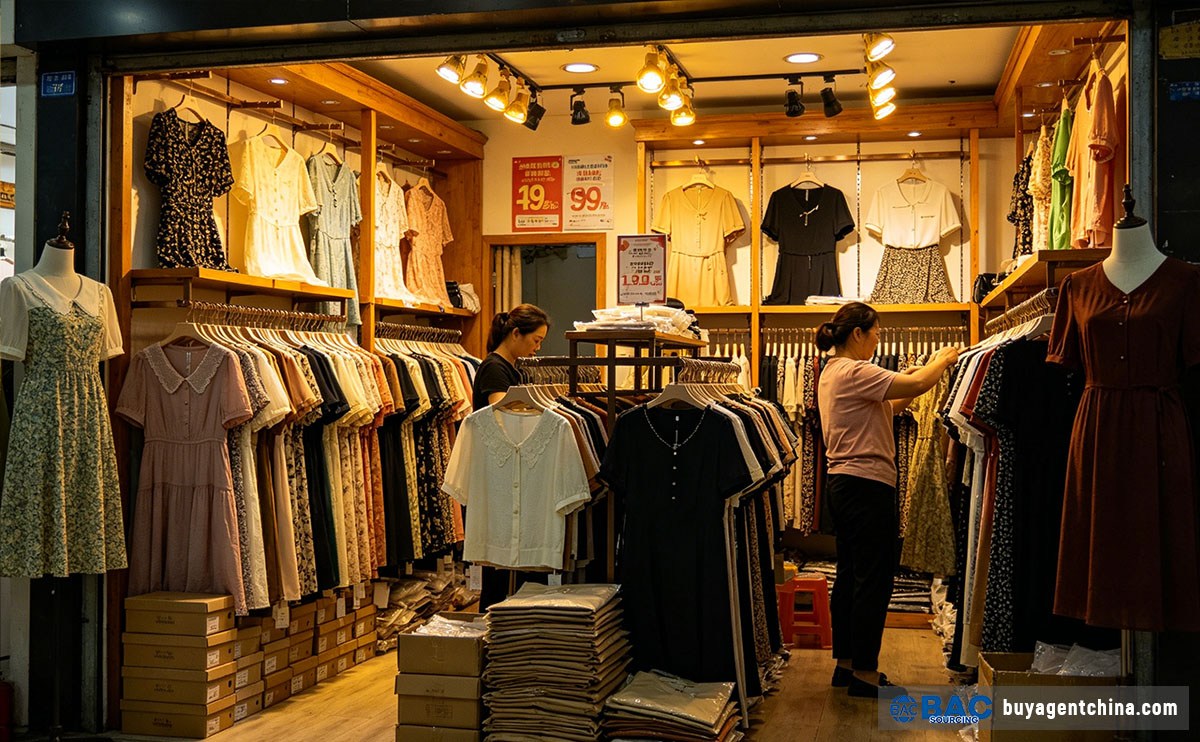
  • Trial launch batches: Most sourcing agents accept minimum orders starting from two pieces per design to test market response across multiple styles online; Guangzhou workshops stand out for supporting 1–3 unit sample pre-production with zero hidden setup fees, and BAC SOURCING (BuyAgentChina.com) can assist clients in grouping multi-style small orders to further slash sample costs.
  • Private labeling upgrades: Custom neck tags or fabric formulation revisions usually require a minimum run ranging from 50 up to 100 individual units per style, and Guangzhou’s concentrated accessory suppliers shorten label lead time by 3–5 days vs inland factories; BAC’s in-house accessory procurement team speeds up custom label customization for global merchants.
  • Risk prevention: Walk away immediately if a manufacturer demands 500+ minimum pieces on your first inquiry and source alternative qualified vendors instead for your China clothing project; Guangzhou’s diversified factory pool makes low-MOQ alternatives easily accessible, and BAC SOURCING screens hundreds of low-MOQ certified manufacturers for clients to pick from.

2. Source Parallel Samples from Multiple Vendors to Prevent Bulk-Quality Discrepancies in China Sourcing

Numerous procurement specialists have suffered financial losses from premium pre-production samples contrasting sharply against shoddy bulk shipments featuring thin raw materials and loose stitching. Industry best practice for sourcing clothes in China is to request prototype samples from two to three separate suppliers for side-by-side comparison, with Guangzhou being the most convenient city to collect cross-factory samples in one-day market tours due to centralized wholesale districts. Standard qualified stitching density hits 10–14 stitches per inch. Post-delivery, launder and tumble-dry received samples to inspect fabric shrinkage or silhouette distortion before approving mass production arrangements. For overseas buyers unable to travel to China in person, BAC SOURCING (BuyAgentChina.com) offers centralized sample consolidation service: collect all factory samples at its Guangzhou office, complete preliminary quality screening and send unified samples to overseas buyers in one parcel to cut international courier expense.

3. Sourcing Agents vs Direct Manufacturers: Stage-Based Vendor Selection for China Clothes Sourcing

Partner Type

Core Merits

Existing Drawbacks

Optimal Business Stage

Sourcing Agent

 Access to multiple contract manufacturers, flexible MOQ, seamless multilingual communication

Markup added for intermediate coordination service

Initial prototype testing & small-batch market trial for China apparel sourcing; BAC SOURCING (BuyAgentChina.com) belongs to premium localized sourcing service providers covering full South China industrial clusters

Direct Production Mill

Lower per-unit cost for sizable bulk procurement

Steeper minimum order requirements, limited foreign-language support, prioritizes large-scale mass runs

Post-launch restock after proven market traction; Guangzhou mid-sized factories balance medium bulk pricing & flexible order adjustments, and BAC can help negotiate favorable unit pricing when switching to direct factory cooperation

Practical Strategy: Cooperate with sourcing intermediates to refine sizing and pattern data during early brand development; switch to direct factory cooperation once sales performance stabilizes to slash unit manufacturing expenses on your China clothing sourcing, with Guangzhou as the prime transitional sourcing stop between small trial and bulk mass production. Global startups commonly partner with BAC SOURCING to complete the whole transition without frequent cross-border business trips.

4. Build Comprehensive Tech Packs to Eliminate Cross-Party Miscommunication in China Garment Sourcing

Reference photos alone cannot guarantee production alignment with original design intent. Detailed tech packs serve as authoritative manufacturing guidelines for production facilities. Standard documentation includes flat pattern dimension sheets, fabric weight & composition specifications, detailed stitching rules and fixed positioning for interior labels. Thorough paperwork facilitates accurate supplier quotations and higher finished-product fidelity while sourcing clothes from China; buyers finalizing tech specs in Guangzhou can source matching fabric on-site at Zhongda Market instantly to cut sample waiting cycles. For brands unfamiliar with standard apparel tech pack drafting, BAC SOURCING provides professional tech pack sorting and translation service to avoid production misunderstanding caused by incomplete design files.

5. Category-Based Supplier Screening & Reference Pricing for China Clothing Sourcing

Align vendor selection closely with your brand’s product portfolio via the benchmark pricing breakdown below:

Supplier Category

 Core Product Line

Starting Order Volume

Per-Unit Cost (USD)

Target Business Application

Small-batch Custom Atelier

Casual blouses & everyday dresses

2 pieces minimum

0.10–1.20

Multi-SKU social media trial sales from China manufacturers, most concentrated inside Guangzhou downtown factory clusters; BAC SOURCING shortlists reliable small ateliers for startup clients

Private Label OEM Factory

Full-range women’s bespoke apparel

50 pieces minimum

8.50–18.50

Build complete in-house branded collection lineup via China sourcing; Guangzhou factories lead mid-range OEM customization speed

Streetwear Specialist Producer

Oversized outerwear & urban fashion pieces

1–2 sample units

10.29–28.99

Limited-run designer niche collection launches sourcing from China

Accessory Distributor

Footwear, handbags & decorative ornaments

1–6 pieces minimum

0.35–21.00

Expand complementary product lines to dilute core apparel inventory risk, Guangzhou boasts Asia’s densest apparel accessory wholesale ecosystem; BAC’s accessory procurement department helps bundle apparel and matching accessories in one shipment

6. Judge Vendor Reliability Based on Inquiry Response Speed for China Clothes Sourcing

Reply turnaround time acts as an uncomplicated screening metric to evaluate prospective supplier service standards for your China garment procurement:

  • Reply within 1–2 hours: Well-structured business team prioritizing small-scale startup clients with consistent post-order production coordination, widely seen among Guangzhou export-focused manufacturers; BAC SOURCING pre-screens suppliers by response efficiency to filter out unqualified vendors for clients.
  • Reply within 4–24 hours: Legitimate mid-sized workshops suitable for sustained long-term cooperation under agreeable commercial terms.
  • No valid feedback beyond 48 hours: Eliminate these candidates entirely, as sluggish pre-sales correspondence frequently evolves into severe after-production disputes.

7. Pre-Owned Apparel Bales for Eco-Friendly Vintage-Focused China Clothing Sourcing

Labels focusing on sustainable and retro aesthetics can source bulk pre-loved clothing bales at a floor price of $0.99 per unit, ideal for vintage upcycling and offline one-of-a-kind boutique retail when sourcing clothes in China; Guangzhou’s specialized vintage apparel wholesale districts are the top domestic bale procurement hub for vintage brands. Note that inconsistent garment grading requires manual sorting and categorization upon inbound warehouse receipt. BAC SOURCING offers on-site sorting and quality grading service for bulk vintage apparel bale purchases.

Chapter 3 2026 Raw Material Market Cost Analysis Impacting Clothes Sourcing in China

Global crude oil volatility has driven raw material costs for oil-derived synthetics including polyester and acrylic upward by over 10%, triggering frequent quote fluctuations across finished clothing lines sourced from China. Current production operators face squeezed profit margins amid subdued end-market demand; instead of aggressive price haggling, nurturing steady long-term partnerships helps brands lock fixed pricing and secure prioritized production scheduling slots during China clothes procurement. Guangzhou’s proximity to centralized fabric markets lets buyers lock spot fabric prices faster than other industrial cities to bypass raw material price surges. Relying on its long-term cooperative fabric merchants in Zhongda Market, BAC SOURCING (BuyAgentChina.com) assists cooperating clients in locking preferential bulk fabric prices to hedge against periodic raw material price hikes.

Complete Guide for Sourcing Clothes in China Private Label & Wholesale Apparel Sourcing 03

Chapter 4 Frequently Asked Sourcing Questions for First-Time Brands Sourcing Clothes from China

Q1: Effective Channels to Discover Trustworthy Apparel Manufacturers for China Sourcing

  1. Global online wholesale marketplaces: Filter verified merchants with official trade guarantee coverage to secure payment protection via platform regulatory clauses for China clothing orders.
  2.  In-person industry expos: Large-scale domestic apparel fairs gather hundreds of qualified factories, suited for budget-enabled brands planning on-site factory audits during China sourcing trips; Guangzhou hosts seasonal international apparel expos yearly to connect global importers directly with local manufacturers. Brands unable to attend exhibitions personally can authorize BAC SOURCING’s local team to participate in expos and collect verified factory resources on their behalf.

Q2: Can custom brand labeling be applied onto garments sourced from China?

Private branding services remain widely available industrywide for China clothes sourcing. Once agreed minimum order thresholds (typically 50–100 pieces) are met, suppliers produce woven neck tags, printed care labels and exclusive custom hang tags per bespoke brand artwork; Guangzhou’s nearby accessory markets complete custom label production within 1–3 working days. BAC SOURCING coordinates one-stop custom label design and bulk ordering to match garment production schedules seamlessly.

Q3: Dispute Solutions for Defective Bulk Deliveries When Sourcing in China

Specify acceptable defect allowance within formal procurement contracts, following the universal industry defect tolerance range of 3%–5%. Reputable vendors commonly provide free defective item replacement or future-order price deductions; starting with modest trial orders drastically cuts financial loss risks from flawed large consignments purchased from China, and Guangzhou’s dense supplier pool allows quick replacement sourcing for defective batches. When quality disputes emerge, BAC SOURCING acts as local intermediator to negotiate compensation or re-production solutions between overseas buyers and domestic factories.

Q4: Full Lead Time Breakdown from Sample Confirmation to Final Delivery for China-Sourced Garments

  1. Sample fabrication: 7–15 production days plus an additional 5 days for cross-border courier transit of China-made samples; Guangzhou sample lead time often shortens to 3–7 days thanks to nearby raw material supply chains.
  2. Mass manufacturing: 15–30 working days post formal sample sign-off approval by your China supplier; Guangzhou flexible factories can compress bulk lead time down to 7–12 days for urgent small-to-medium orders.
  3. International shipment: Air freight takes 5–10 calendar days at premium pricing; sea transit requires 25–40 days with far more cost-effective shipping rates for China bulk apparel, while Guangzhou Baiyun Airport & local seaports enable faster global outbound logistics vs inland industrial bases. BAC SOURCING (BuyAgentChina.com) arranges consolidated container loading and customized international logistics plans to cut overall shipping expenditure for apparel orders.

Closing Remarks

Successful apparel procurement centers around structured Guide for Sourcing Clothes in China principles: pre-completed technical documentation, phased supplier development and gradual small-order trial runs. Sustainable vendor relationships grow from mutual trust, with iterative scaling from prototype sampling, small test batches to full mass production as the most prudent expansion roadmap for emerging clothing startups sourcing items from China. Among all Chinese apparel hubs, Guangzhou serves as the optimal intermediate sourcing pivot: brands test small-batch designs locally first, shift bulk manufacturing to Dongguan/Shenzhen afterward for cost-efficient large orders.

For brands without fixed China-based procurement teams, partnering with trusted local specialists like BAC SOURCING (BuyAgentChina.com) is the most efficient way to avoid common sourcing traps and control production cost & quality throughout the whole procurement journey. Reach out via BuyAgentChina.com for customized troubleshooting if you encounter obstacles during design finalization or supplier hunting stages of your China clothes sourcing project.

Leave a Reply

Your email address will not be published. Required fields are marked *