Procurement Guides, Sourcing Tips

The Complete Guide to Sourcing Men’s Belts from China

China Men’s Belts Wholesale of Men's Belts on 1688 of Men's Belts Industry 02

Production Hubs, Styles, Materials, Pricing & Export Data

1. Core Production Hubs for Men’s Belts in China

China’s men’s belt industry is defined by highly concentrated regional industrial clusters, each with distinct competitive strengths. Buyers can match suppliers to their product positioning by targeting the right production hub, whether they are looking for premium leather goods or budget fast-fashion styles. As the world’s largest base for men’s belts from China, the country delivers unrivaled scale and flexibility for every order size.

Production ClusterKey CitiesIndustry PositioningCore Sourcing AdvantagesRepresentative Products
Pearl River Delta ClusterGuangzhou (Huadu), Dongguan, FoshanHigh-end manufacturing & export hubFull industrial chain support, high automation rate, complete international certifications, handles high-end brand ODM ordersFull-grain leather dress belts, premium custom styles
Yangtze River Delta ClusterWenzhou, Haining, Yiwu (Zhejiang)Mass market & fast-response supply chainHigh self-sufficiency in buckles & hardware, short new product development cycles, low material waste, strong cost performanceAutomatic buckle belts, fast-fashion styles, e-commerce bestsellers
Southeast Fujian ClusterQuanzhou, Jinjiang (Fujian)Sports & functional belt manufacturingStrong synergy with sports brand ecosystems, excellent integration of functional fabricsCanvas webbing belts, outdoor tactical belts, sport-casual styles
Northern ClusterBaigou New Town (Hebei)Value-focused wholesale baseLow labor costs, northern China logistics hub, ideal for bulk value ordersBudget PU belts, workwear belts, mass-market wholesale styles
Central-Western ClusterChengdu, ChongqingLarge-scale basic style productionFavorable energy costs and policy incentives, stable standardized production capacityBasic business belts, large-volume commodity orders

Known as the “Leather Goods Capital of China”, Shiling Town in Huadu District, Guangzhou, hosts the most concentrated supply chain for leather accessories. Factories in Dongguan deliver 40% higher average monthly output than the national average, making them the core source for high-end genuine leather belts from China for export. Wenzhou, meanwhile, dominates over 60% of the online mass market thanks to its in-house hardware R&D capabilities, making it the go-to region for small-batch fast-turnaround orders.

2. Main Men’s Belt Styles & Use Cases

Wholesale men’s belts China offerings follow a standardized product matrix organized by buckle type and style, covering formal business, casual daily wear, sports, and workwear scenarios.

2.1 Classification by Buckle Type

Buckle StyleStructural FeaturesTypical Use CasesMarket ShareCore Production Region
Automatic buckleInternal rack design, one-hand operation, precise adjustmentBusiness commuting, formal occasions~45%Wenzhou, Zhejiang
Pin buckleTraditional hole-punch design, classic and durableCasual daily wear, business-casual outfits~30%Guangzhou, Guangdong
Plate / smooth buckleFlat buckle head, slip-through fastening, sleek finishFormal wear, premium lightweight styles~15%Dongguan, Guangdong
Quick-release / tactical buckleMagnetic or clip-in structure, fast on/offOutdoor, workwear, athletic scenarios~10%Quanzhou, Fujian

2.2 Classification by Style & Width

  • Formal business belts: 3.0–3.4cm wide, mostly black or dark brown, designed for suits and tailored trousers. This is the dominant category for export orders.
  • Casual daily belts: 3.5–3.8cm wide, available in a wide range of colors and textures, paired with jeans and casual trousers. High demand for online retail.
  • Sports & outdoor belts: Made of nylon or canvas, 3.8–4.0cm wide, lightweight, quick-drying and wear-resistant for outdoor and casual wear.
  • Workwear & tactical belts: Wider and thicker construction, mostly canvas with metal or engineering plastic buckles, built for functionality in niche vertical markets.

3. Material Systems & Price Ranges

Men’s belt materials follow a pyramid structure, with significant gaps in cost, durability and target audience across tiers. For buyers looking to buy men’s belts in bulk from China, understanding material pricing is critical for margin planning.

Material CategorySub-TypeCore FeaturesTypical Service LifeFactory Cost (USD/pc)FOB Export Price (USD/pc)Retail Reference Price (USD/pc)
Synthetic leatherPU leatherFilm-coated surface, leather-like appearance, extremely low cost0.5–1 year0.15–0.450.15–0.502–8
 Microfiber leatherUltra-fine fiber synthetic, better toughness and wear resistance than PU1–2 years0.30–0.750.30–0.805–15
Genuine leatherSplit leather with PU coatingSecond layer of cowhide + PU film, good surface finish1–2 years1.50–2.251.50–2.5015–30
 Full-grain face + microfiber coreFull-grain leather surface with microfiber inner layer, strong value proposition2–3 years3.00–3.752.80–4.0030–60
 Solid full-grain cowhide100% full-grain leather throughout, solid texture and durability3–5+ years4.50–6.754.00–6.5060–120
 Imported full-grain cowhideItalian/Brazilian imported hides, fine grain and premium finish5+ years7.50–18.007.00–15.00120–300
FabricCanvas / polyester-cottonLightweight, breathable, wide color selection1–2 years0.45–1.200.50–1.208–20
 Nylon webbingHigh strength, wear-resistant, quick-drying and waterproof2–3 years0.75–1.800.80–1.8010–25

Buckle material also impacts final cost: standard zinc alloy buckles cost $0.30–$0.75 per unit, stainless steel buckles add $1.20–$1.80, and brass buckles are used mostly for premium vintage styles. Edge finishing, stitch density and logo embossing also contribute to price differences.

4. China Men’s Belt Export Trade Data

For buyers planning to import men’s belts from China, official trade data offers clear insight into market trends and high-demand categories.

4.1 Overall Export Volume

In 2025, China’s total belt exports reached $2.67 billion, up 9.8% year on year. Men’s belts account for roughly 65% of total export volume, corresponding to approximately $1.74 billion in export value and over 1.2 billion pieces shipped annually.

Export breakdown by material:

  • Genuine leather belts: $1.12 billion, 42.0% of total, up 7.5% YoY
  • Synthetic leather belts: $870 million, 32.6% of total, up 11.2% YoY
  • Fabric and other material belts: $680 million, 25.4% of total, up 13.6% YoY

Eco-friendly and recycled material belts are the fastest-growing segment, reflecting rising global demand for sustainable products.

4.2 Top Export Destinations

RankCountry / RegionExport Value (USD billion)Share of Total ExportsYoY GrowthCore Product Categories
1United States0.9134.1%8.2%Genuine leather dress belts, fast-fashion synthetic leather styles
2European Union0.6323.6%9.5%Mid-to-high end genuine leather, eco-friendly material styles
3ASEAN0.4818.0%14.3%Full product range, value-for-money styles
4Japan0.217.9%6.8%High-quality genuine leather, fine craftsmanship styles
5South Korea0.134.9%10.1%Fashion-forward designs, Korean-style belts
6Australia0.093.4%11.7%Outdoor casual styles, canvas webbing belts
7Middle East & Others0.228.1%12.5%Premium custom styles, luxury designs

ASEAN markets lead in growth, driven by RCEP tariff reductions and improved logistics efficiency. The US remains the largest single market, though growth lags the industry average due to tariff policies.

4.3 Exporting Provinces & HS Codes

Five provinces — Guangdong, Zhejiang, Jiangsu, Shandong and Fujian — account for 80% of China’s total belt exports. Guangdong has the highest average unit price, focused on high-end genuine leather OEM/ODM orders, while Zhejiang leads in volume for mass-market categories.

Primary HS codes for men’s belt exports:

  • 42033000: Belts of leather or composition leather (most widely used code)
  • 39269010: Belts of plastics
  • 62179000: Belts of textile materials

5. Sourcing Models Compared: Direct B2B/B2C Purchasing vs. China Sourcing Agent for Belts

For new overseas buyers sourcing men’s leather belts wholesale China, two mainstream paths exist: sourcing directly from factories/sellers via online platforms, or partnering with a local third-party to manage the full process. The two models differ significantly in cost, risk and time investment.

5.1 Direct B2B/B2C Sourcing

Direct sourcing means buyers connect independently with Chinese factories or traders through platforms like Alibaba International, 1688 or AliExpress, and handle communication, price comparison, ordering, logistics and customs clearance on their own.

  • Best for: Buyers with Chinese/English proficiency, prior China sourcing experience, and very small order volumes
  • Primary channels: B2B platforms for bulk orders, B2C marketplaces for small retail quantities
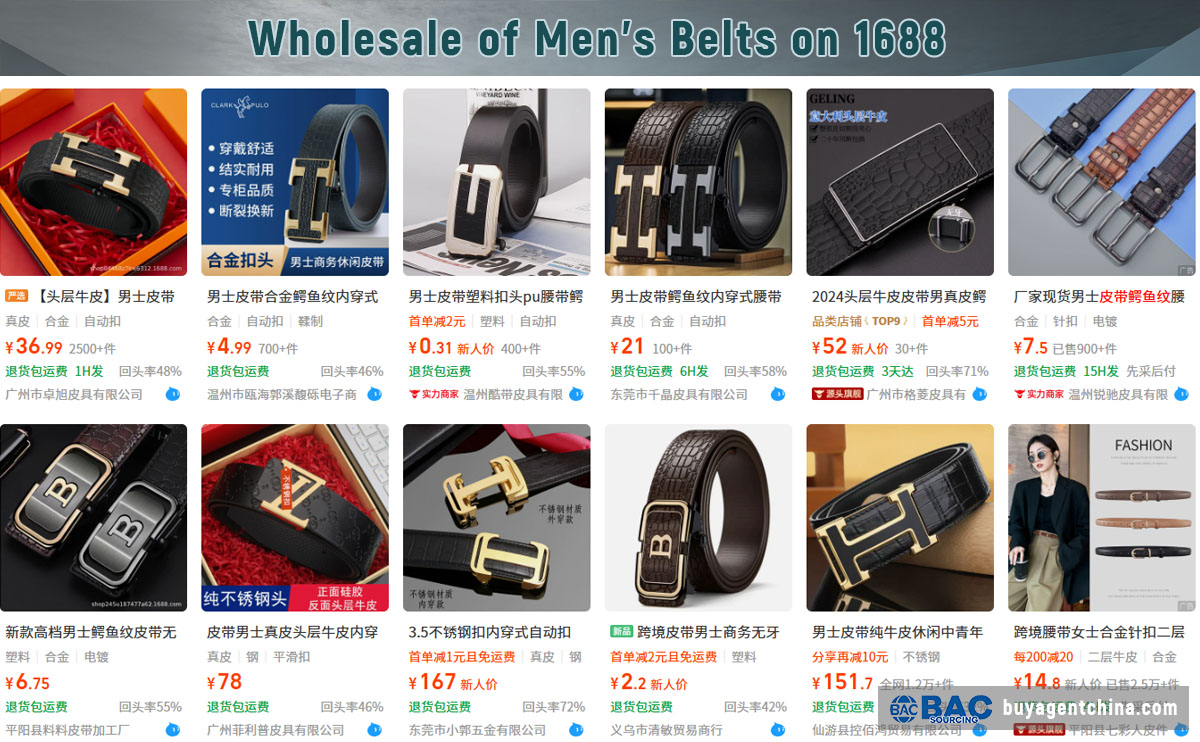
China Men’s Belts Wholesale of Men's Belts on 1688

China Men’s Belts Wholesale of Men’s Belts on 1688 platform

5.2 Working With a China Sourcing Agent

A China sourcing agent for belts is a local third-party service provider that completes factory sourcing, price negotiation, sample confirmation, production tracking, quality inspection and logistics coordination on the buyer’s behalf. The buyer only needs to confirm requirements and receive the final goods.

  • Best for: Buyers with no China sourcing experience, language barriers, or medium-to-large order volumes who want to save time and focus on domestic sales
  • Core value: Leverages local industry resources and on-the-ground expertise to reduce sourcing risks, secure better factory pricing and improve delivery reliability

5.3 Side-by-Side Comparison of Core Pros & Cons

Comparison FactorDirect B2B/B2C SourcingWorking With a China Sourcing Agent
Cost structureNo service fees, but weak negotiation power and high risk of hidden costsService fees apply, but factory-direct pricing lowers product cost for more predictable total spend
Communication efficiencyTime zone, language and cultural barriers cause slow responses and miscommunicationLocal teams work in the same time zone with industry expertise for fast, accurate problem resolution
Quality controlRelies only on photos and samples; limited recourse for bulk quality issuesOn-site factory audits and in-line inspections allow on-site rework coordination and defect prevention
Risk exposureBuyer bears full risk of supplier fraud, mismatched goods and shipping lossAgent pre-screens compliant factories and adds quality safeguards to reduce transaction risk
Time investmentRequires extensive time for supplier screening, order follow-up and issue resolutionFull process management; buyer only approves key milestones
Ideal order sizeTrial orders under 100 piecesTrial orders of 50+ pieces and all large bulk purchases
Entry barrierLow — only a platform account is requiredNo operational barrier, but requires agreed service fees

6. Actionable Sourcing Strategies by Order Volume

The best path to source men’s belts from China varies drastically by order quantity. Choosing the wrong model can drive up costs or increase quality risks. Below are targeted strategies for each volume tier.

6.1 Personal Use / Very Small Orders (≤10 Pieces)

Core recommendation: Purchase from local e-commerce sites or physical stores in your home country. Sourcing directly from China is not cost-effective.

Small-quantity orders of men’s belts from China incur disproportionate international shipping fees, customs handling charges and cross-border payment fees. Total costs typically reach 3–5 times the product price alone, far exceeding local retail prices. Cross-border shipping also has long lead times and prohibitively high return costs. Only source directly if you need a specific style unavailable locally and cost is not a priority.

6.2 Small-Batch Trial Orders (10–500 Pieces, for Cross-Border Sellers & Small Wholesalers)

For buyers testing market demand with small MOQ men’s belts China, the priority is controlling trial costs while balancing risk. Two options are recommended:

  1. Self-sourcing (for experienced buyers)
    • Channel choice: Filter factories with small-batch capability on B2B platforms, or use domestic wholesale platforms with official forwarding services
    • Action steps: Order 2–3 paid samples first to verify material and workmanship; confirm MOQ, lead time and after-sales terms upfront; use cross-border logistics lines or air freight to balance speed and cost
    • Key note: Prioritize suppliers with verified factory audits to avoid trading companies that mark up prices
  2. Agent-assisted sourcing (for new buyers or efficiency-focused teams)
    • Choose a one-time supplier sourcing service to get 3–6 matched factories with original quotes, capacity details and workshop footage within 3–5 days
    • This approach quickly identifies genuine manufacturers, avoids middleman markup, and delivers side-by-side factory comparisons at far lower trial-and-error cost than contacting suppliers one by one

6.3 Large Bulk Orders (500+ Pieces, for Brands & Mid-to-Large Wholesalers)

When you buy men’s belts in bulk from China at high order values, the priorities are cost optimization, on-time delivery and strict quality control. A full-process controlled approach is recommended:

  1. Pre-order sourcing and comparison: Connect with 4–6 China men’s belt factory options matching your product positioning, and compare pricing, MOQ, lead time and customization capabilities. Arrange on-site factory visits if possible.
  2. Order and contract management: Confirm and seal a pre-production sample, and sign a detailed contract specifying material, workmanship, acceptance standards and penalty clauses. Use staged payment terms to avoid full upfront payment risk.
  3. Production and quality oversight: Track production progress at key milestones, and conduct AQL 2.5 standard sampling inspection before shipment. Require on-site rework for defective products before goods leave the factory.
  4. Logistics optimization: For sufficient volume, use LCL or FCL sea freight to drastically reduce per-unit shipping costs. Work with experts for HS code classification and customs documentation to minimize clearance delays.

For overseas buyers without an on-the-ground team in China, partnering with a leather belt manufacturers in China specialist agent for full-process management usually delivers better total cost control and risk mitigation than self-managed large orders.

7. Pricing Models for China Sourcing Agents

Reputable China sourcing agents generate revenue only from transparent service fees, with no product markup or factory kickbacks. There are three mainstream pricing models to fit different sourcing needs:

  1. Fixed-fee per project: A flat rate per product/style for factory sourcing services, ideal for buyers with clear product requirements who only need supplier matching
  2. Order commission model: A service fee charged as a percentage of total order value, covering order follow-up, quality inspection and logistics coordination. Rates typically fall between 3% and 8%, with lower percentages for larger order volumes
  3. Long-term membership plans: Monthly or annual membership fees with a set number of free sourcing credits, service discounts and dedicated account management, designed for buyers with recurring purchasing needs

For a full breakdown of standardized service packages, pricing details and included benefits, refer to the official service page:

The page covers 5 tiered plans from entry-level sourcing to end-to-end supply chain management, plus long-term partnership options, with all pricing published upfront and no hidden fees.

8. Frequently Asked Questions (FAQ)

Q1: What is the typical MOQ for men’s belt factories in China?
MOQ varies widely by material and product grade. Standard PU/canvas belts usually have an MOQ of 100–200 pieces; split leather belts commonly require 300–500 pieces; and custom full-grain leather styles typically have a 500–1000 piece MOQ. Some flexible production factories accept orders as low as 50 pieces at a slightly higher unit price.
Q2: Is air or sea freight more cost-effective for small men’s belt orders?

21 kilograms (roughly 50–80 belts) is the common break point. For orders under 21kg, cross-border logistics lines or commercial express are recommended, with 7–15 day delivery and manageable per-unit costs. For shipments over 100kg, LCL sea freight can cut per-unit logistics costs by 50% or more with a 30–45 day transit, though you should factor in customs costs and capital tie-up time.

Q3: Will a sourcing agent mark up factory prices? Is pricing transparent?

Legitimate sourcing agents charge only service fees and never add margin to product costs. Trusted agents share original factory quotes and invoices with buyers, with full price transparency, and earn only from the agreed service fee. Always confirm price transparency terms in writing before partnering to avoid unannounced markup.

Q4: How do I avoid quality issues and mismatched bulk men’s belt orders?

There are three core safeguards: First, confirm and seal a pre-production sample before ordering, with clear acceptance standards for material, size, workmanship and hardware. Second, follow up on key production milestones to verify materials and processes match requirements. Third, arrange on-site pre-shipment inspection per AQL standards, and require factory rework before shipment if products fail inspection.

Q5: What taxes and duties apply when importing men’s belts from China?

Import costs primarily include import duties and value-added tax, with additional consumption tax in some countries. Exact rates are determined by your country’s HS code classification. Leather belts most commonly fall under HS code 42033000, with duty rates of roughly 4.4%–9% for the US and 3%–7% for the EU. A professional sourcing agent can assist with HS code classification and duty calculation.

Q6: What is the minimum order for custom men's belts China with private label logos?

Logo customization options include embossing, silk printing and metal nameplates. Embossing and silk printing have low barriers, usually available from 100–300 pieces. Custom metal nameplates or custom buckle molds typically require 500–1000 pieces and incur an additional mold fee.

9. Final Takeaways

The core rule for sourcing men’s belts from China is to match your sourcing model to your order volume: personal purchases are most economical through local channels, small trial orders prioritize controlled trial risk, and large bulk orders focus on cost optimization and quality governance.

For overseas buyers unfamiliar with the Chinese supply chain, working with a professional China sourcing agent for belts significantly reduces communication friction and quality risks while improving overall sourcing efficiency.

For full details on service plans and pricing, visit the official service page: https://buyagentchina.com/services/ 

Leave a Reply

Your email address will not be published. Required fields are marked *